
Badminton is a typical overhead swing sport. Power for clears, heavy smashes and drop shots travels from the lower body and torso through the scapula, shoulder joint and upper arm. The shoulder joint has the largest range of motion in the human body; its stability relies on four rotator cuff tendons and the muscles around the scapula. The upper arm (biceps and triceps) is responsible for backswing loading and braking upon impact.
A common mistake among amateur players is using the shoulder and upper arm to compensate for core power. Habitual shoulder shrugging, over-reliance on big arm swings, excessive external rotation during backswing, and lack of natural unloading after hitting put repeated tension, compression and shear force on the rotator cuff, long head of the biceps tendon and upper arm muscles. This gradually leads to subacromial impingement, rotator cuff tendon degeneration, and chronic strain with fascial adhesions in upper arm muscles.
This article compiles frequently asked questions from badminton players. It distinguishes ordinary fatigue soreness from pathological injuries, explains injury prevention, stroke correction, and how to use the Ultriix S1 on shoulders and upper arms. The goal is to help players avoid shoulder and arm strain and build healthy sports recovery habits.
1. Why does badminton cause arm pain more easily than other sports? How is it different from regular muscle soreness?
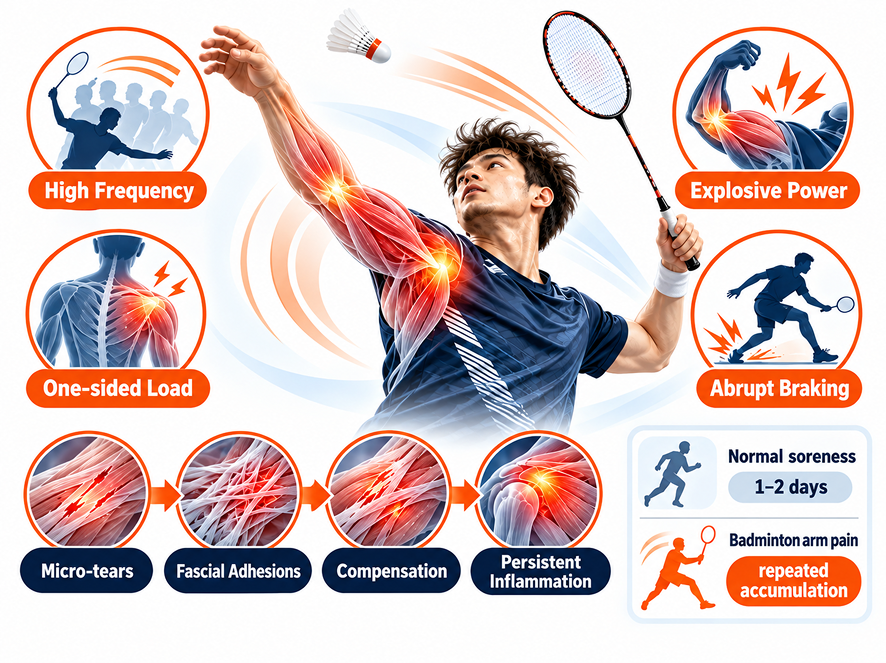
Arm injuries in badminton have four unique traits: high frequency, unilateral loading, instantaneous power output and abrupt braking. Unlike steady, uniform exertion in jogging or gym training, every smash, backhand drive and net tumble requires rapid tendon contraction followed by sudden braking. Tendons and fascia endure repeated shear and tensile stress.
Most players overuse one arm only, creating muscle imbalance between left and right sides, and compensatory strain accumulates over time. Normal post-workout soreness usually comes from lactic acid build-up and fades within 1–2 days. Pain from badminton, however, often stems from micro-tears in tendons, fascial adhesions and compensatory muscle strain. Ignoring these symptoms can lead to persistent inflammatory injury.
2. Sore rear shoulder and weak arm lift after playing – is it frozen shoulder?
In most cases, it is not frozen shoulder. It is rotator cuff strain specific to badminton. Frozen shoulder is mainly joint capsule adhesion seen in older adults. Player shoulder pain develops from repeated overhead swings that compress and pull rotator cuff tendons. Combined with unstable scapular control, the humeral head impacts the acromion, resulting in fatigued stiff tendons and reduced strength.
Typical symptoms: soreness during clears and smashes, weakness when lifting the racket, little relief after rest. Without care, it progresses to rotator cuff degeneration.
3. Stiff, sore inner forearm after frequent net tumbles and lifts — what causes this?
This is chronic strain of the forearm flexors. Net play demands fine control from wrists and forearms. Frequent small bending and rotating contractions keep forearm flexors continuously tense, gradually creating fascial adhesions and muscle tightness.
Many players underestimate injuries from net shots and believe only hard smashes damage arms. In fact, cumulative strain from repetitive small movements often leads to stubborn soreness.
Injuries from net play require consistent daily care. Tension built by countless small movements needs targeted gentle release. After badminton, use the Ultriix S1 for forearm care to deeply relax tight flexors, release fascial adhesions and boost local circulation to ease stiffness and soreness.
4. Pain when using wrist for shots, cannot smash. How to assess injury severity?
● Mild: dull pain only during hard smashes or backhand hits; no discomfort at rest, no tender trigger points.
● Moderate: soreness while gripping the racket or bouncing the shuttle; stiff wrist flexion/extension, clear fixed tender spots.
● Severe: dull aching even at rest; sharp pain and weakness with loading, unable to hold racket normally.
Mild and moderate cases can improve with proper care. Severe injury requires immediate rest and medical consultation.
How to use Ultriix S1 for recovery at different injury stages
Mild injury
Slide the Ultriix S1 slowly along the muscle bellies of forearm flexors and extensors, then gently move to soft tissue around the wrist, 5–8 minutes per side. Deeply relax tight forearm muscles, reduce persistent pull on wrist tendons and prevent mild strain from worsening.
Moderate injury
Build on the mild-care routine, focus on forearm bellies especially on the sore side. Hold briefly around tender areas for roughly 20 seconds, 5–8 minutes per side. It helps release fascial adhesions and improve local blood flow to create better conditions for tendon repair. Pair this with wrist flexion, extension and rotational resistance training to speed recovery.
Severe injury
Stop playing and consult a doctor. Only start deep recovery with Ultriix S1 after medical evaluation during rehabilitation.
5. Outer elbow pain and sharp pain on backhand hits — what is this condition?
This is lateral epicondylitis, commonly known as tennis elbow, the most frequent elbow injury among amateur badminton players. The root cause is over-reliance on forearm and wrist power during backhand strokes and flat exchanges without torso rotation loading. This repeatedly pulls and irritates the extensor tendon attachment on the outer elbow, triggering aseptic inflammation.
At first pain only occurs during impact. Later, lifting objects, twisting towels or gripping the racket all become painful. It is a chronic strain and needs early intervention with Ultriix S1.
6. What are the four most common injuries on the racket arm in badminton?
Sorted by prevalence:
1. Rotator cuff strain: caused by overhead smashes and clears; soreness and weakness at the rear shoulder.
2. Lateral epicondylitis (badminton elbow): triggered by backhand and hard drives; outer elbow pain.
3. Forearm flexor & extensor strain: frequent net tumbles and lifts; stiff aching forearms.
4. Wrist flexor tendon strain: excessive wrist compensation; aching wrists and weakness on impact.
7. Why is shoulder shrugging during smashes so harmful?
Shrugging elevates the scapula and narrows the space between the acromion and humeral head. During backswing and impact, the supraspinatus tendon gets directly squeezed and rubbed against the acromion. Repeated stress leads to subacromial impingement.
Correct technique requires stable, depressed scapulae. Power comes from torso rotation driving the arm, not forced shoulder lifting. Shrugging also forces the biceps to compensate and increases load on the anterior shoulder tendons.
8. Can Ultriix S1 be used for shoulder and arm prehab before badminton?
Yes. The Ultriix S1 works great for pre-activity soft tissue preparation after light cardio and before dynamic stretching. Its purpose is not deep relaxation, but to improve the extensibility of rotator cuff, arm tendons and fascia, reduce soft tissue stiffness and lower the risk of tendon impingement and compensatory strain during swings.
Steps:
1. Low-intensity warm-up cardio (5 min): jogging or jumping jacks to raise core temperature and heart rate, preparing muscles and fascia for release.
2. Ultriix S1 soft tissue pre-treatment: apply conductive gel to target areas, select a comfortable intensity level and keep the massage head moving slowly and continuously.
● Shoulder: infraspinatus, teres minor and soft tissue around scapula on the rear shoulder, approx. 3 minutes per side.
● Upper arm: biceps and triceps, approx. 2 minutes per side.
3. After S1 treatment, perform dynamic stretches and scapular activation drills (YWT exercises, resistance band external rotation) to prime neuromuscular function before playing.
9. What is the correct sequence for Ultriix S1 post-game shoulder & arm release?
Badminton creates multiple strain points on arms and shoulders after play. Follow the scientific order: from large muscle groups to smaller tendons, top down.
1. Start with posterior rotator cuff muscles (primary smash strain zone). Use medium-low setting with steady movement for 3–4 minutes to release fascial tightness from overhead strokes.
2. Next care for inner and outer elbow tendons to relieve strain from backhand and drives.
3. Finish with forearm flexors/extensors and soft tissue above the wrist to release stiffness accumulated from net shots.
Total time per arm: 10–12 minutes. After massage, rest for 5 minutes then perform gentle static stretches to ease fatigue.
10. Play 3–4 times weekly: how to build regular shoulder & upper arm maintenance routine
① Pre-game warm-up: 5 min light cardio → Ultriix S1 pre-treatment for shoulder + upper arm → dynamic stretching + scapular activation.
② Post-game: rest briefly, static stretch pectoralis minor and rear shoulder, then use Ultriix S1 to release tissues around rotator cuff and upper arm.
③ 2–3 deep maintenance session each week targeting rear shoulder and tight arm regions. Frequent players should avoid consecutive heavy smash sessions to allow tendon recovery.
11. How to use ULTRIIX S1 to address shoulder tension imbalance from long-term one-handed racket use?
The fascia on the rear shoulder and upper arm muscles on your racket side remain chronically tight, while the back muscles on your non-racket side tend to be weaker.
Daily Care Routine:
Racket side (focus on release): Use ULTRIIX S1 daily to release the posterior rotator cuff and upper arm muscles on your racket side. Select the proper intensity based on your comfort level and move the massage head slowly and continuously. Spend 3–4 minutes on soft tissue care for one shoulder, and 2 minutes for the upper arm.
Non-racket side (focus on strengthening):
Prioritize strength training to balance scapular stability on both sides. After strength training, use ULTRIIX S1 promptly to release the worked areas. It helps ease post-training muscle tightness and improve local circulation, so your strengthening exercises deliver true protective benefits. Release after training to reduce persistent soft tissue tightness on one side and lower the risk of compensatory injury with every swing.
12. Can I use Ultriix S1 daily for mild elbow inflammation?
Yes, once per area daily. Limit each elbow session to under 5 minutes. Select a comfortable setting and focus on soft tissue around tendon attachment points. Gentle daily care gradually releases fascial adhesions from chronic pulling, reduces tendon stiffness and prevents recurring strain.
13. The three worst arm-damaging badminton technique mistakes
1. Smash powered purely by arm strength: no hip/torso rotation, brute forearm force. Rotator cuff and elbow tendons absorb all impact force.
2. Forced backhand: abrupt wrist braking and overloading during backhand strokes, easily strains outer elbow tendons.
3. Excessive wrist tension on net shots: constant tight wrist control for net tumbles and cross net shots builds cumulative strain.
These three techniques are the main causes of arm injuries for amateur players. Fixing stroke mechanics plus regular Ultriix S1 care lets you enjoy badminton long-term.
14. What should proper shoulder power feel like in badminton?
Correct power feels like a whip crack, not heavy lifting. Force starts from pushing off the ground and hip rotation, transfers through torso to the shoulder. The shoulder externally rotates to load energy, then elbow extends, forearm internally rotates and wrist/fingers deliver the whip-like snap.
The shoulder acts as a transmission hub, not the source of power. If you feel like you are lifting or swinging the racket with your shoulder, your kinetic chain is broken and injury risk rises sharply.
Conclusion
Shoulder and arm injuries in badminton are “silent injuries”. They do not force you to stop immediately like an ankle sprain, nor disable walking like a torn knee ligament. Friction between rotator cuff tendon and acromion happens quietly; wear on the long head of biceps tendon within the bicipital groove develops gradually; minor labral tears may cause no obvious pain for months.
Silent does not mean harmless. Every time you keep playing despite mild shoulder or arm soreness, every ignored twinge, builds toward a sudden debilitating injury where you cannot lift your arm.
Scientific shoulder and arm maintenance does not mean giving up the thrill of smashing. It means treating shoulder and arm discomfort as an important warning signal. Pre-match shoulder activation, post-play deep tissue release and weekly rotator cuff & arm strength training are all investments into your kinetic whip chain.
Protect your shoulders and arms well, stay free from acromial impingement, and keep hitting powerful, fluid rear-court shots so you can enjoy badminton for years to come.