
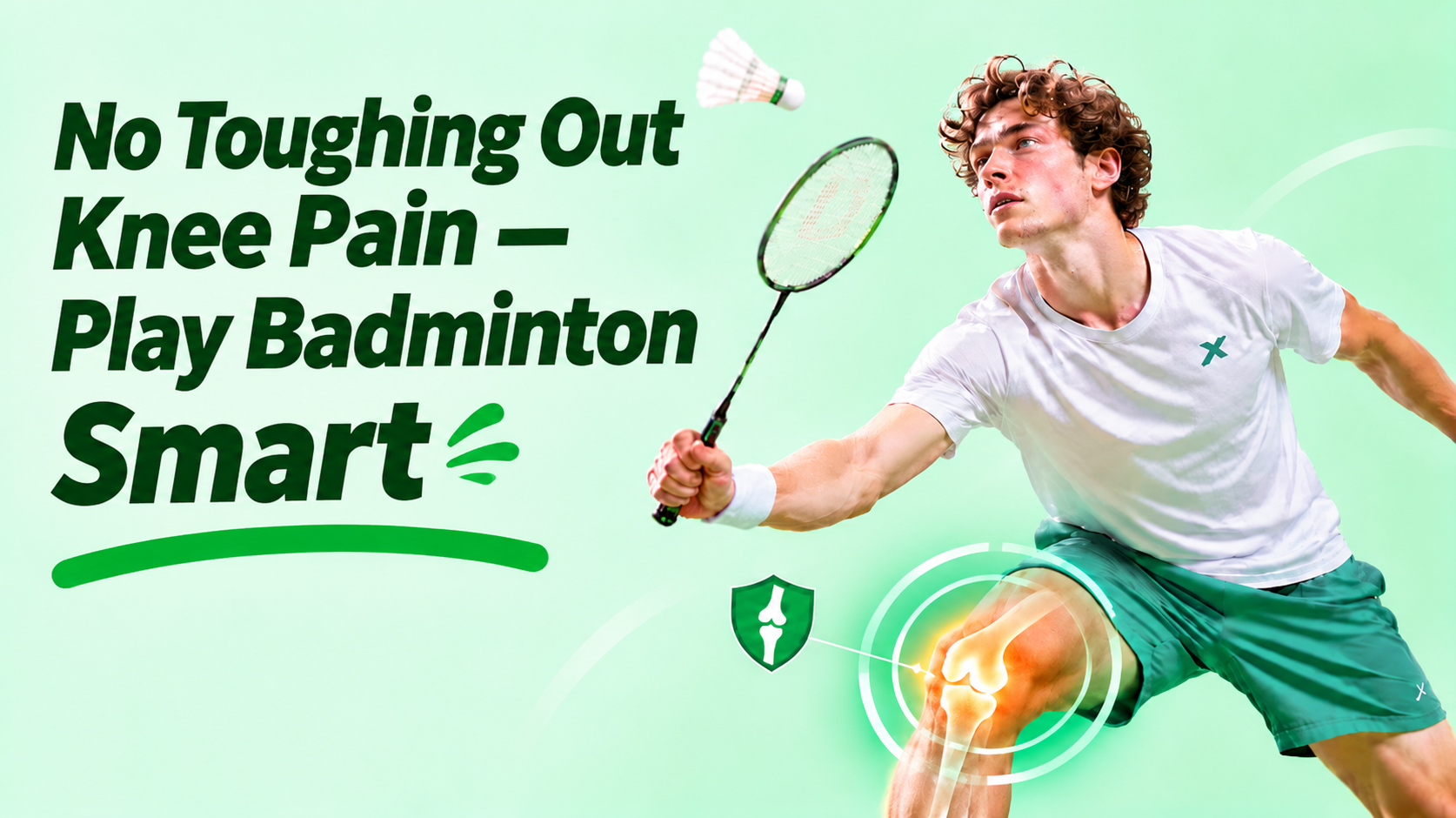
The most tiring part of badminton may not be your swinging arm, but your knees, which endure constant sudden stops, lunges and landings.
Many players have this experience: you feel great while playing, but your knees start to ache and tighten after you get home, and the discomfort becomes especially noticeable when walking down stairs the next day.
Why does this happen? The load on your knee joint comes not only from impact during play, but also closely relates to the condition of surrounding muscles, tendons and fascia.
1. Why is badminton so demanding on the knees?
Badminton involves countless lunges, rapid stops and jump landings. At the moment you land, the knee bears 3 to 5 times your body weight. Weak quadriceps and glutes, knee valgus on landing, insufficient warm-up, or overly long single sessions place repeated shear and compression stress on tendons, cartilage and menisci. Tiny micro-tears build up over time and gradually turn into pain.
This is where ULTRIIX S1 shines, targeting the three key weak points:
● Weak muscles do not mean you cannot train — you need to release tension first. When muscles stay chronically tight, they lose power and efficiency. Use ULTRIIX S1 to loosen your quads, glutes and other muscle groups in advance. Tight muscles, like overstretched rubber bands, become flexible power sources, boosting your training effect and on-court performance.
● Poor warm-up = pulling a cold rubber band. ULTRIIX S1’s 1.1 MHz ultrasound generates deep tissue heat and improves blood circulation. Combined with dynamic warm-ups, it creates endogenous preheating for your joints, far more effective than light jogging alone.
● Fatigue buildup = every unrecovered strain adds up. The post-game recovery function of ULTRIIX S1 helps clear that fatigue right away, so it does not accumulate into chronic strain.
Weekend warriors who play for long stretches once a week are at higher risk of knee injuries. If this describes you, pay close attention to the sections below.
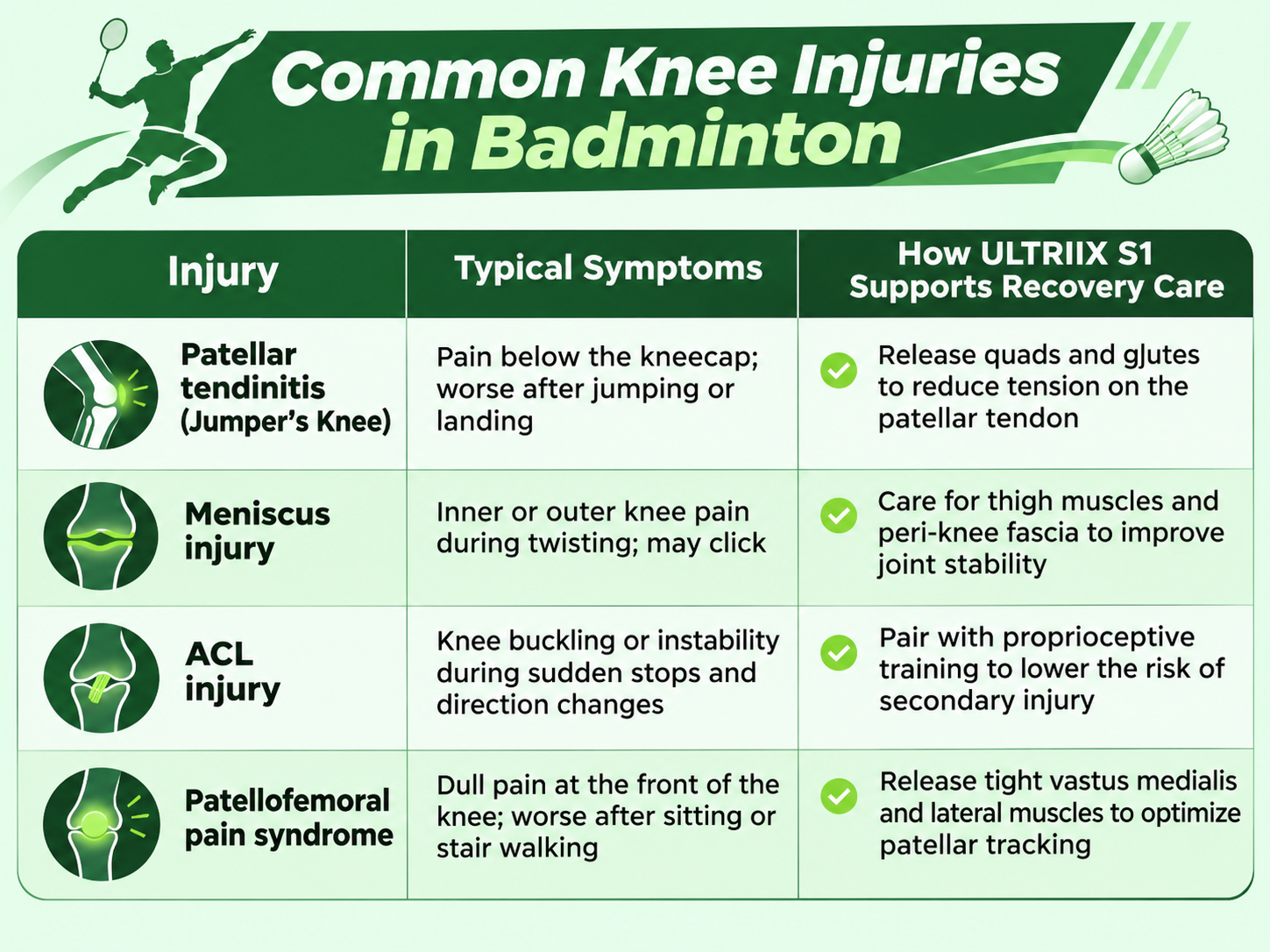
2. Common knee injuries in badminton
3. Why is an ACL injury so tricky?
Its symptoms can be deceptive. An ACL injury often does not stop you from walking normally, so many players assume they are fine after a twist. Once back on court, however, instability becomes obvious. Over time, repeated friction from an unstable joint can lead to meniscus tears. This is a silent injury, often discovered only after a second accident.
What ULTRIIX S1 does: It is not a device to repair ligaments. During rehabilitation, it loosens tight surrounding soft tissues and boosts local circulation. This helps muscles regain dynamic control over the knee and reduce buckling. True functional recovery relies on structured strength and proprioceptive training. ULTRIIX S1 is a supportive tool to amplify your training outcomes.
4. Why are meniscus injuries so common in badminton?
Badminton’s footwork pattern requires lots of rotation and sudden stopping while the knee is bent. The meniscus is under massive shear force, like a biscuit being squeezed between two hard surfaces. If your thigh muscles fail to stabilize the knee, or if your knee caves inward on landing, the stress on the meniscus multiplies.
The logic behind ULTRIIX S1 care: A lot of meniscus strain comes from muscles failing to hold the joint steady. Use ULTRIIX S1 to care for your three key stabilizer groups: quadriceps, hamstrings and glutes. When these muscles work strongly and coordinately, shear stress on the meniscus drops. Spending 5–8 minutes on peri-knee soft tissue care after play acts as a safeguard to reduce load on your menisci.
5. What is patellar tendinitis? Is it the same as Jumper’s Knee?
Yes. Patellar tendinitis is widely known as Jumper’s Knee. It causes pain just below the kneecap (between the patella and tibial tuberosity), which spikes when jumping or landing. Badminton does not have as many repeated jumps as volleyball, but single-leg landings after smashes and repeated stretching during lunges still subject the patellar tendon to chronic overload.
Read the dedicated question 10 below for guidance on using ULTRIIX S1 for patellar tendinitis.
6. What does knee buckling mean during play?
Knee buckling is a clear sign of knee instability. It may stem from ACL insufficiency, meniscus damage or abnormal patellar tracking. It means the joint cannot maintain proper mechanical alignment under load at certain angles.
If this happens, stop high-intensity play and seek professional assessment. During rehabilitation and your return to sport, ULTRIIX S1 can be used as a regular care tool to preserve soft tissue flexibility and joint mobility, supporting a safe return to court.
7. ULTRIIX S1 before play: How to warm up your knees
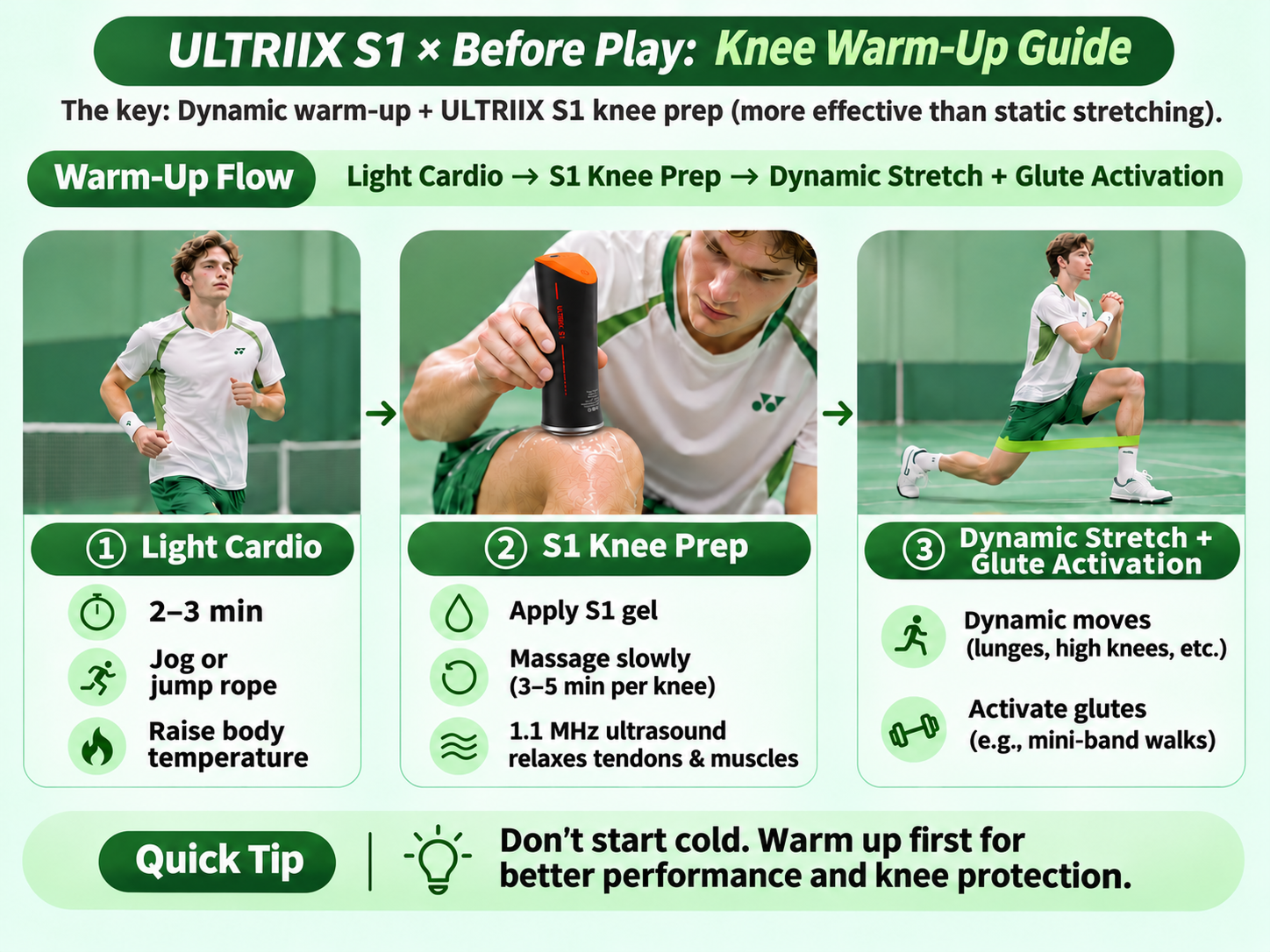
This is one of the most valuable use cases for ULTRIIX S1. We recommend a combination of dynamic warm-up and pre-play soft tissue conditioning, instead of static stretching only. Full warm-up sequence: Light cardio → ULTRIIX S1 peri-knee conditioning → Dynamic stretching + glute activation
Step 1: 2–3 minutes of light cardio (jogging or skipping rope)
Raise your core body temperature so muscles and fascia respond better to release work. Do not skip this step.
Step 2: ULTRIIX S1 deep pre-conditioning around the knee (core step)
● Apply a generous amount of ULTRIIX conductive gel over the distal quads, patellar tendon and pes anserinus;
● Move the massage head slowly or in circular motions, 3–5 minutes per knee;
● Focus on tendons and muscle soft tissue;
● The 1.1 MHz ultrasound from ULTRIIX S1 gently loosens tight fascia and tendons, lowers muscle tone, and relaxes stiff patellar tendons and front thigh muscles to reduce pulling stress during forward lunges.
Step 3: Dynamic stretching + glute activation
After releasing with S1, follow up with targeted dynamic drills such as walking lunges, high knees and side shuffles. Add glute activation drills like banded side steps. Weak glutes often force knees to compensate and bear extra stress. Finish this sequence before you start playing.
💡 Tip: Many players jump straight into games without warming up — that is a cold start. Adding ULTRIIX S1 gives your knees an invisible protective layer.
8. ULTRIIX S1 after play: Is post game recovery important?
Yes, even more critical.
After exercise, the soft tissues around your knees stay contracted and tight. Without proper release, fatigue accumulates and develops into chronic strain. Post-play recovery is essential to protect your musculoskeletal system and extend your playing career.
Post-play recovery sequence: Static stretching → ULTRIIX S1 peri-knee care
Step 1: Static stretching (hold 30–60 seconds per stretch)
Focus on quadriceps, hamstrings, calves and glutes.
Step 2: ULTRIIX S1 soft tissue care (key step)
● Apply plenty of conductive gel to the lower quads, patellar tendon, pes anserinus and soft tissue along the sides of the knee;
● Move the massage head steadily or in circles, roughly 5–8 minutes per knee;
● Ease tight tendons and fascia, relieving stiffness built from lunges and jumps;
● Post-play use supports metabolic waste clearance and tissue recovery, leaving your knees fresher for the next session.
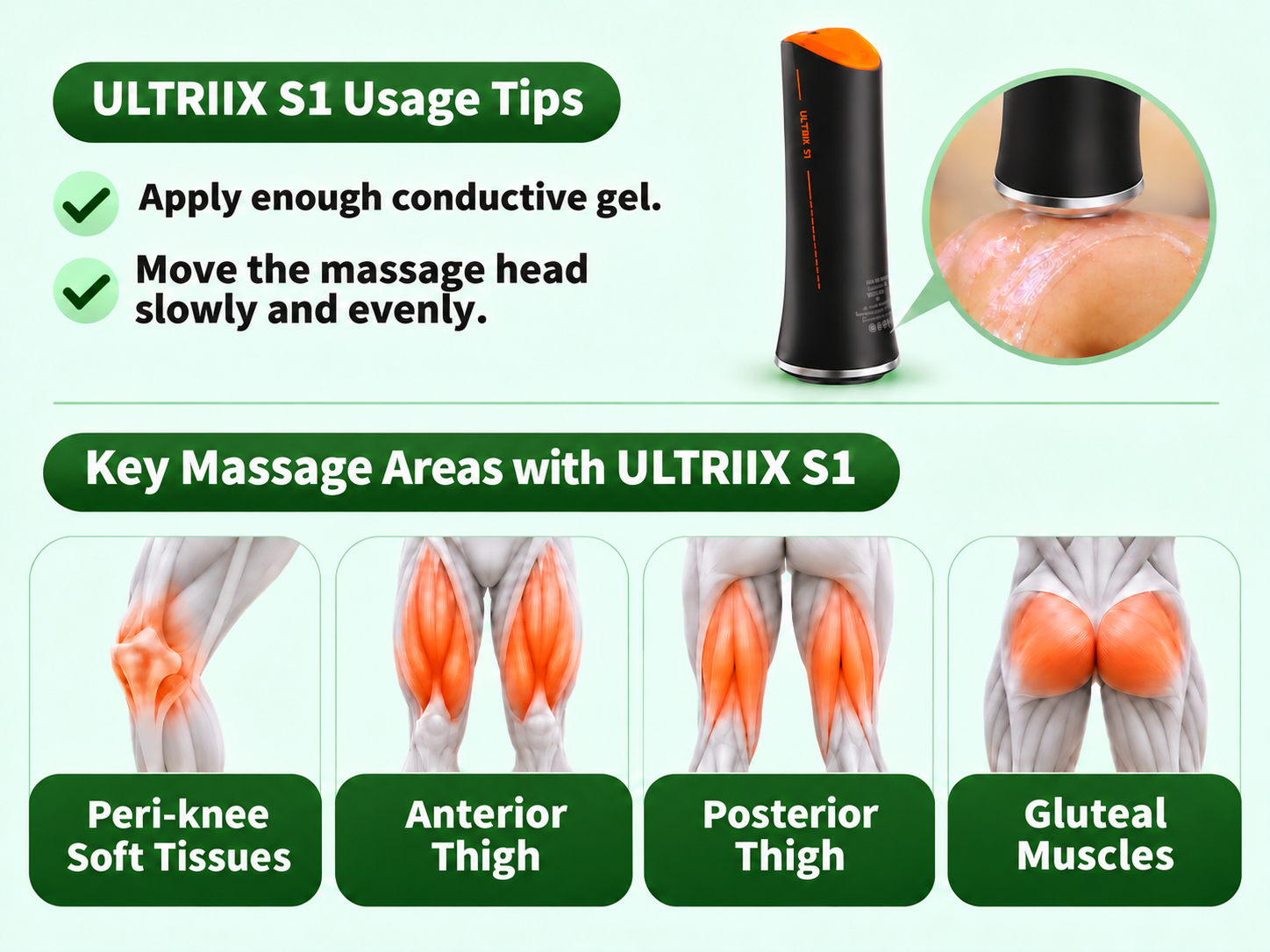
9. Key areas for regular badminton knee care with ULTRIIX S1
Recovery care is not only about the knee itself. The supporting muscles that control knee movement matter most.
|
Target Area |
Why It Matters |
S1 Usage Notes |
|
Soft tissue around the knee (tendons, ligaments, fascia) |
Reduce local tension and improve knee stability |
Apply gel fully, move the head steadily or in circles |
|
Front thigh (quadriceps, vastus medialis priority) |
Critical for stable patellar tracking |
Move slowly along the muscle belly, focus on the medial head |
|
Back thigh (hamstrings) |
Stabilize the knee front-to-back |
Work from the ischial tuberosity down toward the back of the knee |
|
Gluteal muscles |
Prevent knee valgus and lower patellar pressure |
Focus on gluteus medius and piriformis |
Use ULTRIIX S1 to release these muscle bellies and tendon attachment points. This helps reduce stress on the knee and improves circulation, so your knees stay stable for your next game.
10. Using ULTRIIX S1 for patellar tendinitis or patellofemoral pain syndrome
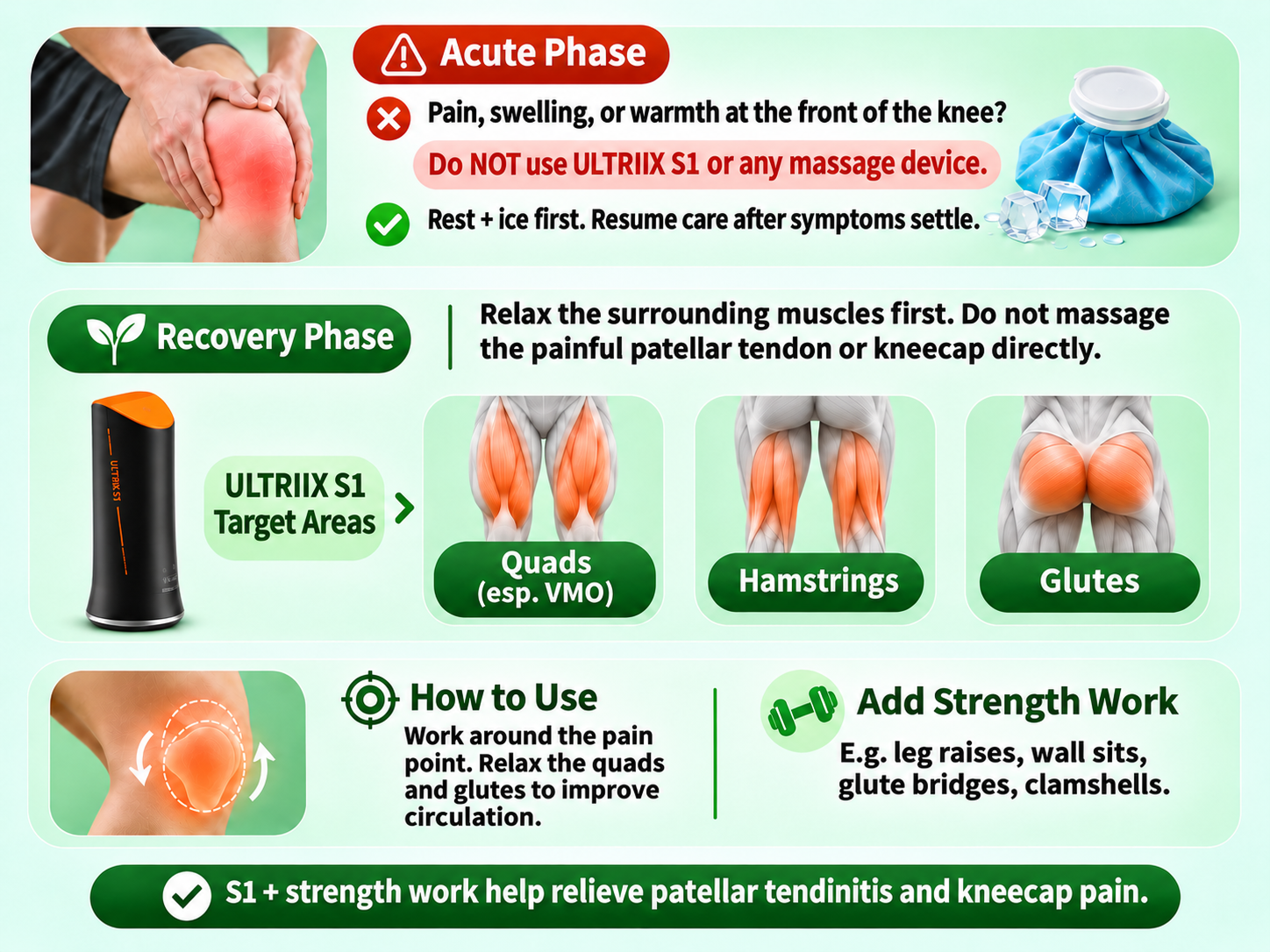
⚠️ Acute phase
If you have sharp tenderness, swelling or warmth around the kneecap, this is active inflammation. Do not use ULTRIIX S1 or any massage device at this stage. Prioritize rest and ice. Start soft tissue care only once swelling and acute pain fade.
📌 Recovery phase care
Once acute pain calms down, the goal is to release muscles that pull the kneecap out of alignment — do not massage directly on the sore tendon or patella. Prioritize these groups with ULTRIIX S1:
● Quadriceps (especially vastus medialis): Patellar tendinitis and patellofemoral pain often stem from imbalanced quad tension that pulls the patella off track.
● Hamstrings: Release posterior thigh muscle bellies to balance front-back knee tension.
● Gluteal muscles: Weak glutes lead to knee valgus and higher patellar pressure; releasing glutes supports better lower-body alignment.
For patellar tendinitis and patellofemoral pain, work around the tender spot instead of directly on it. Focus on quads and glutes to improve circulation. Always pair this with strength training — strength work is the root solution for these issues. Recommended drills: Straight leg raise, wall sits, glute bridges, clamshells. Combined strength training and ULTRIIX S1 care deliver the best relief.
11. Are knee sleeves helpful?
Knee sleeves improve proprioception. They help you sense knee position and load, triggering protective reflexes during quick direction changes. Research shows, however, external bracing alone has limited injury prevention effects. No brace can fully replace your body’s natural stabilizing system.
Bracing is supplementary; muscle strength is the foundation. ULTRIIX S1 helps keep your muscles loose, flexible and functional. They are not competing alternatives — they work together.
12. Patellar strap vs full knee sleeve
● A patellar strap is best for players with patellar tendinitis or patellofemoral pain. It distributes pressure across the patellar tendon;
● A full wraparound sleeve delivers broader support for general joint instability;
● For badminton, patellar straps are popular: they do not restrict movement while easing tendon load;
● If you feel significant knee instability, pick a brace with lateral support stays.
13. Do wall sits protect knees?
Wall sits are classic isometric quad exercises that build knee support. Proper form: knees stay behind toes, knees track in line with toes, shins vertical. Wall sits are not suitable for everyone. People with patellofemoral disorders should avoid them, as wall sits increase patellofemoral joint pressure. If unsure about your knees, start at a shallow angle (~30°) and watch for pain.
Pro tip with ULTRIIX S1: After wall-sit training, release your quads with S1 to ease training stiffness and keep your next session comfortable.
14. Landing technique to reduce knee impact
Correct landing sequence: Heel touches first, then roll forward to the ball of your foot, bend knees to absorb shock, and keep knees aligned with toes. The most dangerous pattern: Forefoot landing plus knee valgus, which creates massive torsional stress on the ACL. Always line your knees up with your toes on landing.
How ULTRIIX S1 helps: Poor landing form is often not a knowledge problem. Tight glutes and hamstrings limit your body’s ability to react correctly on landing. Regular release with ULTRIIX S1 keeps these tissues flexible, supporting more stable landing mechanics.
15. Why “weekend players” get knee injuries more easily
One large session after a week of inactivity is a common injury trigger. Sedentary weekdays leave knee muscles and ligaments under-activated. When you suddenly play high-intensity badminton with constant stops, lunges and jumps, your body lacks time to adapt and recover. Sports experts describe this as “exercise bingeing”: occasional overdoing it is riskier than regular moderate play.
If you are a “weekend warrior”, ULTRIIX S1 fits your routine perfectly:
● Pre-game on Saturday: Use S1 for soft tissue conditioning to wake dormant muscles;
● Post-game on Saturday: Deep recovery work to speed up recovery;
● Follow-up care on Sunday to stop fatigue carrying over into the week.
16. Beyond strength training: How to build knee resilience
Proprioceptive training. Knee stability depends not only on muscle strength, but also your nervous system’s awareness of joint position. Single-leg stands, balance pad drills and eyes-closed single-leg squats train fast reflexes when balance is challenged.
ULTRIIX S1 bonus benefit: Releasing tight muscles after training improves neural control, making proprioceptive drills more effective.
17. Does nutrition affect knee health?
Indirectly, but significantly. Low protein slows muscle and tendon repair; insufficient calcium and vitamin D hurt bone metabolism; omega‑3 fatty acids help modulate inflammatory responses in joints.
Active players should aim for adequate protein intake (1.2–1.6 g per kg of body weight) plus calcium to support long-term knee health. Proper hydration also maintains joint synovial fluid.
ULTRIIX S1 + good nutrition = two layers of support. S1 handles soft tissue recovery, nutrition supplies building blocks for repair. Together, they keep knees in better shape.
18. Can I return to badminton after a knee injury?
Yes, but only after structured rehabilitation and professional clearance. Mild chronic strain (patellar tightness, pes anserinus strain, no tears, locking or swelling): With clearance from a sports medicine doctor or physiotherapist, structured strength training, movement correction, plus regular ULTRIIX S1 soft tissue care, most players can return at reduced intensity. Serious structural injuries (meniscus tear, ACL rupture, extensive cartilage damage): Follow your clinician’s plan for surgery or long-term rehab. Whether you can return and at what intensity must be decided by a rehab specialist. Some severe injuries rule out badminton, due to its stop-start, twisting nature.
Key point: Recovery is not just “pain-free”. It requires full restoration of joint function, strength and proprioception. During rehabilitation, ULTRIIX S1 may be used under professional guidance to maintain tissue flexibility and support recovery.
Conclusion
Badminton is captivating because it constantly challenges your body. Every lunge asks whether your muscles are ready. Every landing tests whether your knees can absorb impact.
Knee trouble rarely comes from one single accident. It builds up from countless small compromises: a quick warm-up, a rushed stretch, one extra game.
Now you have a tool to move past “good enough”---ULTRIIX S1.
● 10 minutes before play: Light cardio + ULTRIIX S1 peri-knee conditioning + dynamic stretches to wake your body;
● 15 minutes after play: Static stretches + ULTRIIX S1 deep recovery to clear fatigue;
● Rest days: Targeted release work to keep knees ready.
Caring for your knees scientifically does not mean giving up the joy of badminton. It means investing in your body with purpose every time you step on and off court.
Light lunges and powerful jumps on court are built on well-cared-for knees. Let ULTRIIX S1 help you keep enjoying this sport for longer.