
Football is a high-intensity sport involving sprinting, sudden stops, directional changes and physical contact. Many players focus solely on improving on-pitch skills and fitness, yet often overlook pre-match activation and deep post-game tissue care.
Mild symptoms include lingering muscle soreness that lasts two to three days after play. In more serious cases, persistent fatigue builds up over time and leads to chronic fascial and soft tissue strain.
Targeting the right areas and adopting proper recovery practices allows you to sustain your on-pitch performance and prolong your sporting career. Today we will break down the key body areas for Ultriix S1 to target before and after football matches, plus efficient operation guidelines.
Warm-up before exercise aims to boost muscle extensibility while preserving explosive power. Avoid over-relaxing your muscles; otherwise, they may turn limp and hinder force generation.
The UltrIIX S1 emits 1.1MHz ultrasound that directly targets deep fascia and tendons. Before using UltrIIX S1, perform light warm-ups to raise muscle temperature and accelerate blood flow — this significantly improves acoustic wave transmission efficiency.
Next, use UltrIIX S1 for a short massage session to release deep stiffness and break down deep tissue adhesions unreachable by surface stretching. Finish with dynamic stretching, which converts newly activated deep tissue extensibility into greater joint range of motion while maintaining muscle tone. This ensures stable support for stroke impact, pushing off, and directional changes during movement.
I. Pre-Match (10–15 Minutes Before Kickoff): Activate Tissues & Prevent Strains
Core Goal: Wake deep fascia, reduce muscle viscosity, improve smooth muscle contraction, and lower the risk of strains during sprints, direction changes and shooting.
The correct sequence: Light Warm-up → ULTRIIX S1 Assisted Release → Dynamic Stretching
1.Priority Areas for Pre-Match Release
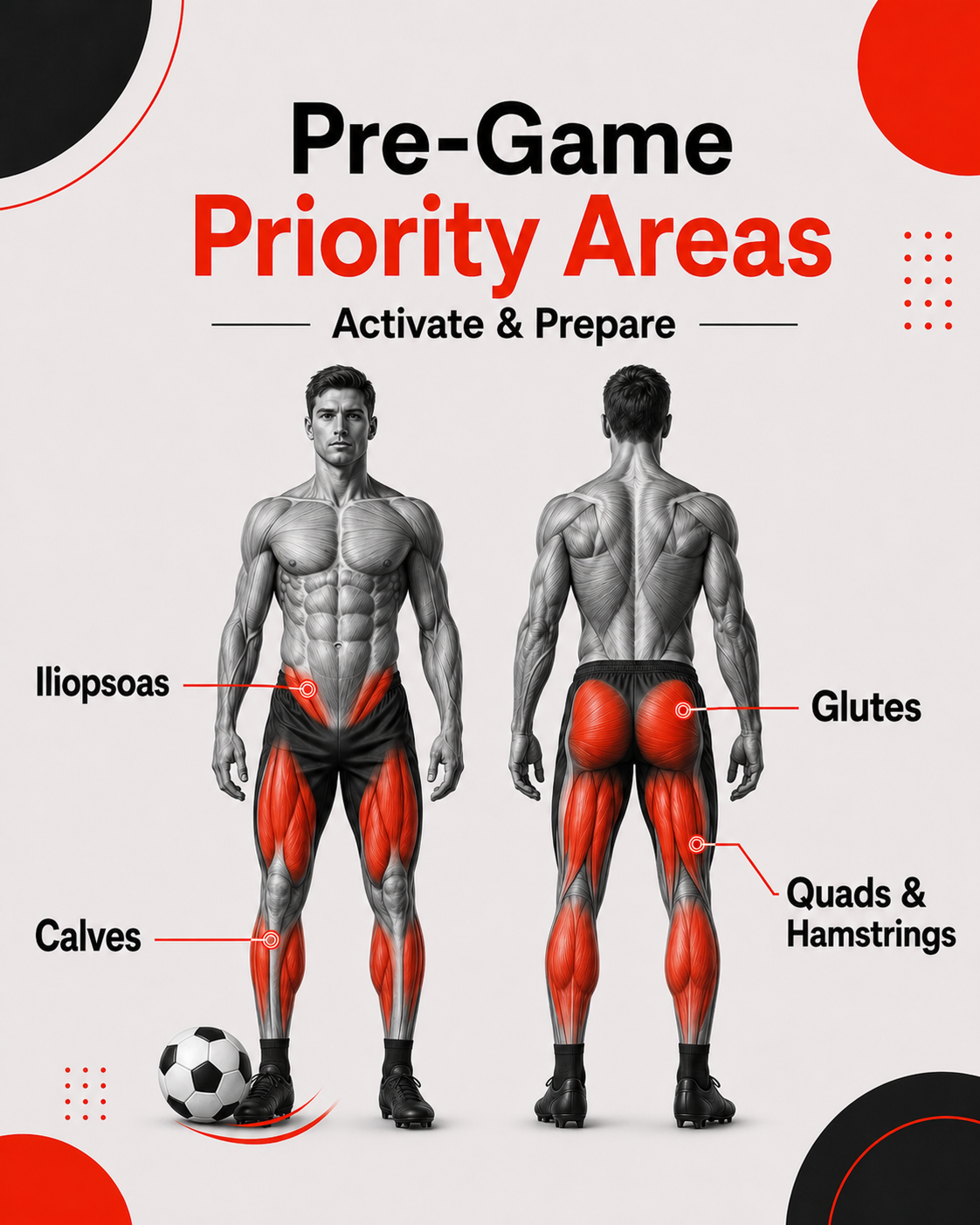
● Posterior Calf (Gastrocnemius & Soleus)
Reason: Primary muscle group for pushing off, sprinting and sudden stops. Stiff fascia pre-match easily triggers cramping and muscle strains.
Guidance: Start at Level 5, move slowly vertically along the muscle fiber line. Total activation time: 2–3 minutes.
● Quadriceps (Anterior Thigh) & Hamstrings (Posterior Thigh)
Reason: Core muscles for acceleration, powerful shooting and defensive strides. Hamstrings are the most commonly strained muscle group in football.
Guidance: Glide slowly along muscle fibers. Spend 2–3 minutes on each side of the thigh. Focus on restoring muscle elasticity.
● Gluteal Muscles (Gluteus Maximus & Piriformis)
Reason: The key link transmitting force between upper and lower body. Tight glutes force compensation from the lumbar spine and knees, directly compromising explosive power for direction changes.
Guidance: Gentle targeted gliding to activate deep fascia, roughly 2 minutes per side.
● Iliopsoas (Deep within the groin)
Reason: Subjected to maximum stretch during long ball dribbling and shot preparation. Stiff deep fascia may lead to hidden strains.
Guidance: Use low-to-medium intensity with slow circular motions for gentle activation; 1–2 minutes per side.
💡Pre-Match Usage Tip:Combining this routine with dynamic stretching delivers enhanced activation results.
II. Post-Game (Immediately After Static Stretching): Deep Release & Fatigue Recovery
Post-workout recovery focuses on relieving fatigue, easing soreness and preventing chronic strain injuries. After exercise, muscles remain in a state of acute contraction and tightness. Starting with static stretching lengthens superficial muscle fibers, eases surface spasms, and returns muscles to their natural resting length — effectively removing the "surface barrier" that blocks sound wave penetration. When you then use the S1, ultrasound energy can penetrate more smoothly into deep fascia and tendon attachment sites (such as the origin of forearm extensor muscles, a common location for tennis elbow, and rotator cuff insertion points). It precisely breaks down adhesions and boosts lactic acid metabolism, greatly accelerating recovery.
Core Goal: Clear accumulated metabolic waste, release fascial tightness, relieve post-match muscle soreness, and prevent overnight fatigue buildup leading to long-term chronic strain.
The correct sequence: Static Stretching → ULTRIIX S1 Deep Tissue Care
1. Primary Recovery Area (Highest Priority)
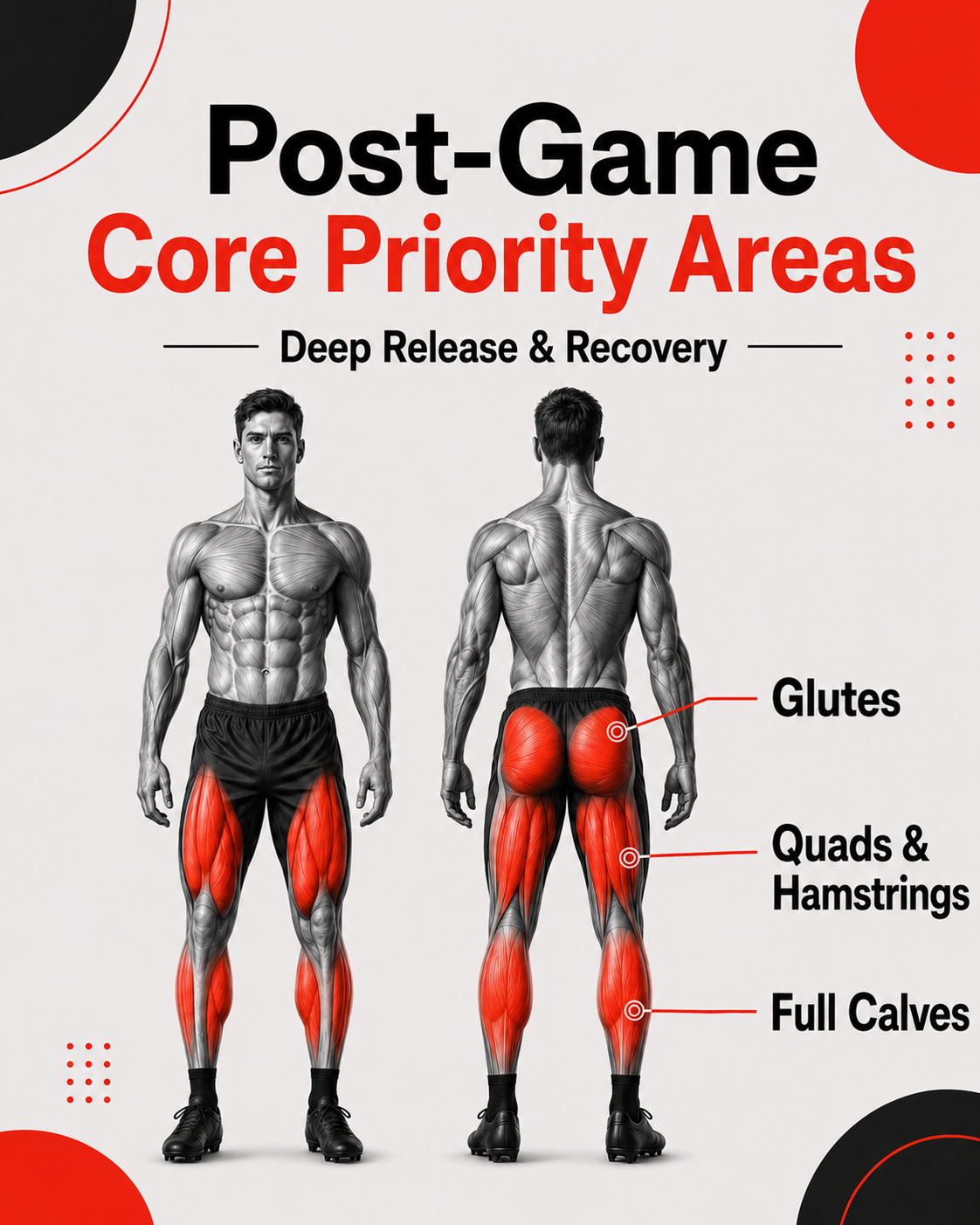
● Full Posterior Calf
Reason: Bears maximum load during full-match running, pushing off and directional changes. Heavy lactic acid buildup occurs here; long-term overload causes Achilles tendon irritation and fascial nodules.
Guidance: Level 5–7, apply ample coupling gel. Hold for 20 seconds at sore tight nodules before moving slowly. 5–8 minutes per leg.
● Quadriceps (Anterior Thigh) & Hamstrings (Posterior Thigh)
Reason: Primary muscles for explosive force generation, prone to significant post-match tightness. Chronic hamstring strain repeatedly disrupts running performance.
Guidance: Glide slowly along muscle fibers, linger at sore trigger points. 5 minutes for the anterior and posterior thigh respectively.
● Gluteal Muscles
Reason: Sustained compensatory effort during full-match physical challenges, turns and jumping. Deep post-match soreness often radiates and triggers lumbar discomfort. Guidance: Focus on releasing the piriformis region, 3–5 minutes per side.
2. Secondary Priority Recovery Area
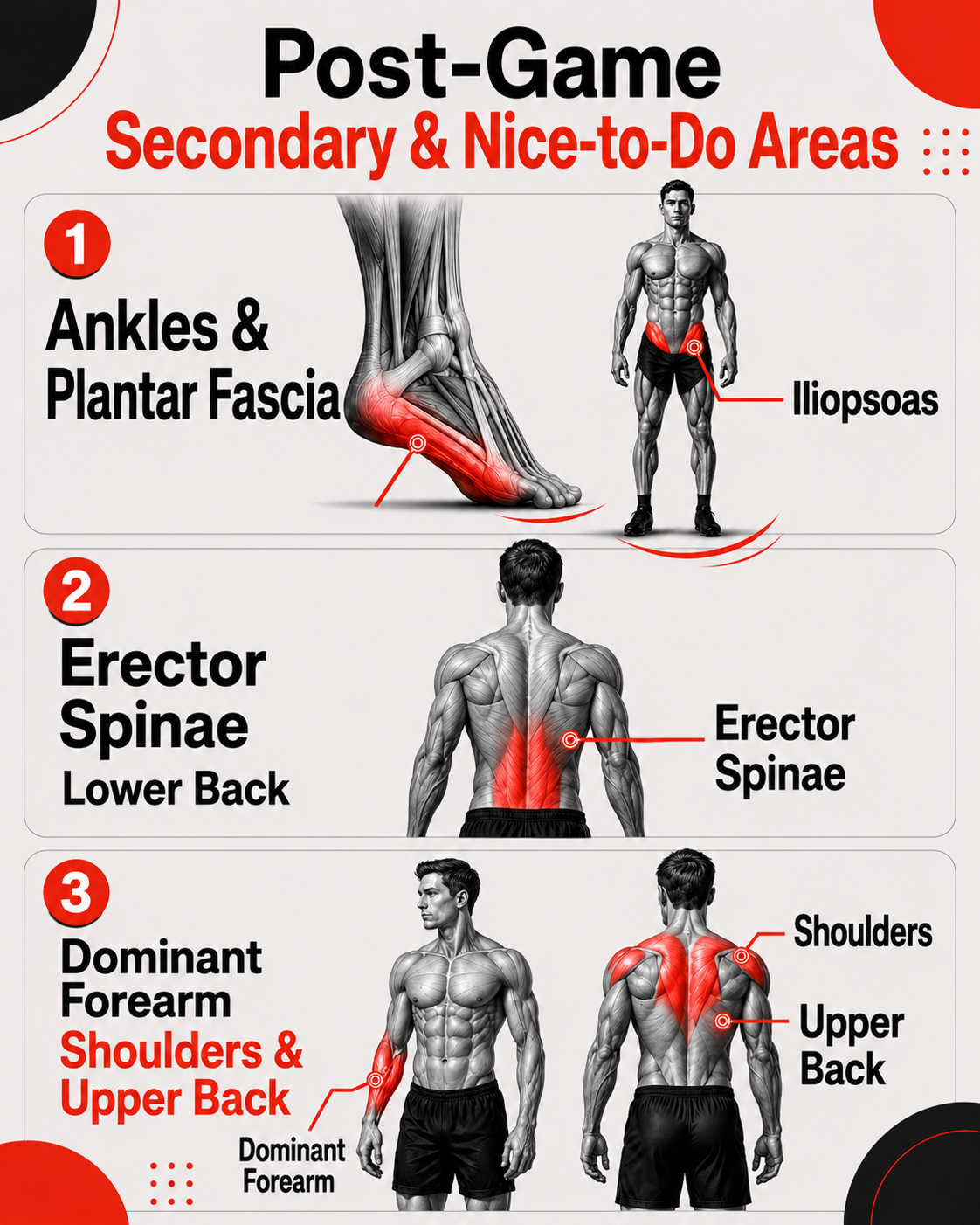
● Peri-Ankle Soft Tissue & Plantar Fascia
Reason: Constant directional changes, landing impact, and historical ankle sprains create persistent stress, leading to chronic tightness and adhesion.
Guidance: Level 4–6 with gentle circular movements. Avoid bony protrusions; prioritize tendon attachment sites. 3 minutes per ankle.
● Iliopsoas (Groin Area)
Reason: Strain from wide-range movements often goes unnoticed. Lack of post-game release gradually causes persistent chronic dull pain.
Guidance: Medium intensity, slow gliding, 2–3 minutes per side.
● Lumbar Erector Spinae
Reason: Continuous core stabilization across the full match. Physical contact and aerial duels frequently lead to stiffness and aching in the lower back.
Guidance: Move slowly along both sides of the spine. Total treatment time: 3–5 minutes.
3. Tertiary Supplementary Recovery Area
● Dominant Forearm, Shoulder & Upper Back
Reason: Repetitive arm swinging and body contact during play; only mild surface fatigue relief is required.
Post-Game Usage Tips
1.Always complete basic static stretching before using the device straight after play — this maximises the clearance of metabolic waste.
2. You may pause over sore strained trigger points and gradually increase intensity within comfortable limits.
3. Do not spend more than 15 minutes treating one area in a single session.
4. Replenish coupling gel as needed during treatment. The ULTRIIX S1 features intelligent detection. If you operate the device with insufficient gel or no gel at all, it will automatically stop working. This prevents ineffective power output and extends the service life of your device.
Most footballers’ chronic discomfort does not stem from one single injury. It accumulates gradually due to insufficient pre-match activation and incomplete post-game recovery.
Carry out precise activation before matches to get your fascia and muscles ready for peak performance. Conduct deep tissue recovery post-game to clear accumulated fatigue promptly. Rather than pushing through soreness and waiting until injury strikes to seek treatment, consistent daily maintenance is the key to extending your sporting career.