
Prolonged tennis play often leads to recurring shoulder soreness, sharp stabs when lifting the arm to serve, and lingering dull aches even after rest — these are the typical symptoms of tennis shoulder plaguing most tennis enthusiasts. As the most prevalent chronic upper-limb strain in tennis, rotator cuff injuries mainly stem from repetitive overhead swings such as serves and smashes. Long-term compression and traction on rotator cuff tendons lead to accumulated micro-tears, which gradually develop into tendinitis and shoulder impingement. In severe cases, tendon strains occur, disrupting regular training and playing routines.
Most players rely on stretching and massage to relieve shoulder discomfort, yet these methods only soothe superficial muscles and cannot reach damaged deep tendons, resulting in recurring strain. To fundamentally avoid shoulder injuries, protection must run through pre-match preparation, in-game play, post-match recovery and long-term training, forming a full-cycle protection system consisting of warm-up activation, technical correction, load management, deep repair and strength building.
The ULTRIIX S1, a 1.1MHz ultrasonic device, fills the gap left by conventional superficial care. It can be integrated into the entire shoulder protection routine to stabilize shoulder joints in multiple dimensions: pre-match tendon activation, in-game emergency relief, post-match micro-injury repair and long-term daily maintenance. Below is a complete practical guide to help you correct flawed force application habits, conduct deep tendon care, and get rid of tennis shoulder for good.
I. Pre-Match: Layered Progressive Warm-Up to Prevent "Cold Shoulder" Injuries
The rotator cuff functions as deep shoulder stabilizers, which cannot be fully activated via conventional warm-ups. Forceful swings with cold shoulder tendons easily trigger tendon strain injuries. Follow this progressive sequence: whole-body heating → superficial muscle activation → deep tendon awakening → swing motion adaptation.
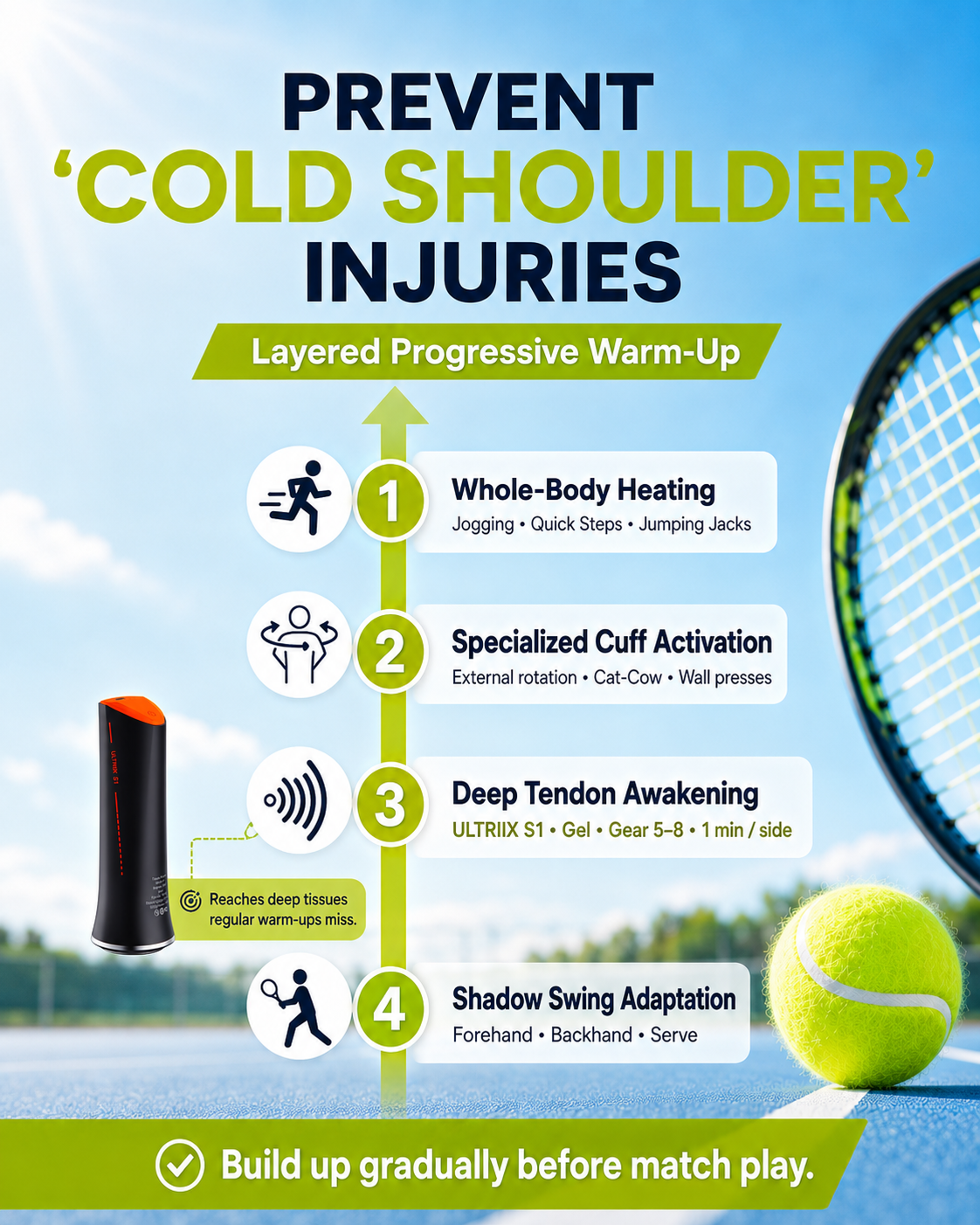
1. Whole-body heating (3–5 minutes)
Jogging, quick stepping and jumping jacks raise core body temperature, boost upper-extremity blood circulation and stimulate synovial fluid secretion, creating ideal tissue conditions for subsequent deep activation.
2. Specialized rotator cuff activation
Complete resistance band external shoulder rotation, cat-cow shoulder mobilization, and wall shoulder presses: 12–15 reps per set, 2 sets for each movement. These exercises activate superficial rotator cuff muscles and scapular stabilizers to establish basic shoulder joint stability.
3. Deep tendon awakening (with ULTRIIX S1)
Adjust the ULTRIIX S1 to gear 5–8, apply a thick layer of dedicated coupling gel, attach the probe closely to the skin, and glide slowly over the anterior shoulder tendons and posterior infraspinatus region for roughly 1 minute per side. Leveraging the penetration capability of the device’s 1.1MHz pulsed therapeutic ultrasound, it reaches deep tendon tissues inaccessible to regular warm-ups, pre-activates fascia and tendons, improves tissue extensibility, and fundamentally lowers strain risks.
4. Progressive shadow swing adaptation
Execute forehand, backhand and serving shadow swings gradually from small to large amplitude to let the shoulder adapt to force trajectories. Never deliver full-power serves or strokes immediately after stepping onto the court.
II. Fix Swing Technique: Cut Compensatory Strength (Key to Prevention)
80% of tennis shoulder injuries stem from flawed force logic: athletes transfer the entire load of the bodily kinetic chain to the shoulder joint. Three high-risk movements require priority correction:
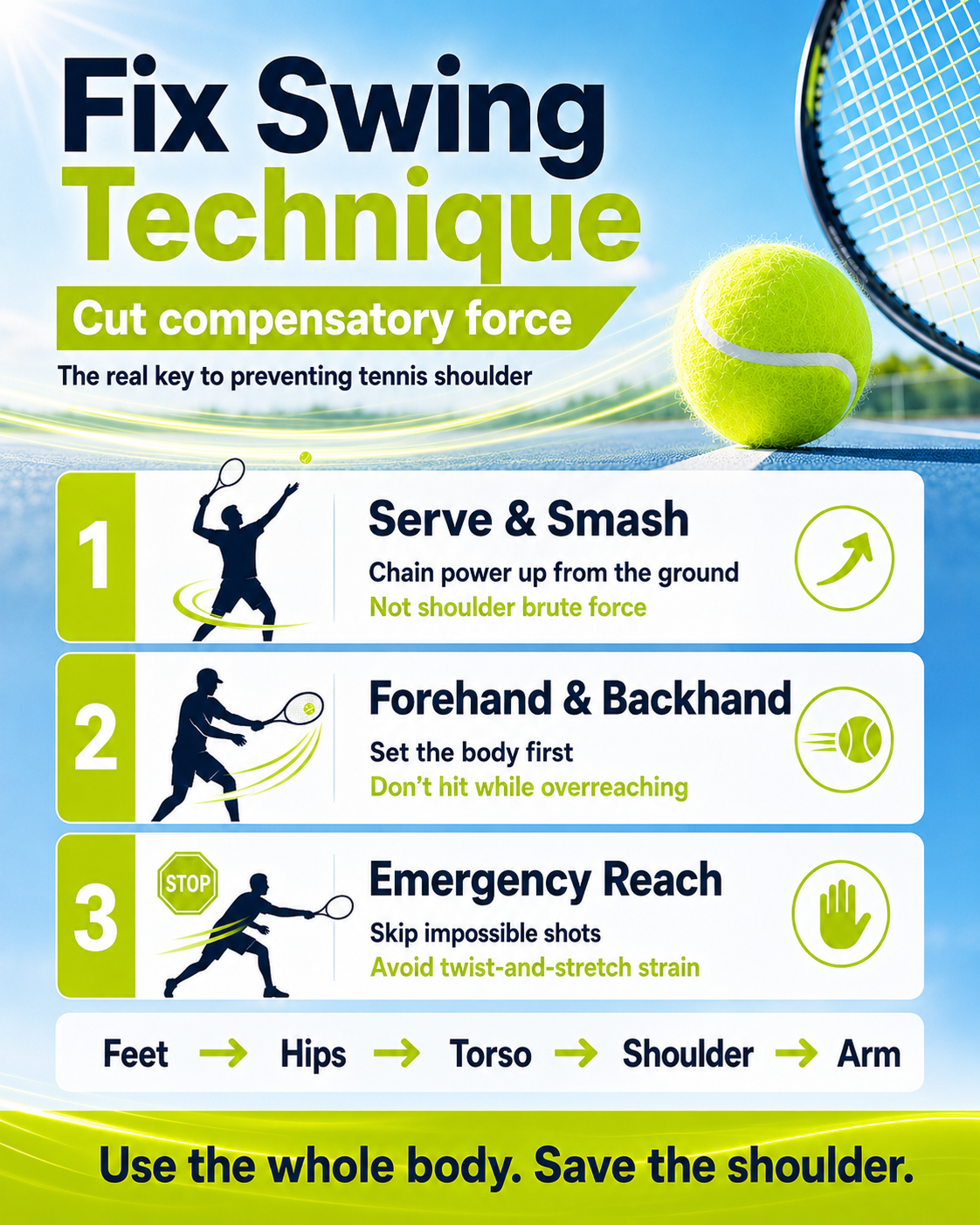
1. Serves & overhead smashes (Avoid shoulder-driven brute force)
The correct force sequence is leg drive → hip rotation → torso rotation → shoulder elevation → arm whipping. The shoulder acts only as a force transmission hub, not the power source. Keep the contact point forward and above the torso; avoid excessive back hyperextension and overstretching the arm backward, which reduces compression and abrasion of the rotator cuff under extreme abduction & external rotation. Decelerate naturally with torso rotation during follow-through instead of forced shoulder braking.
2. Forehand & backhand strokes (Do not overreach with extended arms)
Position the contact point directly in front of your torso; use shuffle steps and crossover steps to get into position before striking. Stretching the arm to reach wide balls imposes extra tensile and shear force on the rotator cuff, triggering tendinitis after repeated use. One-handed backhands must rely on torso rotation to drive swings, rather than brute shoulder exertion.
3. Emergency reaching shots (Abandon unreachable balls decisively)
Give up over-the-shoulder passing shots and wide-angle overhead strikes outside your controllable range. Forced shoulder twisting and arm extension are the top cause of acute rotator cuff tears.
III. In-Match Load Management: Block Accumulation of Micro-Tears
Most rotator cuff injuries arise from accumulated repeated micro-tears; single excessive exertion and continuous overloading accelerate damage:
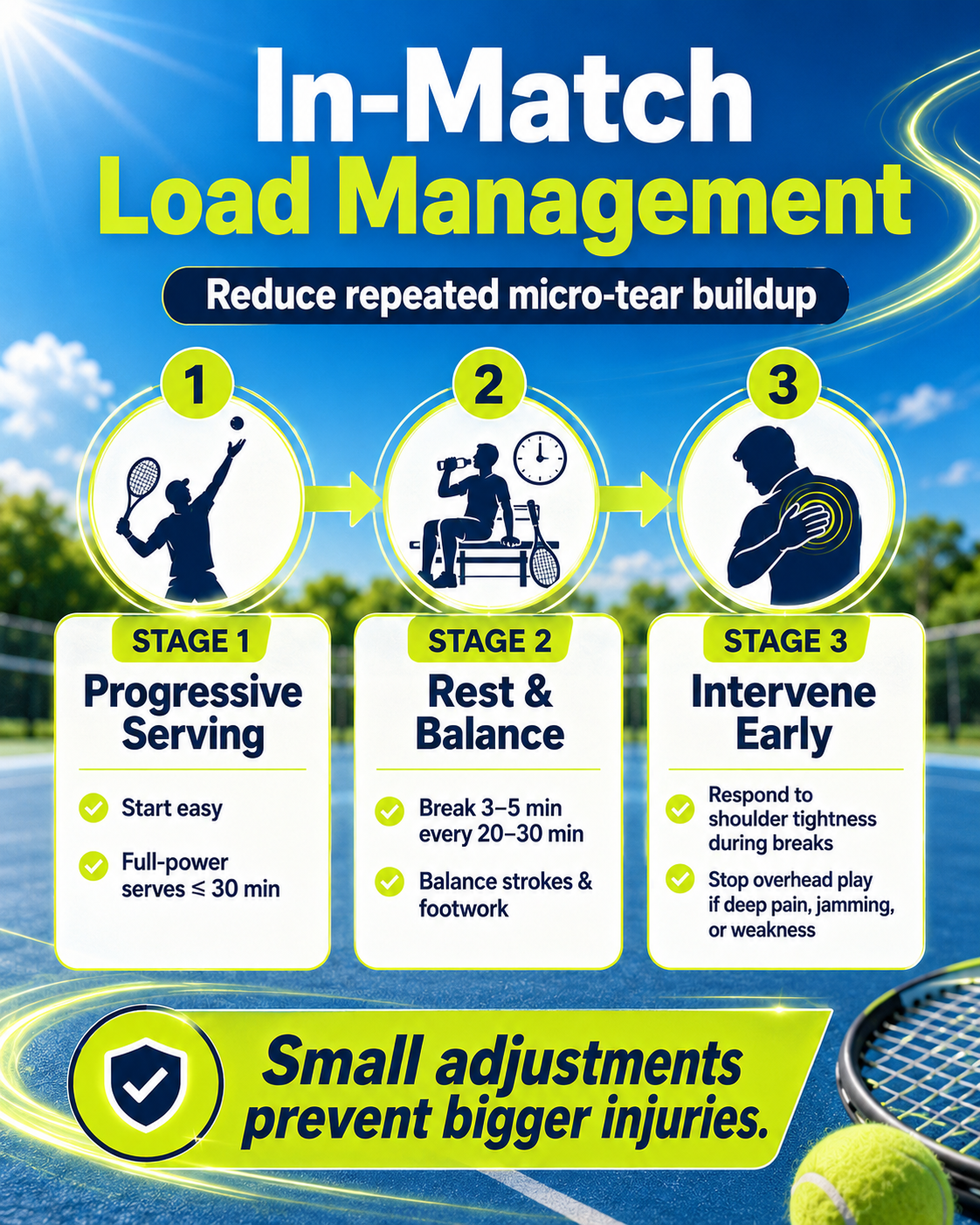
1. Progressive serving drills
Start with gentle serves to build feel, then gradually increase power. Limit continuous full-power serving training to 30 minutes; avoid consecutive overhead smashes to reserve recovery time for rotator cuff tendons.
2. Scheduled rest & balanced training
Rest for 3–5 minutes after every 20–30 minutes of play to mobilize shoulders. Balance training among forehands, backhands and footwork to prevent chronic unilateral shoulder overloading.
3. Timely intervention for discomfort
If tightness and soreness emerge around the shoulder during play, use ULTRIIX S1 at the lowest setting to glide over the shoulder perimeter for 3–5 minutes during breaks to ease deep tension. Cease all overhead movements immediately once dull deep pain, arm-lifting jamming or muscular weakness occurs; never play through injuries.
IV. Post-Match: Layered Relaxation & Rehabilitation to Prevent Permanent Chronic Strain
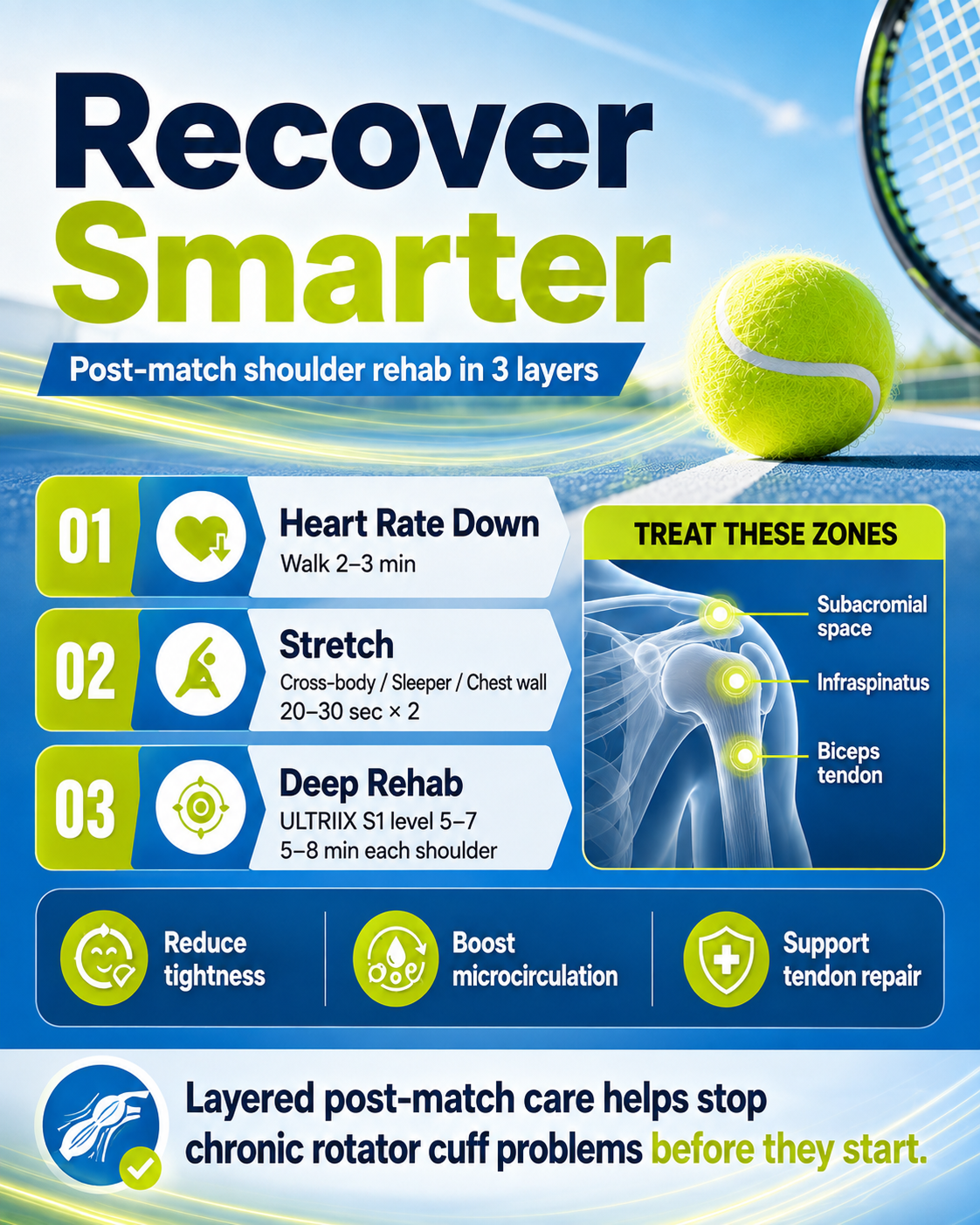
Rotator cuff tissues stay congested and tight after exercise; superficial stretching alone cannot repair deep tendon micro-tears. Follow the routine: heart rate normalization → static stretching → deep tissue rehabilitation.
1. Heart rate stabilization & static stretching
Walk slowly for 2–3 minutes to calm heart rate, then perform posterior shoulder cross-stretch, sleeper stretch and wall chest stretch: hold each pose for 20–30 seconds, 2 sets. Lengthen superficial muscles and relieve spasms to break through the "superficial barrier" for subsequent deep rehabilitation.
2. Deep tissue repair & maintenance with ULTRIIX S1
Use the device after stretching at gear 5–7 with abundant coupling gel. Focus treatment on the subacromial space, infraspinatus insertion points and the long head of the biceps tendon on the anterior shoulder. Move the probe slowly, and pause for 20 seconds at stiff, tender nodules; maintain treatment for 5–8 minutes per shoulder.
Ultrasound energy penetrates 3–6 centimeters to reach deep tendon layers, boosting local microcirculation, accelerating the excretion of metabolic waste and inflammatory factors, releasing fascial adhesions, repairing exercise-induced tendon micro-tears, and drastically cutting the incidence of chronic rotator cuff disorders.
V. Long-Term Reinforcement: Strength Training + Ultrasound Rehabilitation
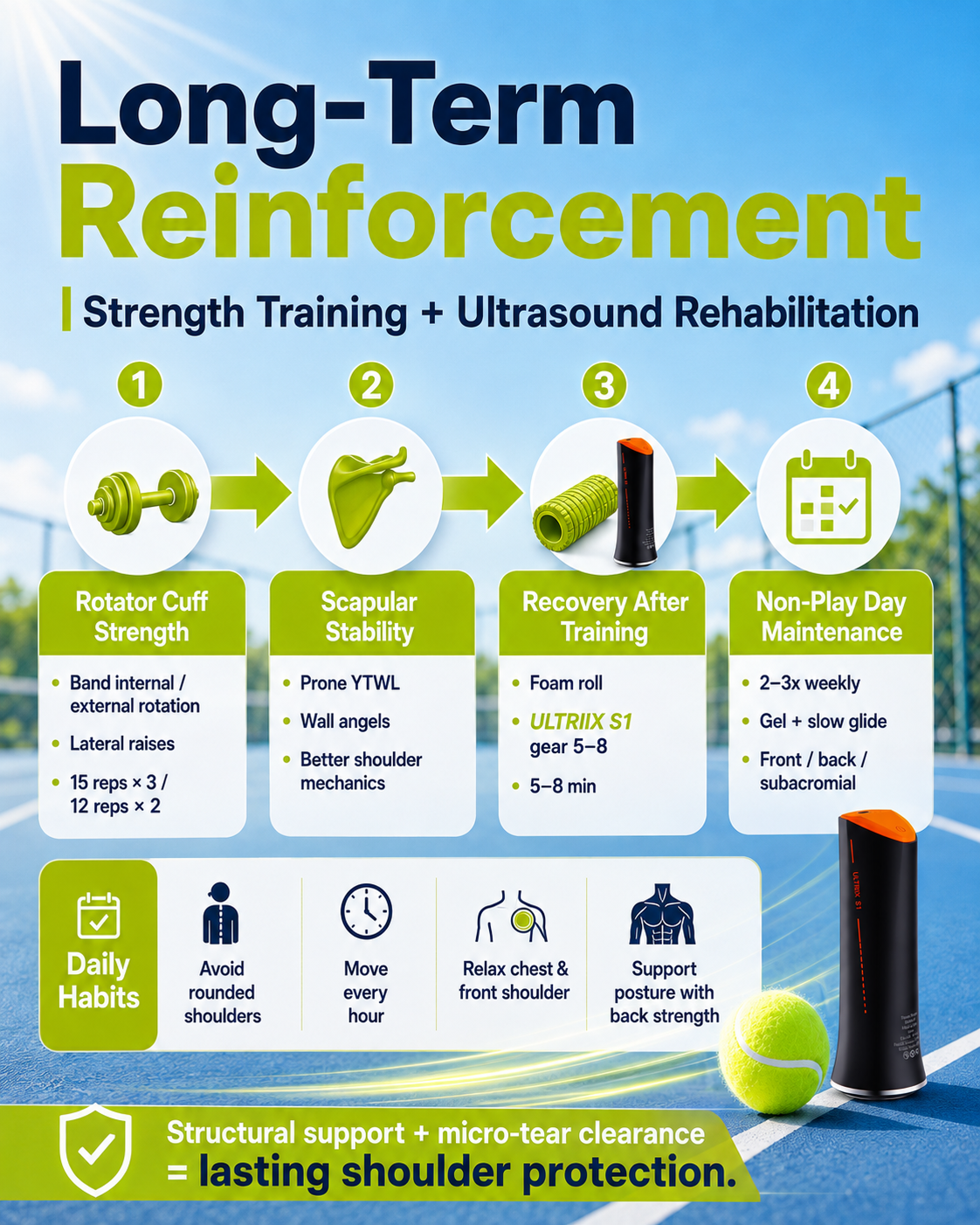
Strengthening rotator cuff strength and scapular stability is the fundamental injury prevention solution. Regular deep maintenance with ULTRIIX S1 consolidates structural support and continuously eliminates accumulated micro-tears, forming a long-term protection cycle far more effective than isolated strength training.
1. Rotator cuff & scapular stability training (2–3 sessions weekly)
● Rotator cuff strengthening
Resistance band internal/external shoulder rotation (15 reps ×3 sets), lightweight lateral raises (12 reps ×2 sets). Balance anterior and posterior rotator cuff strength, improve tendon tensile resistance, and stabilize the shoulder joint structurally.
● Scapular stabilization
Prone YTWL exercises & wall angels (12 reps ×3 sets). Strengthen lower/mid trapezius and serratus anterior, optimize scapulothoracic rhythm, reduce subacromial compression, and mitigate rotator cuff abrasion at the source.
Training tip: After strength training, relax back and shoulder superficial muscles with a foam roller first, then use ULTRIIX S1 at medium gears (5–8) for 5–8 minutes of shoulder maintenance. This alleviates post-workout soreness, accelerates tendon repair, improves training gains, and prevents cumulative training strain.
2. Scheduled ultrasound maintenance on non-play days (2–3 sessions weekly)
Target shoulder stiffness from sedentary office work and residual athletic chronic strain to stop continuous micro-tear accumulation: Operate ULTRIIX S1 at gear 5–8 with thick coupling gel, cover anterior shoulder, posterior shoulder and subacromial areas, and glide slowly for 2–3 minutes per side.
Core benefits: Sustain deep shoulder blood circulation, release chronic fascial adhesions, preserve tendon elasticity, slow tendon degeneration caused by repetitive swings, narrow the subacromial gap induced by rounded shoulder posture, and reduce rotator cuff abrasion from poor daily posture.
3. Posture management & daily habits
Avoid rounded shoulders and kyphosis in daily life; stretch neck and shoulders every hour during desk work. Regularly use ULTRIIX S1 to relax tight chest and anterior shoulder muscles, paired with back strength training to maintain neutral shoulder alignment and avoid overlapping harm from bad posture and athletic strain.
Conclusion
Preventing tennis shoulder relies on full-cycle, systematic maintenance rather than post-injury remedies. The integrated protection system consisting of warm-up activation, technical correction, load management, deep repair and strength training can prevent the accumulation of shoulder micro-tears at the source. Combined with deep ultrasonic care from the ULTRIIX S1, the limitations of conventional superficial relaxation can be overcome to repair tendon damage in depth and stabilize the shoulder joint. Sticking to this scientific maintenance routine effectively guards against rotator cuff strain and shoulder impingement, optimizes swing mechanics, and allows tennis players to enjoy sports steadily and sustainably.