
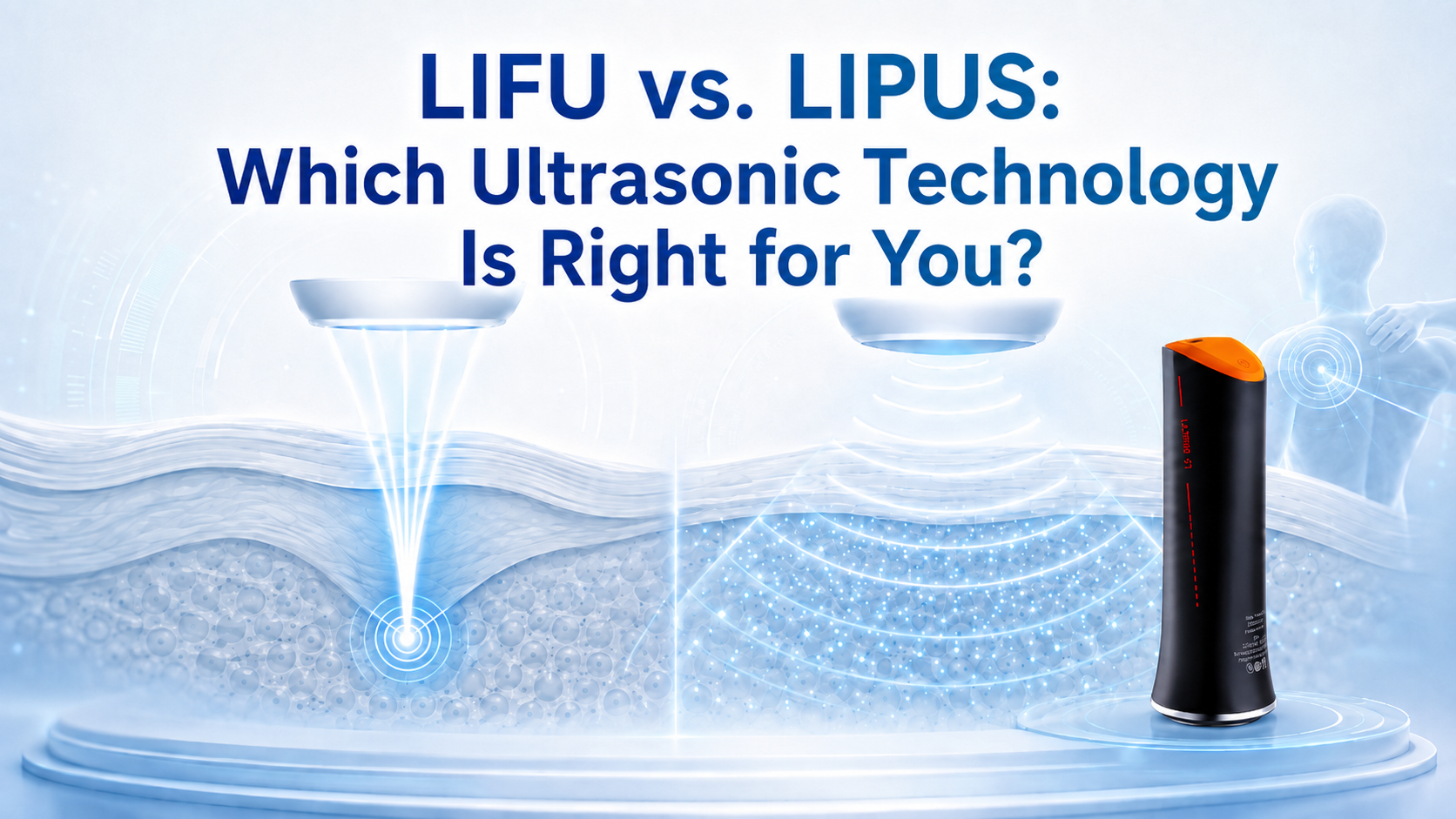
As home ultrasound therapy and sports rehabilitation gain popularity, more people are turning to ultrasound wellness devices. However, the two mainstream technical approaches on the market — Low-Intensity Focused Ultrasound (LIFU) and Low-Intensity Pulsed Ultrasound (LIPUS) — feature similar parameters and terminology, leaving many consumers confused. The key question: which ultrasound technology works best for daily muscle relaxation, injury recovery, and at-home care?
Many buyers fall into the misconception that “higher energy equals better results” and simply chase high focusing power and strong energy. Yet they overlook a critical truth: different ultrasound technologies operate on distinct principles, suit separate scenarios, and carry different safety boundaries. There is no absolute winner; suitability is what matters most.
LIFU and LIPUS represent two fully independent ultrasound systems. One delivers targeted deep intervention at fixed points, while the other offers gentle full-area repair and care. Choosing the wrong technology means you may see little improvement even with consistent use. Picking the technology aligned with your needs enables efficient therapy and effective relief from soft tissue strain.
This article comprehensively compares the two ultrasound technologies from core working principles, functional differences, applicable scenarios and home usability. It helps ordinary users avoid pitfalls and select the optimal ultrasound wellness solution for daily rehabilitation, sports recovery and at-home relaxation.
1. Core Difference: A Pinpoint vs. An Open Palm
The fundamental distinction lies in how energy is output and distributed.
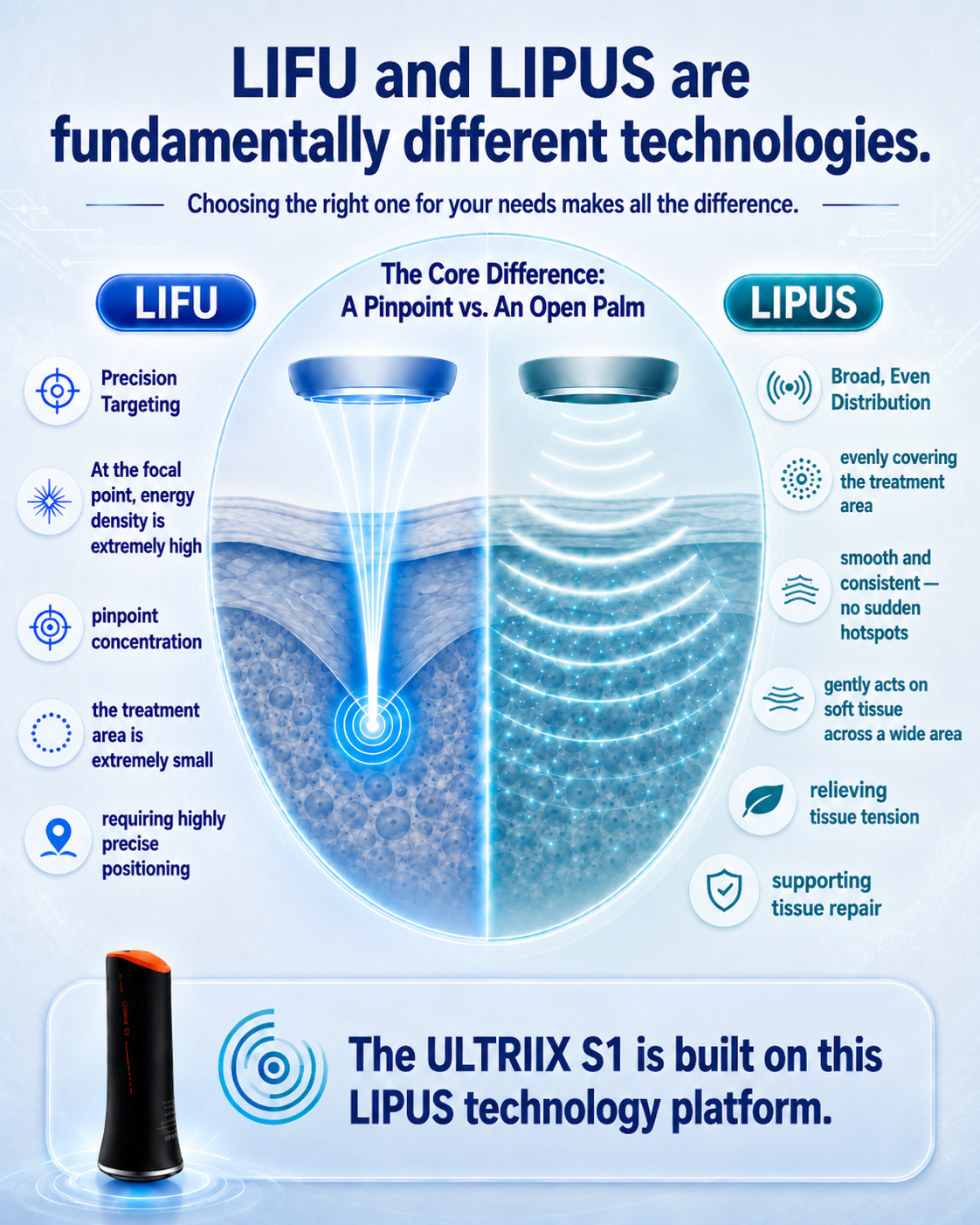
1.1 Focused Ultrasound (LIFU): Pinpoint Strike, Like Light Concentrated by a Magnifying Glass
Focused ultrasound works on the same principle as using a magnifying glass to focus sunlight and ignite paper. An acoustic lens concentrates all acoustic energy precisely onto a focal point at a fixed depth.
At the focal point, energy density peaks and reaches maximum intensity. Along the path of sound waves passing through superficial tissues, energy remains extremely low and produces barely any effect.
Its strengths are concentrated targeted energy and precise localization. Its obvious downside: an extremely small effective treatment zone. High positioning accuracy is mandatory. Minor misalignment of the focal point will drastically reduce effectiveness.
1.2 Pulsed Ultrasound (LIPUS): Full-Coverage Gentle Therapy with Wide Beams
Pulsed ultrasound does not aim for concentrated energy at a single point. Instead, it transmits energy intermittently in pulses via wide beams to evenly cover the target area. Within its effective depth, energy is distributed steadily without localized energy spikes.
It relies on millions of micro-mechanical vibrations per second to gently act on broad soft tissue areas. Primarily through mechanical effects, it improves microcirculation, eases tissue tension and supports tissue recovery, with mild and controllable thermal effects.
The ULTRIIX S1 massager adopts this LIPUS Low-Intensity Pulsed Ultrasound technology.
2. When Should You Choose LIFU?
The core advantage of focused ultrasound is precision, deep penetration and sparing superficial tissue. It is better suited for targeted intervention in professional medical settings:
It is the preferred option when precise treatment of deep small lesions is required, while superficial nerves, blood vessels and skin tissue must be avoided.
Energy can be accurately delivered to deep target areas, while superficial tissues along the wave path are protected from excess energy, minimizing irritation to surrounding healthy tissue.
Nevertheless, such operations demand high precision and professional expertise. They usually require specialists aided by imaging guidance, and are not suitable for regular at-home use.
3. When Should You Choose LIPUS?
For most people’s daily care, sports recovery and at-home relaxation needs, pulsed ultrasound delivers better versatility and more comprehensive outcomes.
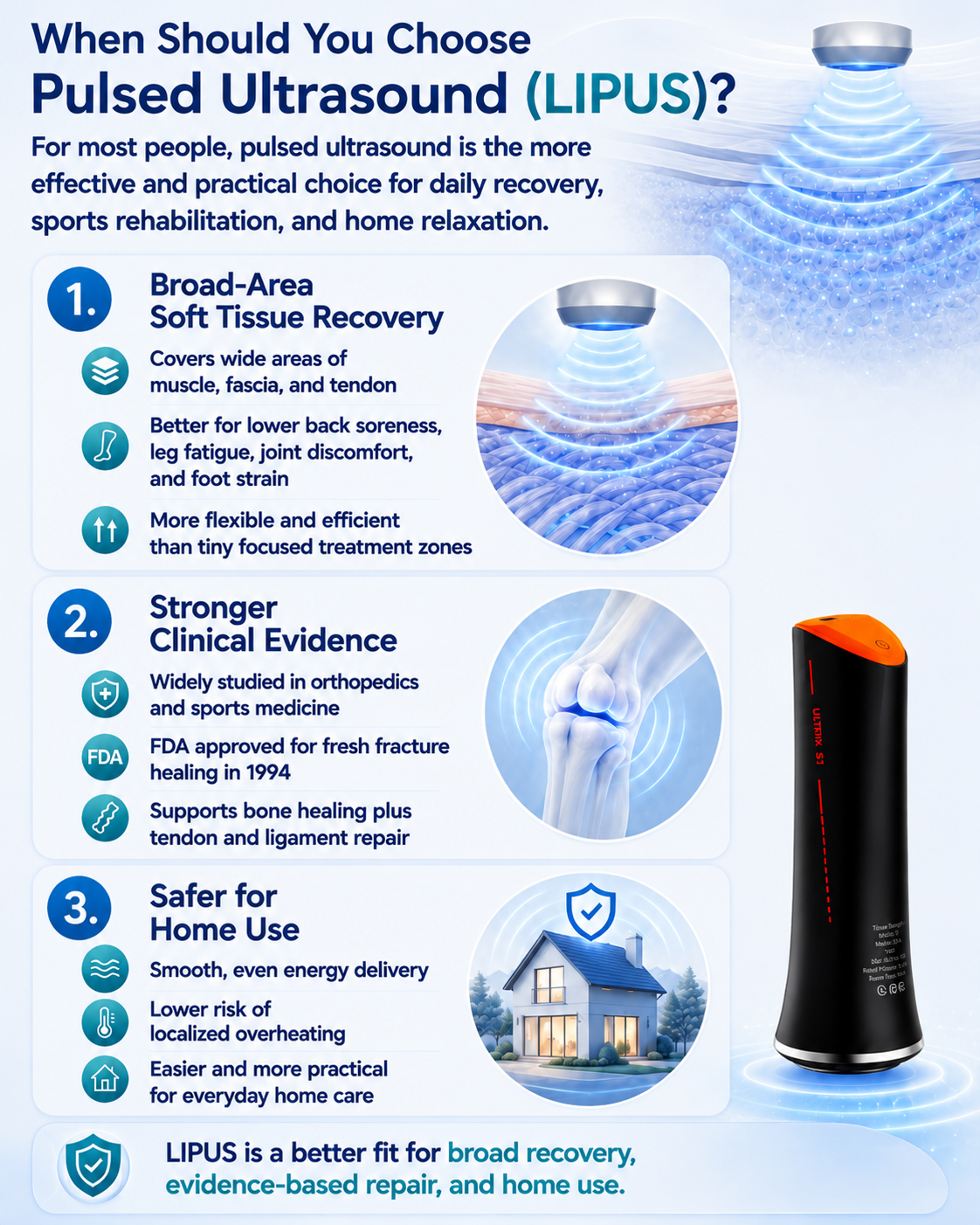
3.1 Recovery from Large-Area Soft Tissue Strain and Fatigue
Common issues including stiff neck and shoulders, lower back soreness, fatigued leg muscles, discomfort around the knee joint and plantar strain are not isolated “point lesions”. They involve widespread fatigue and tightness across muscles, fascia and tendons.
In these cases, focused ultrasound acts like a pinpoint with limited coverage and cannot fully treat an entire muscle group. In contrast, pulsed ultrasound features evenly distributed energy, delivering comprehensive relief and care for large soft tissue regions. When used with sliding motions, it offers flexible coverage and higher efficiency, outperforming focused ultrasound for relaxation.
3.2 Well-Established Evidence Base for Bone Healing and Soft Tissue Repair
Within orthopedics and sports rehabilitation, Low-Intensity Pulsed Ultrasound (LIPUS) is the most extensively researched and widely adopted technology.
As early as 1994, the US FDA approved LIPUS for auxiliary healing of fresh fractures. Numerous clinical studies confirm that mechanical stimulation boosts collagen synthesis and angiogenesis. It delivers proven auxiliary benefits for delayed fracture healing, non-union fractures, as well as tendon and ligament repair.
By comparison, focused ultrasound lacks sufficient coverage and comparable volumes of clinical evidence for widespread tissue repair applications.
3.3 Higher Safety & Ease of Operation for Home Use
Focused ultrasound energy concentrates tightly on the focal plane. Users must aim precisely at target tissue during operation. Misalignment either results in ineffective treatment or risks local overheating and periosteal irritation. Without professional anatomical knowledge, regular users struggle to maintain accurate positioning, leaving very little margin for error at home.
Pulsed ultrasound features mild, evenly distributed energy, lowering risks of heat buildup and tissue burns. Stable, safe results can be achieved even when sliding the probe manually. The low learning curve makes it ideal for everyday home use.
4. How Do Home Ultrasound Devices Boost Safety & User Experience?
On top of the inherent benefits of pulsed ultrasound, some devices integrate practical safety mechanisms to deliver greater peace of mind.
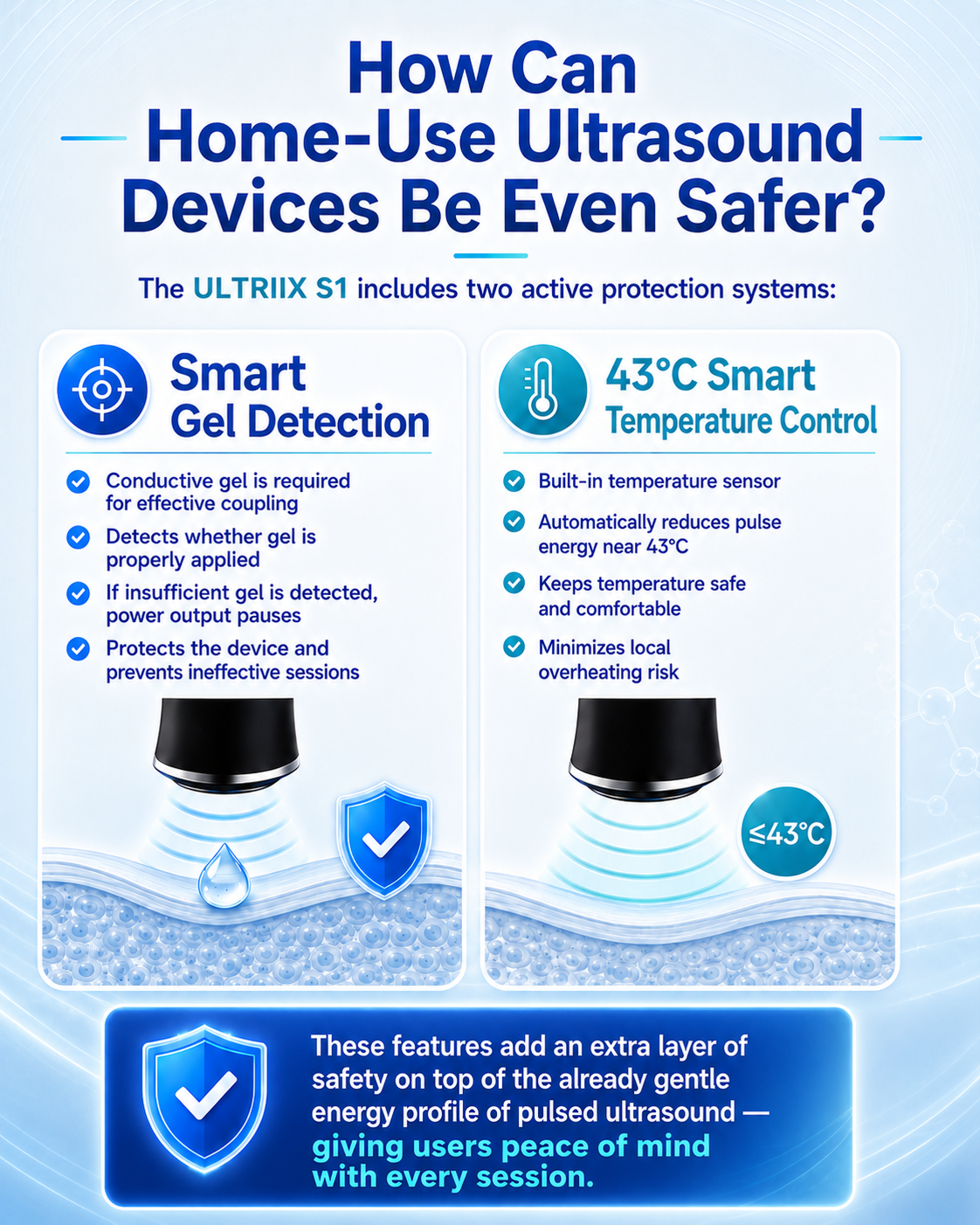
Take the ULTRIIX S1 as an example. It comes with two active protection systems:
● Intelligent Gel Detection: Ultrasound typically requires special conductive gel to transmit energy into the skin. The unit automatically detects adequate gel coverage. If insufficient gel is detected, power output will stop — both protecting the hardware and preventing ineffective sessions.
● 43°C Intelligent Temperature Control: The safe long-duration contact temperature threshold for human skin stands at approximately 43°C. Built-in temperature sensors trigger automatic pulse power reduction when the probe approaches 43°C, stabilizing temperature within a comfortable range and reducing risks of local overheating.
These safeguards build on the naturally mild energy characteristics of pulsed ultrasound, adding an extra layer of security for daily use.
5. Conclusion: There Is No “Best” Technology — Only the Right Fit
If you are a professional practitioner requiring targeted treatment of small deep tissue regions under specific conditions, LIFU delivers unique value in professional clinical environments.
However, if you are an ordinary user suffering from widespread muscle soreness, joint discomfort or fatigue recovery needs, or seeking safe, convenient at-home rehabilitation therapy, LIPUS ultrasound massage devices offer far broader applicability. They are safer, simpler to operate, and supported by clinical evidence more relevant to everyday strain recovery.
The core of ultrasound therapy is never chasing maximum energy. Under safe operating conditions, selecting the technology matching your needs and maintaining consistent use is the key to sustainable wellness results.