

For those who love tennis, badminton, or strength training, repeated swinging, force exertion, and racket gripping keep the forearm muscles in a state of high-frequency use over long periods.
Many people notice during exercise that:
● After increasing swing repetitions, the forearms tend to feel tight;
● After prolonged racket gripping, fatigue sets in around the elbow;
● After a training session, the arm muscles take a long time to relax.
These symptoms are often related to the long-term, high-frequency pulling of the forearm extensor muscles, which keeps the elbow tendon attachment area and surrounding soft tissue in a persistent state of tension and accumulated fatigue.
Many people wait until discomfort becomes noticeable before taking action. In fact, scientific intervention before and after exercise, combined with regular daily care, is more effective at maintaining healthy soft tissue and reducing the chance of recurring strain. Today, we'll share a complete at-home care routine combining the ULTRIIX S1 with stretching, organized into three scenarios.
I. Before Exercise: Ultrasound Massage First, Then Warm-Up Stretching
Before exercise, the forearm muscles and fascia are often relatively stiff. Jumping straight into high-intensity exertion subjects the tendons to strong pulling shocks, which can worsen strain.
Using ultrasound first to gently soothe deep soft tissue and improve extensibility, followed by warm-up stretching, effectively reduces the pulling load during exercise.
ULTRIIX S1 Pre-Workout Care Procedure
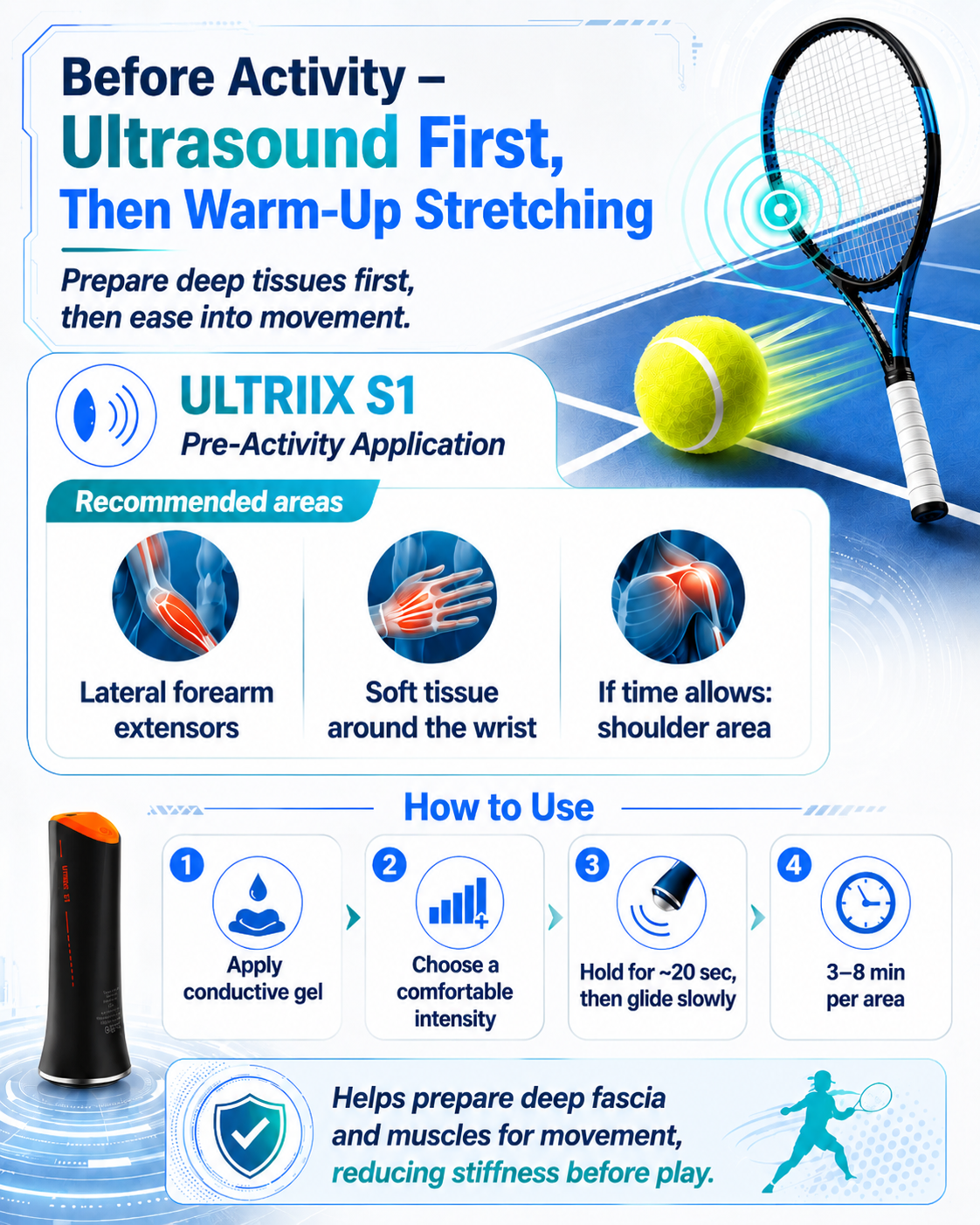
1. Application Areas
● Lateral forearm muscle group;
● Soft tissue near areas with high wrist activity;
● If time allows, we recommend using S1 on shoulder joint area
2. How to Use
● Apply the specialized gel;
● Turn on the device and select a suitable intensity level;
● Rest the device on the skin for 20 seconds to feel the intensity. Once comfortable, begin moving slowly (3–8 minutes per side). This helps deep, tight fascia and muscles enter a relaxed state in advance, preparing them for the subsequent exercise .
Warm-Up Stretching: Wrist Extensor Activation & Mobilization
① Wrist Circles Activation (Highly Recommended)
● Action: Extend your arm forward; make a fist or keep the palm relaxed; slowly draw circles with your wrist as the center; 15–20 repetitions clockwise and counterclockwise.
● Tip: Move gently and slowly. Aim for a feeling of warmth and stretch in the wrist; avoid overexertion.
② Forearm Dynamic Stretch
● Action: Extend your arm with palm facing down; slowly move the wrist up and down; feel the lateral forearm muscles gradually lengthen; 10–15 continuous repetitions.
● Key point: Keep the movement smooth; don't force it to the maximum range.
● Tip: Move gently and slowly. Aim for a feeling of warmth and stretch in the wrist; avoid overexertion.
③ Shoulder Joint Dynamic Circles
● Action: Let both arms hang naturally; roll the shoulders forward 10 times; roll backward 10 times; gradually increase the range of motion.
● Tip: Move gently and slowly. Aim for a feeling of warmth and stretch in the wrist; avoid overexertion.
④ Empty Swing Warm-Up
● Action: Without a ball; simulate forehand and backhand swings; gradually increase speed.
● Recommendation: Continue for 1–2 minutes to let the body adapt to the force patterns of tennis.
● Tip: Move gently and slowly. Aim for a feeling of warmth and stretch in the wrist; avoid overexertion.
II. After Exercise: Relieve Fatigue First, Then Static Stretching
After exercise, the forearm muscles are in a congested, fatigued state, and pressure at the tendon attachment area increases. Immediately applying heavy pressure or aggressive stretching can instead increase the burden on soft tissue.
Using Ultriix S1 first to improve local circulation and clear metabolic buildup, followed by static stretching, yields more efficient and safer relaxation.
ULTRIIX S1 Recovery & Relaxation Procedure
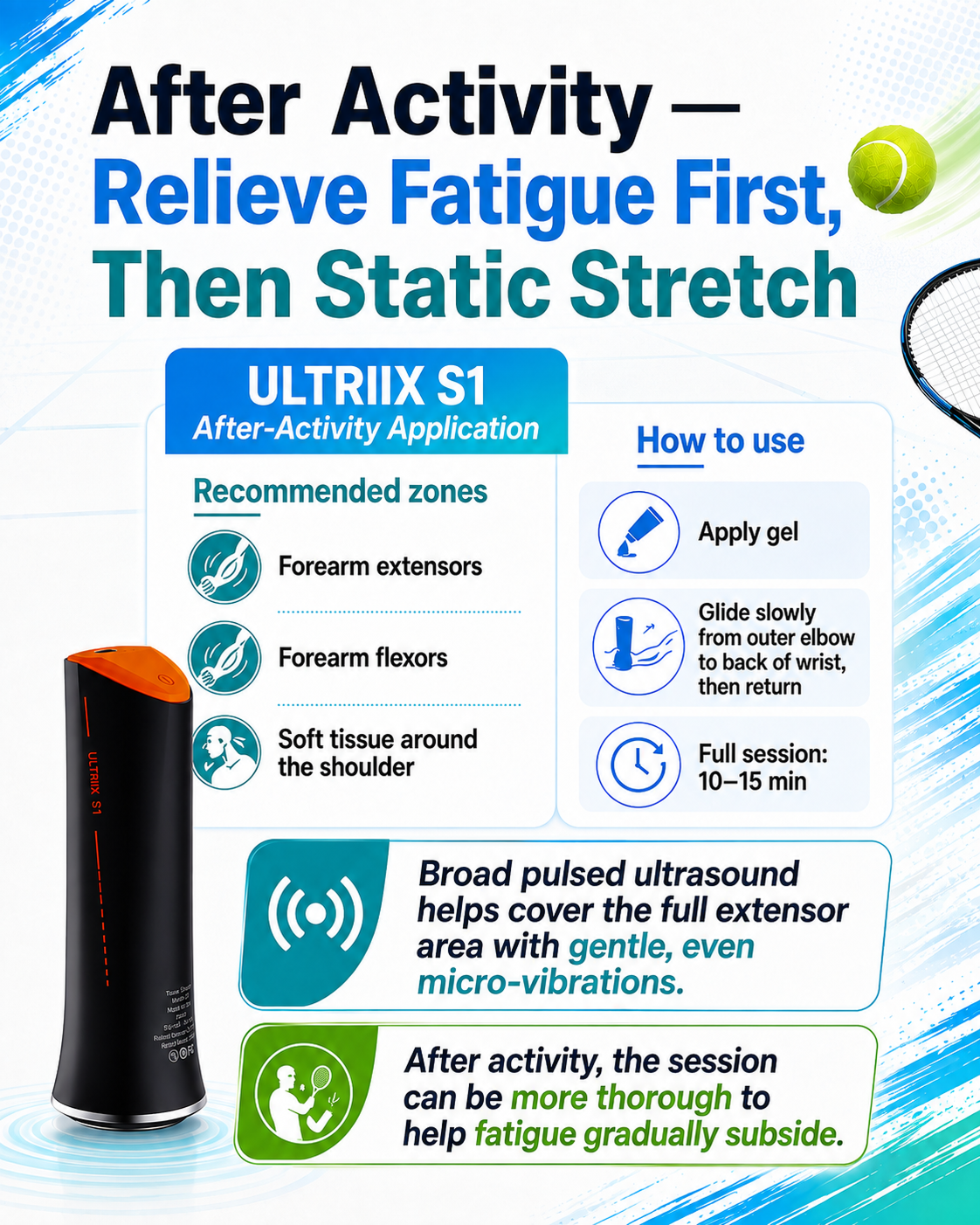
After exercise, wait for your heart rate to gradually return to a steady pace, then use the ULTRIIX S1 to relax the relevant areas.
Recommended Areas: ✅ Forearm extensor muscles ✅ Forearm flexor muscles ✅ Soft tissue around the shoulder
Usage tip:
● Apply gel to the forearm extensor muscles;
● Use the ULTRIIX S1 to slowly glide from the lateral elbow to the back of the wrist, then glide back at the same slow pace. The entire session takes about 10–15 minutes.
The wide-beam characteristic of pulsed ultrasound precisely covers the forearm extensor region, delivering a continuous, even, tingling micro-vibration sensation that helps post-workout tight muscles gradually "release." Unlike pre-workout preparation, relaxation at this stage can be more thorough, allowing fatigue in the soft tissue to gradually subside.
Static Extensor Stretching
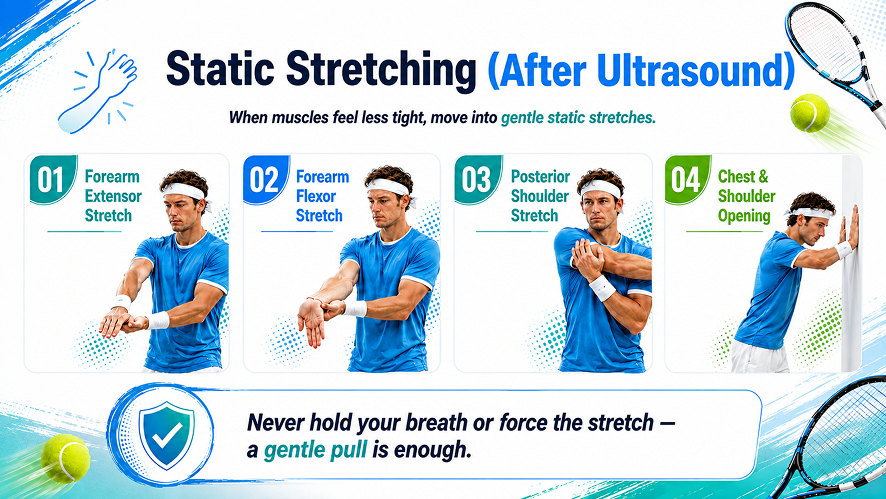
When the muscles feel less rigid and no longer unbearably uncomfortable, perform static stretches:
① Forearm Extensor Static Stretch (Key Focus)
● Action: Extend your arm; palm facing down; use your other hand to gently press the back of the hand downward; feel the stretch along the lateral forearm.
● Hold 20–30 seconds, 2 sets per side.
② Forearm Flexor Static Stretch
● Action: Extend your arm; palm facing up; use your other hand to gently pull the fingers back; feel the stretch along the inner forearm.
● Hold 20–30 seconds.
③ Posterior Shoulder Stretch
● Action: Bring one arm across your chest; use the other hand to assist and pull it closer to your body; feel the stretch in the back of the shoulder.
● Hold about 30 seconds.
④ Chest & Shoulder Opening Stretch
● Action: Place both hands on a wall; slowly lean your body forward; open the chest and shoulder area.
● Hold 20–30 seconds.
Avoid holding your breath or forcing extra pressure — a mild stretching sensation is sufficient. Many people with tennis elbow experience find that doing a round of pulsed ultrasound gliding relaxation before stretching not only makes the stretch feel more even, but also reduces the rebound of discomfort afterward.
III. Beyond Training Sessions: Long-Term Daily Care Matters
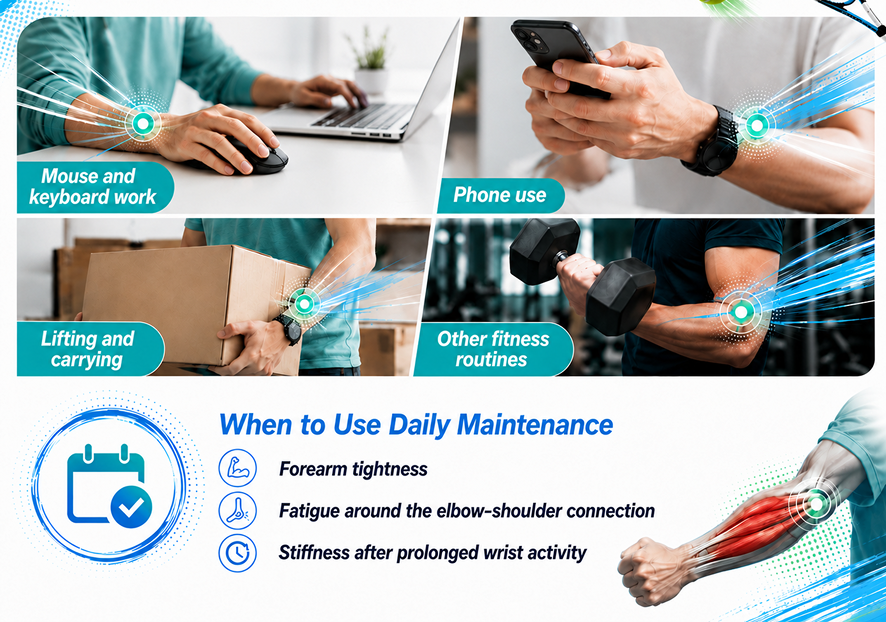
Although the exercise time is limited, our arms are engaged every day through:
● Mouse use;
● Phone use;
● Lifting and carrying items;
● Fitness training.
These repetitive movements can also keep the forearms in a state of tension. Therefore, in addition to targeted care before and after exercise, daily maintenance is equally important.
Daily Usage Scenarios
When you experience: ✔ Forearm tightness, ✔ Fatigue in the shoulder-elbow connection area, ✔ Stiffness after extensive wrist activity, you can schedule a 10–15 minute soothing relaxation session.
Use the ULTRIIX S1 to slowly glide from the lateral elbow to the upper-mid forearm. Don't rush — go at a pace that feels comfortable. Thanks to the device's dual safety protection (gel detection and temperature control), even non-professionals can operate it easily without worrying about excessive heat or incorrect technique. This daily or every-other-day "micro-relaxation" is like a gentle stretching session for your muscles — the key is preventing tension from continuously accumulating.
IV. Tennis Care Isn't Just "Press Where It Feels Off"
Many people fall into a common misconception:"If an area feels tight, just keep stimulating it."
But truly scientific athletic care requires attention to the entire movement chain.
A tennis swing involves more than just the elbow — it also includes:
● Shoulder stability;
● Forearm control;
● Wrist mobility;
● Core and lower-body force generation.
Reasonable training, adequate warm-up, post-exercise stretching, and the right supportive tools are what help the body better adapt to long-term athletic demands.
V. Summary: No Shortcuts — Only Healthy Microcirculation and Muscle Balance
Whether you're a dedicated ball-sport athlete or an office worker who often experiences stiff, aching elbows when facing the classic strain presentation of "tennis elbow", you can follow this scientific care pathway:
● Before exercise: Use pulsed ultrasound to awaken deep tissue warmth, preparing muscles before dynamic stretching;
● After exercise: Release muscle tension through static stretching and gentle ultrasound massage, supporting faster recovery;
● In daily life: Maintain a reasonable frequency of deep ultrasound physical care to reduce the risk of strain building up over time.