
Golf combines endurance and coordination. At the moment of swing, force transfers through a full-body kinetic chain. The neck and ankles act as critical stabilizers at the upper and lower ends of your body, bearing continuous yet often overlooked loads. Many golfers focus their attention on the lower back and knees, ignoring that cumulative strain in the neck and ankles can gradually hurt swing stability and reduce athletic performance. Unresolved chronic strain in these areas may turn into recurring discomfort.
This blog covers common neck and ankle troubles for golfers. We discuss injury mechanisms, movement triggers, recovery routines, and daily care with the ULTRIIX S1. It helps golfers read their body’s warning signals, build scientific pre-game prevention and post-game recovery habits, reduce neck and ankle strain, and enjoy golf safely.
Q1: Head still, torso rotating —The hidden load on your neck
A golf swing requires your head to stay in position while your torso rotates widely. The neck must resist the twisting pull from torso rotation. The upper trapezius, levator scapulae and sternocleidomastoid muscles maintain isometric contraction throughout repeated swings. Constant muscle tension reduces blood flow and builds metabolic waste, leading to stiffness and soreness when turning your head after play. Most golfers only care about backs and knees and neglect neck stress, which slowly develops into chronic neck muscle strain.
The neck is the most underrated load-bearing zone in golf swings.
Q2. Neck soreness in golfers: how to tell muscle strain apart from cervical spine problems
When your neck hurts after golf, many people blame it on stiff neck or sleeping posture. But neck load from golf swings is far more complex.
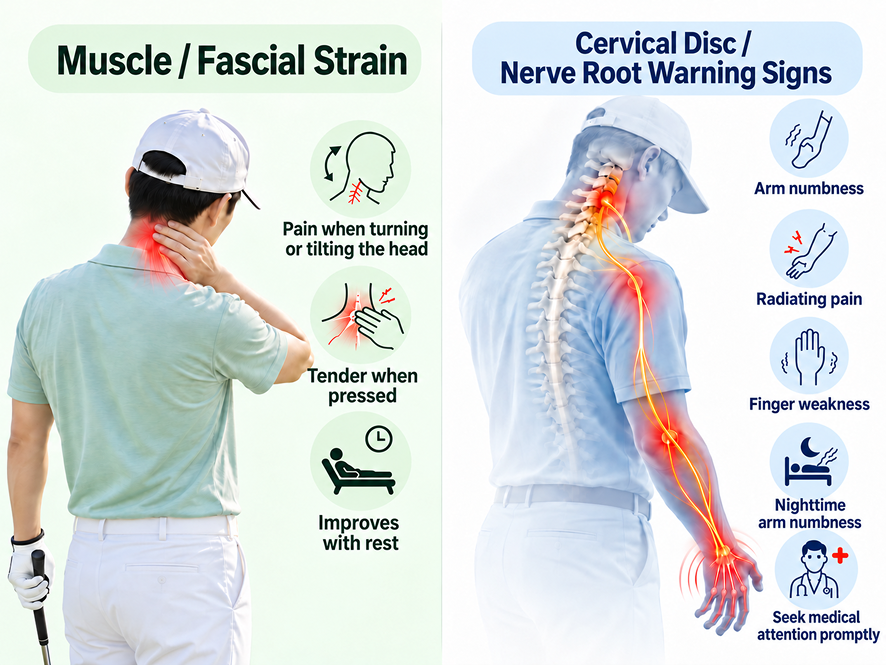
Neck discomfort comes from two distinct sources: myofascial strain, or cervical disc / nerve root issues. Simple self-check to identify your condition:
① Soreness on both sides of the neck when turning or tilting your head; pain eases with rest, tenderness when pressing muscles. This is mostly myofascial strain caused by swinging.
② If accompanied by numb arms, radiating pain, weak fingers, or nighttime arm numbness, nerve root irritation may be involved. This signals disc-related risks. Seek medical help promptly; home physical therapy is not recommended.
Q3: How does the weight transfer and hip rotation in golf swings injure the ankles?
In your golf setup, your feet maintain stability. During the downswing, weight shifts rapidly laterally from the rear foot to the lead foot. On uphill, downhill or sidehill lies, ankles resist lateral torsion. Beyond vertical weight bearing, ankles endure heavy shear stress from inversion and eversion. Repeated lateral stress fatigues the ligaments and peroneal muscles around the ankle, resulting in outer ankle soreness, ankle instability and reduced joint stability.
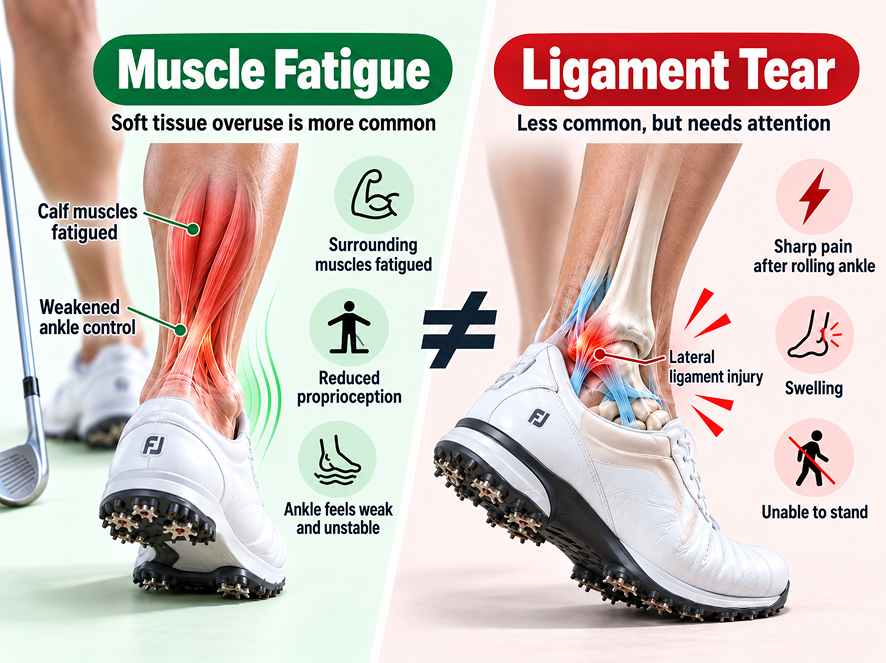
Q4: Ankle weakness and instability — Muscle fatigue or ligament tear?
Most cases are not ligament tears. Repeated lateral loading fatigues the peri-ankle muscles and impairs proprioception, weakening ankle control and creating the feeling of unstable, wobbly ankles. If there is no sharp pain, swelling or inability to stand after a sprain, the issue is usually soft tissue fatigue and strain. If you keep spraining your ankle or your leg gives way while walking, consult a doctor to check for ligament laxity and injury.
Q5: Playing often on sloped courses puts extra stress on your ankles
On sloped lies, your body sits on uneven ground. Ankles must continuously maintain balance and stay held in inversion or eversion. Ligaments and outer calf muscles stay tight, and lateral stress multiplies.
Extended play on hilly courses easily causes soreness and fatigue around the lateral ankle. Golfers with past ankle sprains will feel more discomfort. Slopes do not directly sprain ankles, but they quietly build up cumulative strain.
Q6. Post-round neck muscle strain: why we can treat the back of the neck but must avoid the front
For neck strain, the core rule is to avoid blood vessels, nerves and the spinal cord. Massage is never recommended on the front of the neck. The front neck contains carotid arteries, vagus nerves and other vital neurovascular structures; this is a high-risk zone.
Focus care on the muscle bellies at the back of the neck: upper trapezius, levator scapulae, the area from the base of your skull down to the shoulders. These muscles stay in constant isometric contraction during swings and are the main source of post-round stiffness and soreness.
Q7: How to use ULTRIIX S1 for pre-round neck pre-treatment
Pre-round pre-treatment helps reduce muscle viscosity and lowers risk of pulling injuries during swings.
After applying conductive gel, use ULTRIIX S1 over posterior neck muscles, 2‑3 minutes per side. Keep the treatment head sliding slowly at all times.
After ultrasound care, perform gentle dynamic neck movements. Avoid forceful, wide-range neck rotation.
Finish pre-treatment before starting swing practice.
Q8: How to use ULTRIIX S1 to relieve neck strain after golf, and what benefits does it bring?
Apply ULTRIIX S1 to posterior neck muscles: upper trapezius bellies and levator scapulae from the base of skull to shoulders. Apply sufficient conductive gel and slide or circle the treatment head. 3–5 minutes per side, once daily.
Area to avoid: front of the neck.
ULTRIIX S1 relaxes tight neck-shoulder muscles and indirectly reduces pulling pressure on the cervical spine. It releases muscles and fascia to reduce neck load.
① Relieve persistently tight neck and shoulder muscles
During swings, upper trapezius and levator scapulae maintain isometric contraction and often become rigid after play. ULTRIIX S1 ultrasound penetrates deep into muscles and fascia to ease spasms and stiffness, returning neck muscles from a tense state to normal.
② Improve local circulation and speed up metabolic waste clearance
Sustained neck muscle contraction compresses local blood vessels, causing ischemia and waste buildup, which leads to post-round stiffness and soreness when turning the head. ULTRIIX S1 ultrasound boosts microcirculation to flush out accumulated waste and help your neck recover faster.
③ Indirectly reduce traction stress on the cervical spine
Chronic neck muscle tension continuously pulls on the cervical spine and increases load on intervertebral discs and facet joints. Releasing posterior neck muscles reduces abnormal pulling force upstream and relieves cervical pressure.
④ Safe, gentle and non-impacting
The neck has delicate anatomy with dense blood vessels and nerves. Impact massage or heavy pressing is unsuitable.
Unlike traditional percussion devices, ULTRIIX S1 uses gentle penetrating ultrasound energy with no mechanical impact. It suits delicate areas like the neck and delivers deep, mild care for posterior neck muscles.
Q9: How to use ULTRIIX S1 for pre-round pre-treatment around the ankles
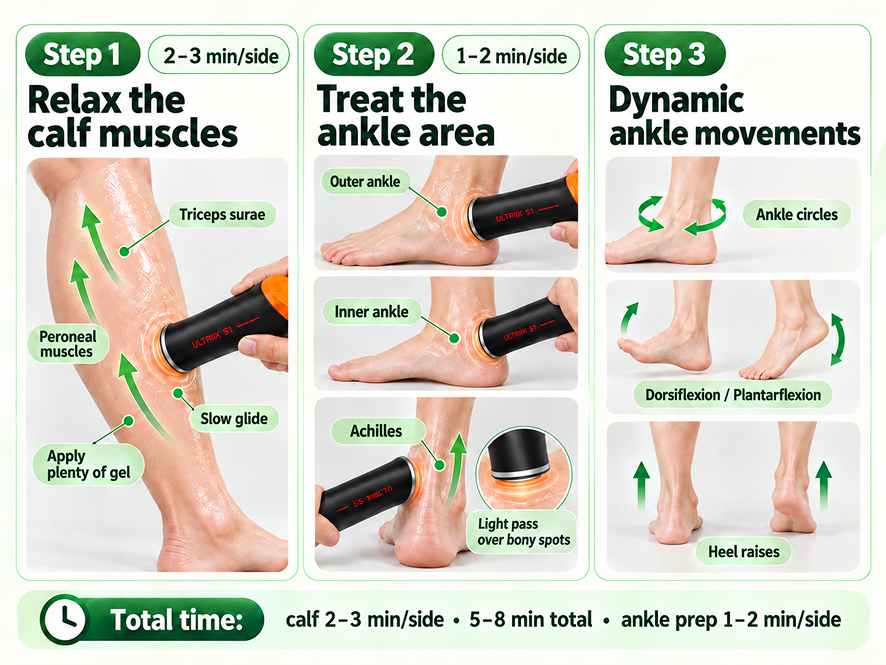
The goal of pre-round care is to relax upstream calf muscles, reduce pulling stress on ankle ligaments and improve ankle mobility. Treat calves first with ULTRIIX S1, then gently work on soft tissue around ankles, followed by dynamic ankle drills.
Step 1: Relax calf muscles (4–6 minutes)
Key regions: distal peroneus longus & brevis, triceps surae bellies
Operation: apply enough gel, slide probe slowly
Step 2: Gentle pre-treatment around ankle (2–4 minutes)
Key regions: lateral ankle (peroneal muscles, lateral ligaments), medial ankle (posterior tibial tendon), both sides of Achilles tendon Operation: slide the treatment head slowly. Glide lightly over bony protrusions of medial and lateral malleolus without lingering, so energy targets soft tissue only.
Step 3: Dynamic ankle mobility
After ultrasound pre-treatment with ULTRIIX S1, perform ankle circles, dorsiflexion / plantar flexion and calf raises to prepare ankles for movement. Recommended total duration: 2–3 minutes per outer calf, total 5–8 minutes for both sides; 1–2 minutes per ankle for peri-ankle pre-treatment.
Relax upstream calf muscles first with ULTRIIX S1 to lessen pull on ankle ligaments. Next, gently stimulate peri-ankle soft tissue. Finally, dynamic movements complete pre-game conditioning. Combined, these steps help your ankles stay stable and flexible before tee-off.
Q10: How to use ULTRIIX S1 for ankle strain after golf
After your round, lightly stretch peroneal muscles and tissue around the Achilles tendon first, then use ULTRIIX S1 for ultrasound recovery.
Relax calf muscles upstream to “unbind” and reduce persistent muscle traction on ankle ligaments. Treat soft tissue surrounding the ankle afterward for longer-lasting results.
Focus on outer and posterior calf bellies: peroneal muscles, gastrocnemius and soleus. Then work on tissue around lateral ankle (peroneal muscles, lateral ligaments), medial ankle (posterior tibial tendon) and both sides of Achilles tendon. Apply adequate gel, slide or circle the treatment head slowly and evenly on skin. Glide gently over medial and lateral malleolus bone bumps, keep energy focused on soft tissue and target muscles and ligaments. 5–8 minutes per calf, total 10–16 minutes for both legs.
ULTRIIX S1 ultrasound therapy relaxes tight calf muscles, reduces constant pull on ankle ligaments, improves local circulation and speeds up metabolic waste removal, easing post-round ankle soreness and fatigue.
Q11: Poor swing habits worsen neck strain
① Rigidly locking your head with excessive force, keeping neck muscles under extreme tension;
② Overshouldering on backswing, torso rotation exceeding neck tolerance;
③ Lifting your head too early to track the ball, frequent head movement during swings;
④ Swing only with arms, insufficient torso rotation so all twisting stress transfers to the neck. These habits amplify pulling load on neck muscles and increase post-round neck stiffness and soreness.
Q12: Can ankle braces or neck supports enhance protection?
● Ankle braces: golfers with past sprains or poor ankle stability may wear thin supportive braces on slopes to limit excessive inversion/eversion. Healthy golfers should avoid long-term use, which weakens calf muscles through disuse.
● Neck collars: not recommended during golf. They restrict torso rotation and alter swing mechanics, adding extra strain to knees and lower back. Neck protection relies primarily on improved swing technique and pre-game muscle release, not rigid bracing.
Q13: Can ULTRIIX S1 neck care be combined with cervical traction or other physical therapies?
✅ They may be used separately, but never simultaneously.
1. Do not use ULTRIIX S1 while receiving cervical traction. Traction changes cervical structure and soft tissue tension. Adding ultrasound energy at the same time raises risks of discomfort or dizziness.
2. Recommended interval: at least 30 minutes apart. Traction first, rest for a while then use S1 to release tight posterior neck muscles; or use ULTRIIX S1 first and wait before traction.
3. Other physical therapies (heat, infrared, EMS) should also be applied separately, not at the same time.
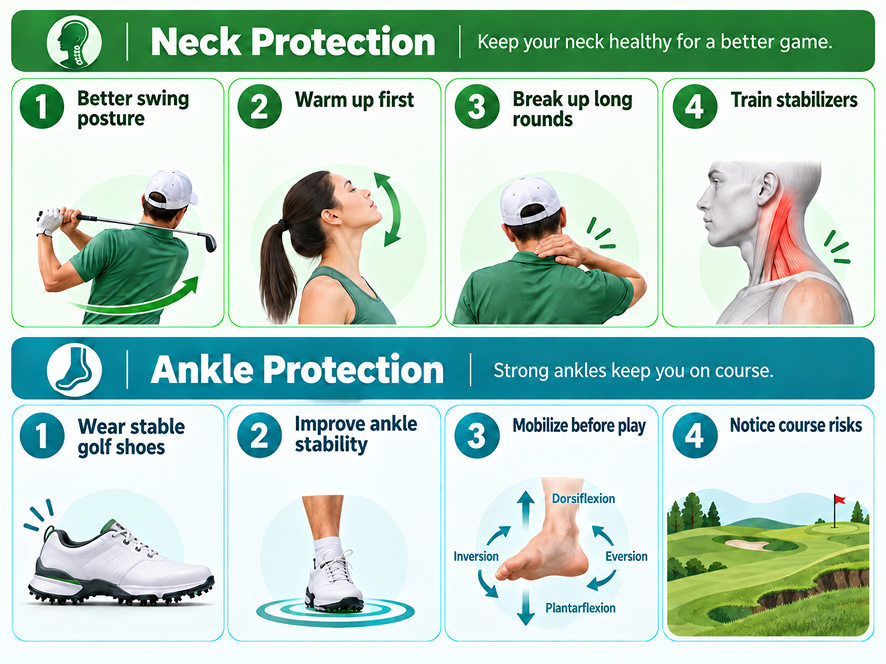
Q14: Beyond ULTRIIX S1 care, what are key protection tips for golfers’ necks and ankles?
✅ Neck protection tips
1. Maintain proper swing posture and avoid neck compensation
Do not rotate your neck alone during swings; rotate from the thoracic spine. Many golfers lack shoulder rotation and twist their neck forcefully, causing neck strain and high facet joint pressure. Keep your head steady at impact and avoid early head lifting.
2. Pre-round warm-up + post-round stretching
Before tee-off: thoracic rotation, scapular mobility and gentle neck stretches; avoid powerful swings without preparation. After play: release upper back, upper trapezius and suboccipital muscles to ease constant neck tension from static posture.
3. Limit single-round duration and take breaks
Long periods of looking down at the ball and holding fixed posture build continuous neck pressure. Pause for short breaks every few holes and mobilize your neck and shoulders.
4. Stabilizing muscle training daily
Focus on deep neck flexors and middle/lower trapezius to fix rounded shoulders and reduce compensatory neck tension.
✅ Ankle protection tips
1. Choose proper golf shoes
Pick shoes with good traction and stable arch support. Avoid overly soft, unsupported soles that allow ankle inversion/eversion injury during weight transfer.
2. Weight transfer drills for ankle stability
Golf swings require shifting weight between feet. Strengthen peroneal muscles, foot intrinsics and calves to improve ankle proprioception and reduce sprain risk. Try single-leg stands and calf raises.
3. Fully mobilize ankles before play
Perform ankle dorsiflexion, plantar flexion, inversion and eversion to loosen the talocrural joint. Do not expose stiff ankles to sudden swing impact.
4. Watch for course hazards
Be careful of uneven fairways and rough ground. Uphill or downhill shots add extra lateral stress to ankles; slow down and adjust your stance.
Q15: Can chronic neck strain recover merely with rest?
Rest alone only temporarily relieves pain.
If your underlying swing mechanics remain unchanged, neck muscles keep enduring abnormal pulling force. Returning to golf easily creates a vicious cycle: pain → rest → pain.
Break this cycle with a three-stage intervention framework:
● Optimize swing biomechanics first;
● Apply ULTRIIX S1 for deep soft tissue care before and after rounds;
● Targeted strengthening of core neck-shoulder stabilizers.
Only combining all three delivers long-term protection.
Q16: What safe strengthening exercises are suitable for a golfer's Neck — And what should be avoided?
✅ Safe recommended exercises:
Low-load neck-shoulder isometric holds:
press your hand lightly against your forehead, back or sides of your head, apply gentle neck resistance for 5–10 seconds, repeat 8–10 times. Goal: activate deep neck stabilizers, not maximize raw strength.
Middle/lower trapezius training: prone Y-T-W, resistance band rows, scapular retraction. Strengthen scapular stability and indirectly reduce upper trapezius over-tension.
Scapular stability drills: wall angels, band external rotation. Improve neck-shoulder linkage and reduce isolated neck loading.
Isometric neck holds and scapular work create mild fatigue in posterior neck muscles (upper trapezius, levator scapulae). Without timely release, accumulated tension causes stiffness and chronic strain. After each training session, glide ULTRIIX S1 slowly over the back of the neck for 3–5 minutes. It relaxes tight muscles and improves circulation, so neck training protects your cervical spine rather than creating new strain.
❌ Exercises to avoid:
Heavy weighted neck work: weighted neck flexion/extension, neck machine training. Most golf neck injuries stem from excessive muscle pulling, not insufficient strength.
Forceful neck manipulation, fast neck whipping: high risk of muscle strain, facet joint dysfunction and nerve irritation. Heavy loaded wide-range neck rotation: shearing stress on cervical facet joints and discs.
Golf neck care does not require brute force. Endurance and postural stability are the priority. Low load, high repetition and slow pace are the safest training style matching swing demands.
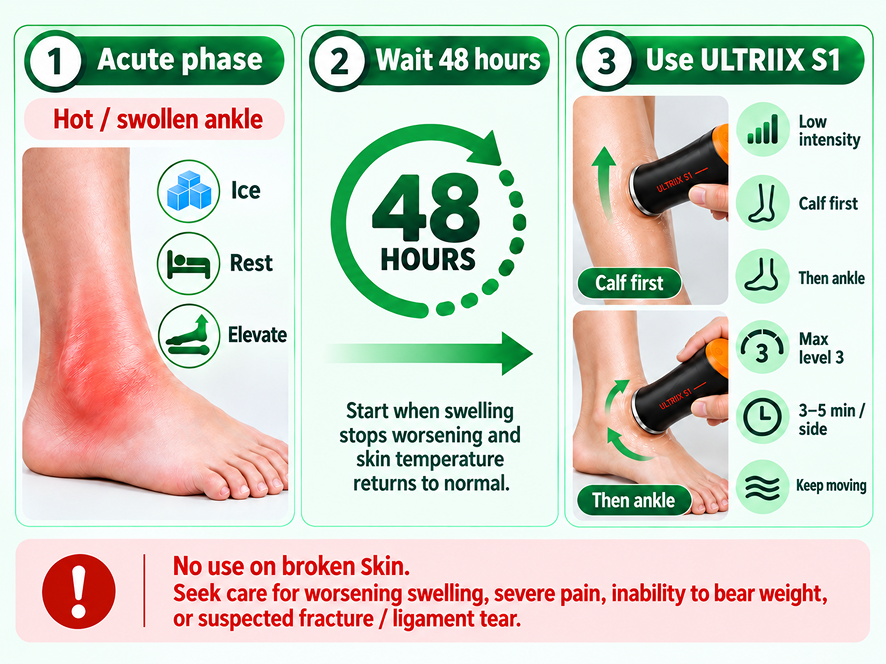
Q17: Can I still use ULTRIIX S1 if my ankle is swollen and hot after golf?
We do not recommend using it immediately.
Acute swelling and warm skin mean the acute inflammatory phase. Prioritize: ice, rest, elevate limb. Wait 48 hours until swelling stops worsening and skin temperature returns to normal, entering the subacute phase before using ULTRIIX S1.
Usage guidelines:
1. Start on low power levels
2. Treat calf muscle bellies first, then gently move to peri-ankle soft tissue
3. For areas with obvious swelling but no broken skin, do not use the ULTRIIX S1 above level 3
4. 3–5 minutes per side, keep slow gliding movement
Notice:
● Do not use ULTRIIX S1 on broken skin.
● If swelling continues to worsen, pain is severe, weight bearing is impossible, or fracture / ligament tear is suspected, seek medical help immediately and do not self-treat.
Q18: How can golfers with a history of ankle sprains reduce recurrence risk?
Golfers with old ankle sprains usually have chronically tight peroneal calf muscles. Abnormal muscle tension constantly pulls on the ankle. The ankle stays under traction during swings and walking, reducing stability and raising re-injury risk.
Pre-round full activation: relax calf and peri-ankle soft tissue first, then perform dynamic ankle drills. Get ankles stable and flexible before tee-off.
Choose suitable footwear: golf shoes with good traction and solid support to reduce lateral sliding on slopes and uneven ground.
Strengthen calves and ankle stabilizers: daily low-load drills such as calf raises, resistance band inversion/eversion, single leg stands to improve dynamic ankle stability.
Consistent home care with ULTRIIX S1: glide over outer calf bellies, peri-ankle tissue and Achilles tendon. Reduce muscle stiffness, improve circulation, ease compensatory pulling on ligaments and relieve daily soreness.
Q19: What neck and ankle symptoms means you must stop playing and seek medical consultation?
Neck:
① Neck pain with arm numbness, radiating pain, finger weakness;
② Frequent dizziness during swings or head rotation;
③ Limited movement after neck impact.
Ankle:
① Repeated ankle sprains, leg buckling even on flat ground;
② Persistent ankle swelling that does not fade after days of rest;
③ Severe pain every time you bear weight.
These signs suggest structural injury risk. Stop playing. Do not rely only on home therapy. Consult a sports medicine physician promptly for assessment.
Conclusion
Smooth swings rely on stable support at both ends of your body. Neck and ankle care is not just for pain relief after injury; it depends on long-term consistency: good swing habits, pre-round warm-up, post-round release and strength maintenance.
ULTRIIX S1 is a portable deep soft tissue care device for post-workout relaxation, daily muscle maintenance, joint soft tissue care and home-assisted recovery. ULTRIIX S1 helps activate muscles and soft tissue before golf, relieves post-play muscle tightness and fatigue, releases deep muscles and fascia and improves local circulation. However, stop activity and seek professional medical evaluation for structural injuries. Protect yourself wisely and play within your limits. You can maintain steady swings and enjoy golf for years to come.