
There is a famous saying in badminton:"70% legs, 30% arms". The lower body is the core power source of the whole game. As the key junction connecting hips, knees and calves, thighs bear the full load of initiation, rotation, lunging, sudden stops, take-off and landing. Compared with upper-body injuries to shoulders, elbows and wrists, thigh strain is often overlooked by players. Most athletes only notice soreness after playing, without understanding the root of pain, faulty movement patterns or recovery methods.
Badminton involves frequent single-leg lunges, explosive push-offs, landing impact after jump smashes, and rapid direction changes. Quadriceps at the front of thighs, hamstrings at the back, adductors on the inner side and tensor fasciae latae on the outer side repeatedly endure eccentric contraction, stretching and impact loads. Long-term incorrect movement, insufficient warm-up, inadequate post-play recovery and muscle imbalance can trigger muscle soreness, stiffness, strains and tendon overuse injuries. These issues not only reduce mobility and hitting stability, but may also lead to secondary compensatory pain in knees and lower back.
This blog summarizes common thigh problems after badminton training and matches. It delivers comprehensive, scientific and easy-to-understand explanations covering pain triggers, movement mistakes, injury identification, preventive training and post-exercise care. It helps badminton players reduce risks of thigh injuries, build healthy training habits and enjoy badminton sustainably.
1. Front of Thighs: The Hardest-Working Muscles on Court
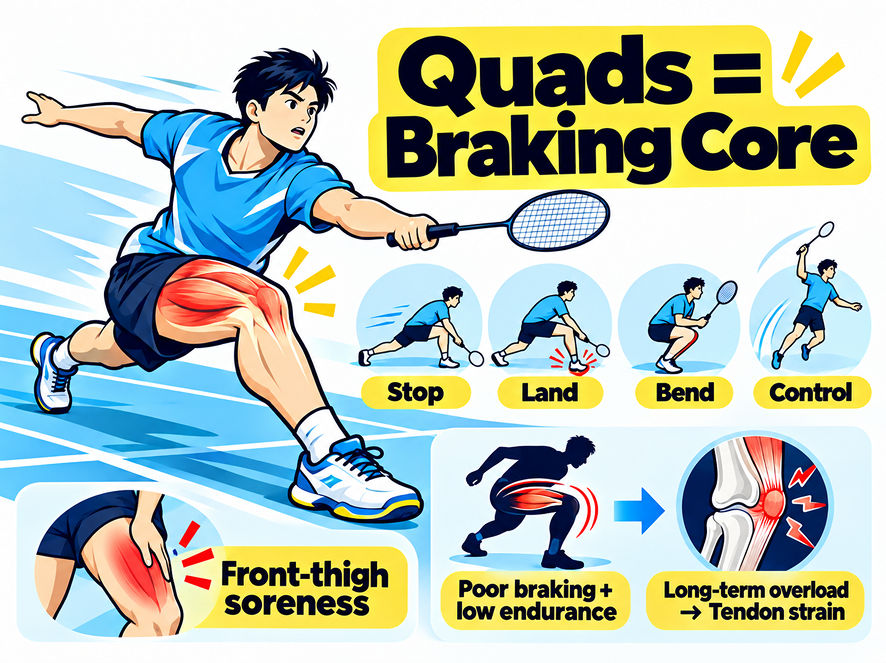
The quadriceps are your braking core in badminton. Sudden stops, landing after lunges, knee flexion cushioning and body stabilization during jumps all rely on eccentric contraction of quads. Especially during wide net lunges and landing after defensive backcourt recovery shots, the quadriceps of one leg absorb impact multiple times your body weight and stay under constant tension. Most amateur players have improper braking patterns and poor muscular endurance, which explains why front-thigh soreness is common after games. Over time, this may lead to quadriceps tendon strain.
2. Soreness Only on One Thigh? The Cost of Unilateral Movement in Badminton
Badminton is a unilateral sport. The racket-side thigh carries most of the load during lunging, braking and rotational push-off, making it more prone to soreness. Key reasons are listed below:
1. Lunging load concentrated on racket-side leg
For net lift reception, forehand backcourt recovery and landing after forehand smashes, the racket leg serves as the front supporting leg in most long lunges. At landing, quadriceps contract strongly to stabilize the body and absorb impact. During lateral movement to defend smashes, thigh adductors on the racket side continuously tense to stabilize the pelvis. Repeated stretching creates micro-tears and soreness.
2. Compensatory rotational load on racket-side thigh
Power generation for clears and smashes starts from push-off of the racket leg. Many amateur players fail to fully rotate from the hip. Power cannot transfer smoothly to the torso and upper limbs, forcing the racket-side thigh to compensate. Muscles stay under high tension for extended periods, worsening fatigue and stiffness.
3. Weight bias & postural imbalance
Players tend to shift weight toward the racket side with slight pelvic tilt. Muscles of the racket-side thigh constantly engage to maintain balance, while the non-racket leg mainly assists initiation. Over time, strength and tension imbalance develop between two legs. Soft tissues on the racket side build up tension and fascial nodules easily.
4. Concentrated pressure upon landing
Landing after forehand jump smashes or defensive backcourt shots usually lands first on the racket leg. Landing without knee bending for shock absorption puts massive instantaneous load on quads and hamstrings, resulting in severe soreness afterward.
✅ Tips for Improvement & Post-Game Care
Add lower-body strength training for the non-racket leg to narrow strength gaps between sides. Control lunge range during play and avoid overextending the racket leg. After playing, use ULTRIIX S1 to focus on the racket-side thigh (quadriceps, hamstrings, adductors) for soft tissue care. Spend 3–5 minutes per region to relieve muscle spasms and fascial adhesions and reduce accumulated strain.
3. Severe thigh soreness that makes stair descent painful the next day: Is it normal?
This is mostly Delayed Onset Muscle Soreness (DOMS). Occasional cases are understandable, yet it is not an ideal training state. We need to tell the difference between scenarios.
Cause: Wide lunges, sudden stops and jump landings in badminton trigger heavy eccentric contraction of quadriceps and hamstrings, creating tiny micro-tears in muscle fibers. If you return to intense play after a long break or push far beyond your usual volume, soreness peaks within 24–48 hours post-training. Squatting, standing up and walking become painful; descending stairs is extra tough because quads keep contracting eccentrically to control movement.
✅ DOMS vs Muscle Strain
● DOMS: Diffuse aching over a broad area, no sharp pinpoint pain. Pain occurs with active movement, while rest brings almost no discomfort. No swelling or bruising. Symptoms gradually ease in 3–5 days.
● Muscle Strain: Sharp tearing pain emerges during movement with a fixed tender spot. Local swelling may appear; pain persists both while moving and resting. Recovery takes much longer. Rest and professional assessment are recommended.
Risk Warning
Frequent severe DOMS that limits daily stair walking means training load exceeds your lower-body tolerance. Repeated heavy DOMS speeds up fascial tightness and accumulation of soft tissue micro-damage. In the long run, tendon irritation and higher risk of thigh strains may occur.
✅ Management & Recovery Advice
1. Do not force deep stretching or continue playing in the acute phase. Light low-intensity activity such as slow walking helps blood circulation.
2. Once pain eases, use ULTRIIX S1 to care for sore muscle groups including quads, hamstrings and adductors. 3–5 minutes per area to relax tight soft tissue, speed up waste metabolism and reduce stiffness and soreness.
3. Long-term adjustment: Avoid sudden high-intensity sessions. Complete dynamic thigh warm-up before play. Progressively increase training volume and build lower-body strength to improve muscle tolerance.
4. Prevention: Do not sit down immediately after playing. Combine static stretching and ULTRIIX S1 deep soft tissue care to reduce the chance of severe DOMS the next day.
4. Sudden thigh weakness during play: Fatigue or chronic strain?
Two main scenarios:
1. Fatigue-related weakness: After long high-intensity running, thigh muscle glycogen depletes and muscle fibers become over-fatigued. This is a normal physiological response and resolves with rest.
2. Strain-related weakness: Chronic tendon and muscle damage reduces soft tissue elasticity so tissues cannot handle explosive force. Symptoms include slow initiation, poor lunge power and weak jumps accompanied by dull stiffness. This is an injury warning sign; continuing high-intensity play greatly raises strain risk.
5. How to distinguish regular muscle soreness from muscle strain?
The core differences lie in pain characteristics, movement response and recovery speed.
Normal post-exercise soreness: Diffuse aching, mild tenderness upon palpation, no pain at rest, slight discomfort with active movement. Resolves spontaneously within 3–5 days without hardened nodules.
Muscle strain: Sharp tearing pain at the moment of force application, fixed tender spot. Walking, knee bending and lunging trigger pain. Severe cases come with swelling and hardened knots. Pain does not fade quickly after rest and worsens with continued activity. It refers to acute tearing of muscle fibers.
6. Can badminton cause thigh tendinitis? What are the symptoms?
Yes, it is a common chronic overuse injury among amateur players. Repeated push-off, lunging and braking create continuous friction and pulling at muscle-tendon junctions of thighs, leading to aseptic inflammation. Common sites include distal quadriceps, proximal hamstrings and inner thigh tendons.
Typical symptoms: Stiffness before play that eases slightly once warmed up, persistent dull pain mid-to-late game, stiffness after prolonged sitting, obvious tenderness at tendon attachment points. Pain worsens with repeated loading and may develop into stubborn chronic strain without intervention.
7. Hard lumps in thighs: Muscle nodules or fascial adhesions?
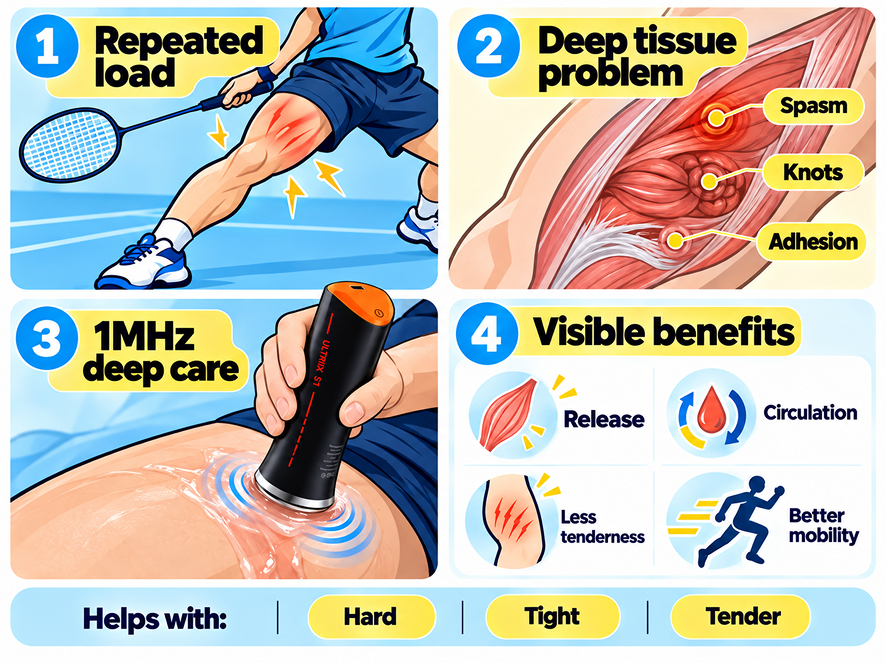
Most badminton players experience both muscle nodules and fascial adhesions at the same time. Repeated movement keeps muscles in sustained spasm, forming hardened muscle nodules. If players only perform simple stretching after training, deep fascia and tendons remain tight while metabolic waste accumulates, resulting in fascial adhesions. Signs include hardened thigh texture, tender lumps, tightness during running and limited range of motion.
Superficial static stretching cannot resolve deep fascia and tendon strain. ULTRIIX S1 can be applied for deep soft tissue care. Pulsed ultrasound penetrates deep under skin to release tight muscle nodules, reduce fascial adhesion, boost local circulation and ease tenderness, improving stiffness and limited mobility. Deep tissue care helps relieve hardened thigh lumps effectively.
8. Why improper push-off patterns hurt thighs the most?
Proper badminton rotation relies on “hip-driven movement, core force transfer and coordinated lower-body engagement”. Force distributes evenly across hips, knees and core. Many amateur players rotate insufficiently from hips and purely rely on thighs for push-off. All explosive load concentrates on thigh muscles and tendons. Muscles stay rigid without proper shock absorption, and rigid impact during push-off and landing rapidly creates micro-tears and tendon strain. This is the primary cause of chronic thigh soreness.
9. 5 High-Risk Habits Leading to Thigh Strain in Badminton
① Start high-intensity running and jump smashes without dynamic warm-up; cold muscles bear explosive load directly.
② Over-wide lunges and knee hyperextension at landing, forcing thigh muscles into extreme braking stretch.
③ Forced movement during defensive recovery with imbalanced posture, causing unilateral thigh overload.
④ Constant muscle tension throughout play; muscles never relax between strides and braking.
⑤ Continuous heavy training without rest, allowing micro-damage to pile up.
10. Singles vs Doubles: Which carries higher thigh strain risk?
Singles has significantly higher strain risk. Singles requires full-court running, frequent sudden stops and direction changes plus long-distance defensive lunges. Thighs keep working hard for braking, stretching and pelvic stabilization at high intensity. Doubles mainly involves short bursts, fixed-point explosive movement and quick transitions, with smaller movement range and lower braking load on thighs. Players doing singles are therefore more susceptible to thigh stiffness, soreness and strain, with higher chance of secondary knee discomfort.
11. Complete Pre-Game Warm-Up Routine Prioritize dynamic warm-up before play
The goal is to raise muscle temperature and improve soft tissue extensibility, preventing sudden tensile load on cold muscles and lowering risks of thigh strain and tendon injury.
✅ Total warm-up duration: 5–10 minutes
Complete Warm-up Routine
1. Pre-warm-up relief with ULTRIIX S1 (2–3 minutes per muscle group)
Before playing, use ULTRIIX S1 with conductive gel on your quadriceps, hamstrings and adductors. It helps reduce baseline muscle tension and improve soft tissue flexibility for smoother dynamic warm-up and greater range of motion.
If your thighs feel stiff or you still have soreness from the previous day, spend an extra 1–2 minutes on tight areas.
2. Light aerobic warm-up (1–2 min) Jog in place and high knees to raise body temperature and boost blood flow in lower limbs.
3. Thigh-focused dynamic drills (core section)
● Butt kicks: Activate hamstrings at the back of thighs
● Side shuffles and side lunges: Mobilize inner thigh adductors and simulate lateral defensive movement
● Alternating forward lunges + rotation: Simulate court lunges and rotational push-off; activate quads and hips
● Small jump-and-land drills: Practice eccentric braking of thighs and adapt to landing shock absorption
4. Full-chain shadow swings (1 min) Simulate rotational swings for clears and smashes, fully activating the power chain from lower body, core to upper limbs to pre-adapt your movement pattern.
12. Stretching thighs after badminton is not enough
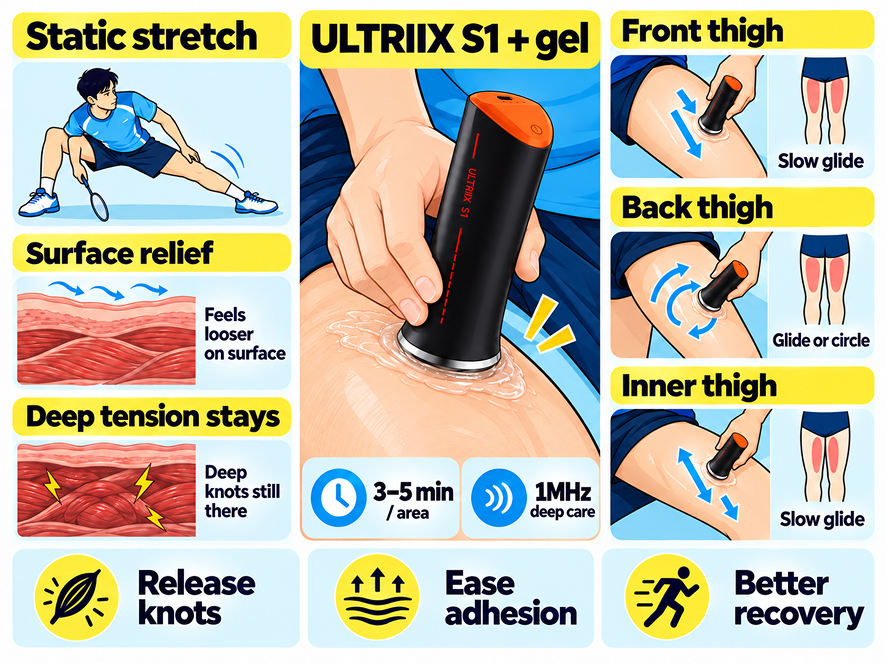
Regular static stretching only lengthens superficial muscles and eases immediate tightness. It cannot address micro-damage in deep muscle fibers, fascia and tendons. Most thigh strain from badminton comes from chronic pulling, spasm and adhesion in deep soft tissues. Stretching alone can only relieve surface discomfort and fails to heal accumulated chronic damage. If you only stretch without deep tissue care, strain will worsen gradually and turn into constant stiffness even at rest.
✅ Complete Post-Game Recovery Protocol: Static Stretching + Deep Soft Tissue Care with ULTRIIX S1
After static stretching, use ULTRIIX S1 with coupling gel on thigh muscle groups, 3–5 minutes per region:
● Quadriceps (front thigh): Large muscle area. Move the applicator slowly and evenly across the whole muscle belly, focusing on tight areas built up from braking and sudden stops.
● Hamstrings (back thigh): Work on the mid-section of posterior thighs. Slide or circle the applicator following muscle fibers to ease tightness from rotation and backward defensive recovery.
● Adductors (inner thigh): Release fascial tightness from lateral lunges and smash defense with slow sliding movements.
Combining ULTRIIX S1 deep fascial release with static stretching helps reduce accumulation of post-exercise micro-trauma and lowers recurrence risk of chronic strain.
13. Can I keep playing badminton during thigh strain?
Judge by severity:
1. Mild strain: Only soreness after play, no pain during movement, no hardened nodules. Reduce training intensity, limit long lunges and explosive jumps. Use ULTRIIX S1 after play for deep tissue care to relieve fatigue and fascial tension for gradual recovery.
2. Moderate strain: Dull pain during play, stiffness after sitting, tightness with force application. Pause high-intensity matches and full-court running; only basic skill drills are allowed. Focus on recovery. Use ULTRIIX S1 daily, sliding slowly along anterior, posterior and inner thigh bellies to release tight muscles and improve circulation.
3. Severe strain: Sharp pain with loading, discomfort walking, obvious tenderness. Stop training completely to avoid secondary injury. Return only after full soft tissue recovery. Once out of acute phase, start ULTRIIX S1 at low power levels targeting thigh muscle bellies to support recovery.
14. How to reduce the risk of recurring thigh strain?
Four core strategies for lasting protection:
① Fix movement patterns
Avoid over-reliance on thigh compensation. Learn hip-and-core driven rotation to distribute load across lower limbs.
② Stick to pre-game dynamic warm-up and staged post-play recovery
Never exercise cold muscles and do not neglect deep tissue strain. Activate muscles with dynamic warm-up and ULTRIIX S1 before play. After play, perform static stretching first, then ULTRIIX S1 deep soft tissue care to relax fascia and boost circulation, preventing fatigue buildup overnight.
③ Regular lower-body strength training
Fix strength gaps and unilateral imbalance to improve muscle cushioning and tolerance. Use ULTRIIX S1 for deep release after strength training to eliminate fatigue and fascial strain.
④ Control training intensity and avoid fatigued play
Rest promptly when muscles feel stiff or sore. Apply ULTRIIX S1 to related muscle groups for deep relaxation to ease spasms and improve circulation, stopping micro-damage before it accumulates.
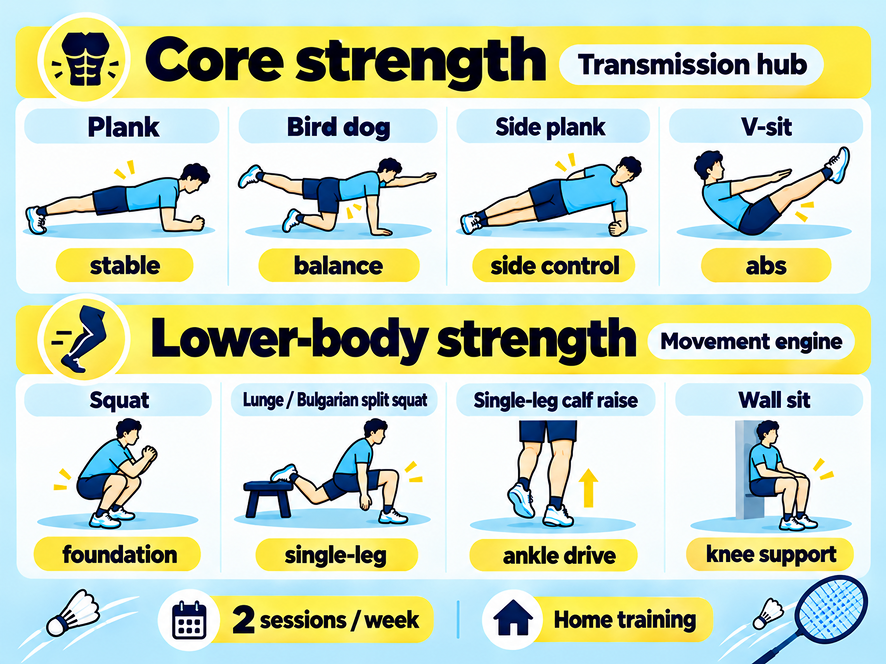
15. How to build core and lower-body strength for badminton?
Badminton follows the principle of “70% legs, 30% arms”. Core and lower-body strength directly determine court mobility, hitting stability and injury risk.
🛡️ Core Strength: The Power Transfer Hub
Core muscles stabilize your torso during fast movement and rotational swings, transferring power from lower limbs to arms.
Plank: Fundamental exercise for abdominal, back and shoulder endurance, improving stability for diving saves. Keep core braced; ears, shoulders, hips, knees and ankles in one straight line.
Bird-dog: On all fours, extend opposite arm and leg simultaneously. Great for training anti-rotation core stability, mimicking balance during rotational hitting.
Side plank: Strengthen obliques and hip muscles, improving control during lateral movement and sudden stops.
Supine double leg & upper body raise (V-hold): Lie supine and lift upper body and legs together to train coordinated contraction of upper and lower abdominals.
🏋️ Lower-Body Strength: Engine of Court Movement
Lower-body strength defines starting speed, lunge range and landing stability. The exercises below can be done at home, recommended twice weekly:
Bodyweight squat: Feet shoulder-width apart, squat until thighs parallel to ground. Key movement to build foundational leg and glute power. Keep knees tracking over toes, avoid knee valgus.
Lunge / Bulgarian split squat: Simulate lunging on court, build unilateral stability and strengthen quads and glutes. Do not let front knee overshoot toes too much; keep weight on front foot.
Calf raise: Target calves and ankles, improve push-off efficiency and landing stability. Perform on a step to increase range of motion.
Wall sit: Limited for maximal strength gain, yet greatly enhances knee support during extreme lunge landing, classic knee-protection drill. Knees form roughly 90°, do not go past toes.
💡 Training Guidelines
Frequency & duration: Train 2–3 days weekly, 40–60 minutes per session; daily training is unnecessary.
Warm-up & stretching: Spend 5–10 minutes on dynamic warm-up before strength work (jumping jacks, hip circles). Static stretching after training is more critical for injury prevention than the workout itself.
Progression: Hold onto a wall for balance if Bulgarian split squats feel unstable. Start with bodyweight only; do not rush to add load.
🛠️ Post-strength-training care with ULTRIIX S1
Resistance training creates minor fatigue and tightness in core and lower-body muscles. Without timely release, accumulated tension leads to stiffness and chronic strain over time. After each strength session, use ULTRIIX S1 and slide slowly over anterior, posterior, inner thigh and glute muscles. It relaxes deep fascia, improves circulation and speeds up metabolic waste removal.
Conclusion
Thighs are the fundamental power base in badminton. Although running seems simple, thighs absorb most of the game’s mechanical load. Most players’ knee discomfort, slow movement and lower-back compensatory pain stem from thigh muscle strain, strength imbalance and faulty movement patterns.
Sports injuries in badminton rarely happen overnight. They accumulate from neglected warm-up, improper technique and insufficient recovery. Thigh soreness, stiffness and discomfort are warning signals your body sends. To enjoy badminton long-term, you cannot only chase better skills and competitive thrills. Soft tissue care and strength training for lower limbs matter equally.
With scientific warm-up, proper movement patterns, deep post-game recovery and regular strength training, you can reduce recurring thigh strain, boost mobility and explosive power on court, stay free of pain and enjoy badminton comfortably and healthily for years.