

During a golf swing, the shoulder joint has one of the largest rotational ranges of motion. From the top of the backswing through follow-through and finish, the shoulder undergoes extensive rotation. The rotator cuff tendons are repeatedly subjected to tensile and compressive mechanical stress throughout this movement. Over time, this cumulative load often leads to subacromial impingement and tendon inflammation. Most of these issues are overuse injuries, not caused by a single traumatic incident.
Shoulder injuries are rarely “broken in one swing”; they build up shot by shot.
To protect your shoulders long-term, it is essential to understand the shoulder load generated by the swing, recognize early warning signs of pain, complete pre-round activation and post-round recovery, and build strength to improve scapular stability and reduce compensatory movement, lowering the risk of sports injuries.
1. Are shoulder injuries identical on the left and right sides for golfers?
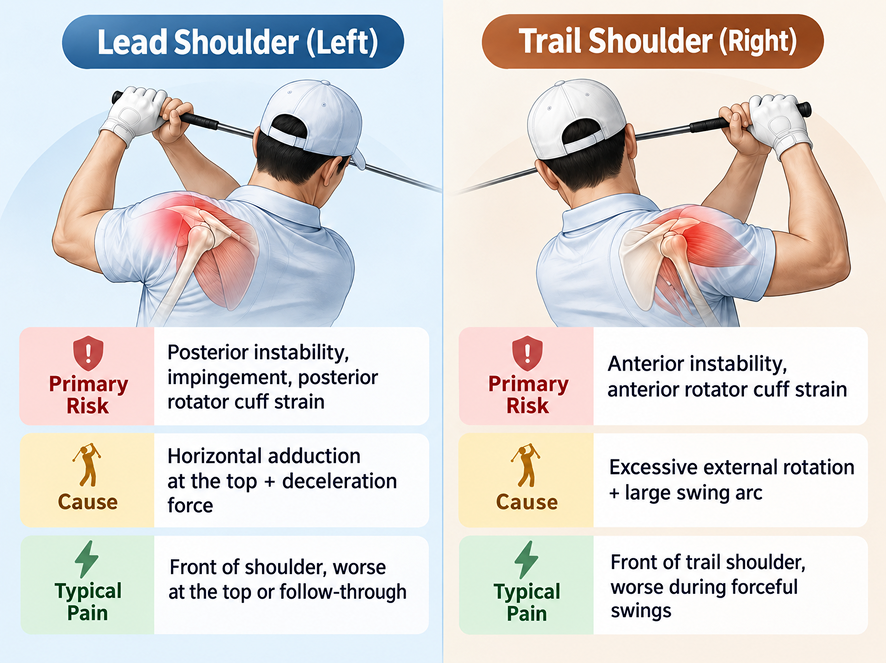
For golf swings, the core pattern is that the lead shoulder (left shoulder for right-handed golfers) is more vulnerable. The trail shoulder also bears significant load, yet the injury patterns differ.
Why is the lead shoulder more prone to injury?
At the top of the backswing, the lead shoulder is forced into extreme horizontal adduction, followed by powerful deceleration after impact. The rotator cuff tendons are repeatedly compressed and stretched beneath the acromion.
What risks affect the trail shoulder?
The trail shoulder is placed in extreme external rotation and abduction during the backswing. If the swing range is excessive and players rely on arm rotation to generate distance, the shoulder joint will be pushed beyond its natural range. This can lead to anterior instability or strain of the anterior rotator cuff (subscapularis). Typical symptoms include pain at the anterior or lateral trail shoulder, especially when swinging with force.
Comparison of Lead vs Trail Shoulder Injuries
2. What are the most common shoulder injuries among golfers?
Rotator cuff injury and tendinitis: This is the most prevalent condition. Repeated compression inflames and wears down rotator cuff tendons (especially the supraspinatus), which may progress to tears. Pain often occurs during transition from backswing to downswing, or the deceleration phase after impact.
Subacromial impingement: The rotator cuff tendon gets “pinched” between the acromion and humerus, causing sharp pain and inflammation. It is usually caused by weak scapular stabilizers or tight pectoral muscles.
Acromioclavicular joint issues: Sharp pain at the top of the shoulder at the top of backswing may indicate AC joint compression or posterior capsular strain.
Labral tears (SLAP lesions): More common in golfers with a history of throwing sports. Symptoms include deep dull ache or catching sensation during the swing.
Bursitis: Inflammation and swelling of the subacromial bursa amplifies pain and limits range of motion.
3. What are the early warning signs of rotator cuff injury in golf?
Early signs of rotator cuff injury: Soreness in the shoulder after play, discomfort when lifting the arm, relieved with rest. As strain accumulates, pain arises with arm elevation, nocturnal shoulder ache, and even limitations with daily movements such as dressing or reaching behind your back.
4. Two truths behind shoulder pain: The difference between rotator cuff injury and subacromial impingement
They are closely related but not the same. Subacromial impingement is the process, and rotator cuff injury is the result.
Subacromial impingement describes the mechanism where tendons get compressed within the subacromial space. Chronic impingement leads to tendon inflammation, wear and degeneration — this is rotator cuff injury.
In a golf swing, the lead shoulder reaches extreme horizontal adduction at the top of backswing, repeatedly compressing the rotator cuff tendons under the acromion. This movement creates two concurrent problems:
Impingement: Tendons are pinched between the acromion and humeral head
Injury: Tendons gradually degenerate under repeated compression and stretching Many golfers’ shoulder pain therefore involves both impingement and tendon damage, each worsening the other. Recovery must address both: reduce impingement and support healing of compromised tendons.
5. Rotator cuff load in follow-through: 5 overlooked movement habits
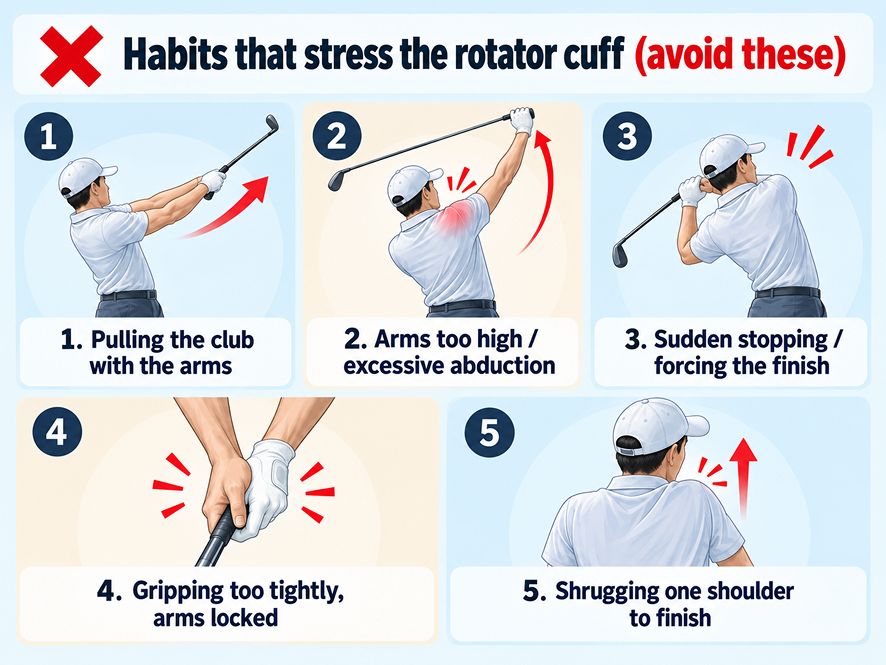
The follow-through is the finishing phase after power release in the swing. Poor movement patterns continuously stretch and compress rotator cuff tendons, accumulating micro-damage and triggering shoulder pain. Common bad habits are listed below:
❌ Poor movement habits (strains rotator cuff, avoid where possible)
1. Pulling the club forcibly with arms, generating follow-through power using upper limbs only: Proper follow-through is driven by torso rotation. Many golfers lack torso rotation and pull the club with arms, subjecting rotator cuff tendons to high tensile load and worsening strain.
2. Excessive shoulder abduction and high arm elevation in follow-through: Raising arms to extreme overhead positions narrows the subacromial space, causing friction and compression of rotator cuff tendons and triggering impingement.
3. Sudden stop and forced club deceleration in follow-through: Torso rotation stops, yet the arms and club retain momentum. Forcibly halting the clubhead creates sudden shear force that violently pulls rotator cuff tendons.
4. Tight grip with rigid arms throughout the swing: Constant grip tension triggers simultaneous contraction of neck and shoulder muscles. The rotator cuff remains under sustained tension, adding extra tendon stress in follow-through.
5. Shrugging one shoulder during follow-through: Insufficient torso rotation leads to compensatory shrugging, depressing the acromion and abrading rotator cuff tissue.
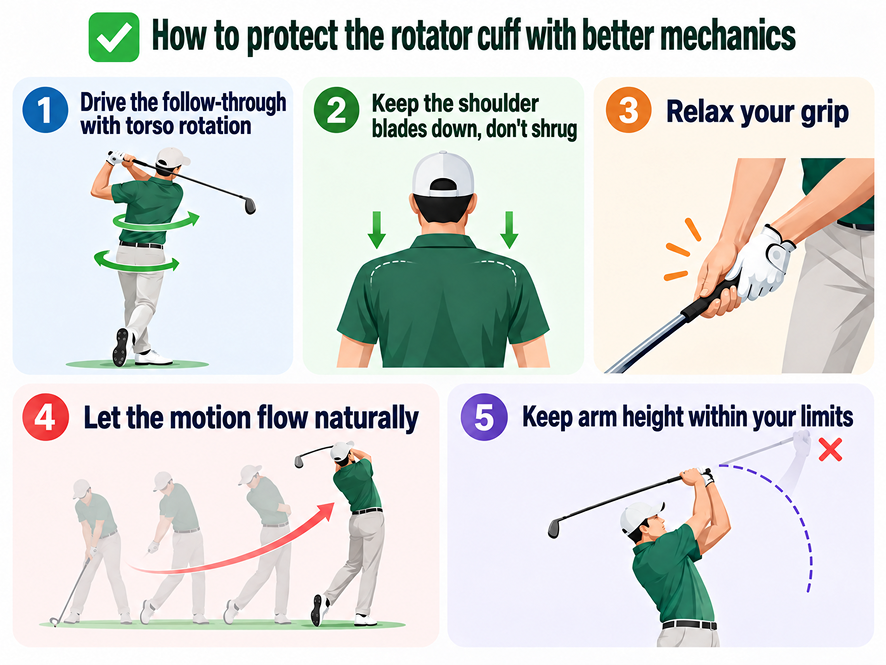
✅ Proper movement habits to protect your rotator cuff
1. Drive follow-through with torso rotation: Power originates from thoracic and pelvic rotation; arms simply follow the torso naturally instead of actively pulling the club.
2. Keep scapulae depressed, avoid shrugging: Keep shoulders away from ears throughout follow-through to maintain scapular stability and prevent subacromial compression.
3. Maintain relaxed grip: Release grip tension after impact, keep a light hold to reduce upper limb tightness.
4. Smooth, natural finish: Do not forcibly brake the clubhead; allow clubhead momentum from torso rotation to complete follow-through gradually without abrupt stopping.
5. Keep arm elevation within your physical limits: Do not deliberately raise arms high in follow-through. Stay within your natural thoracic mobility range and avoid forced extreme abduction.
6. Golf shoulder warm-up: Pre-round activation to prevent rotator cuff injury
A golf swing exposes the shoulder joint to rotation, stretching and explosive load. A complete shoulder warm-up is more than simply raising body temperature; it activates scapular stabilizers, relaxes tight soft tissues, improves rotator cuff mobility, reduces compensatory movement during swings and lowers risks of micro-tears in rotator cuff and labrum.
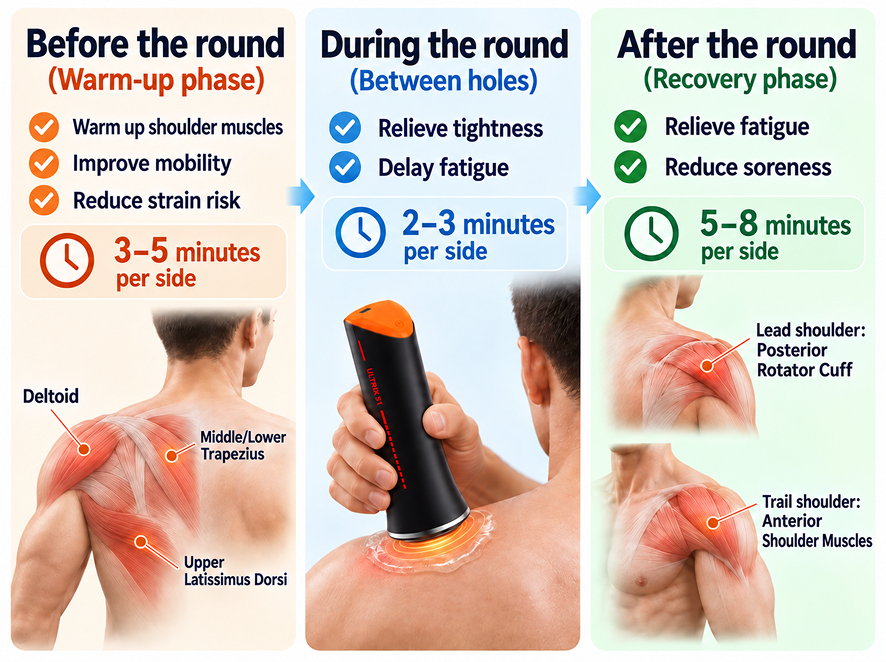
Before warm-up, use the Ultriix S1 to precondition soft tissue around the shoulder. Focus on safe muscle belly areas: mid-lower trapezius, latissimus dorsi and deltoids. Glide slowly, 3–5 minutes per side, to soften tight muscles and prepare for subsequent warm-up.
1. General whole-body preheating (3–5 minutes)
Light aerobic movement such as brisk walking or arm swings to boost blood flow and soft tissue temperature, preventing cold muscles from absorbing sudden swing impact.
2. Soft tissue release around shoulders (with Ultriix S1)
Apply Ultriix S1 to mid-lower trapezius, latissimus dorsi and deltoids. Glide slowly to release pre-round shoulder tightness; recommended 3–5 minutes per side to improve soft tissue elasticity and reduce muscle strain during swings.
3. Dynamic mobility drills (avoid prolonged static stretching)
● Forward and backward arm circles, wall angels: Mobilize the glenohumeral joint and open shoulder range of motion;
● Thoracic rotation drills: Much shoulder stress in golf comes from stiff thoracic spine. When thoracic rotation is limited, the shoulder compensates, and this drill greatly reduces shoulder burden.
4. Rotator cuff and scapular activation (key step)
Banded external rotation and simple YTWL exercises wake up the small rotator cuff muscles. The rotator cuff stabilizes the shoulder joint. Pre-activation allows these muscles to share load during swings and prevents excessive tendon strain.
5. Progressive swing simulation
Start with half-swings and slow swings before moving to full-power swings. Gradually expose shoulder tissues to torsional force to complete the warm-up sequence.
7. Rotator cuff injury prevention: 5 daily habits for golfers
Preventing rotator cuff injury relies on reducing excessive load, building stable support and timely recovery.
① Fully warm up rotator cuff, chest and back soft tissue before swings;
Use dynamic warm-up and Ultriix S1 for pre-round soft tissue activation, raise shoulder tissue temperature and extensibility, so rotator cuff tendons and chest-back muscles are ready for sport. Playing with cold shoulders is a major cause of rotator cuff strain.
② Strengthen scapular and rotator cuff stabilizers;
Focus training on posterior rotator cuff (infraspinatus, teres minor), mid-lower trapezius and serratus anterior. Stable scapulae mean the rotator cuff does not need to bear excessive swing load.
③ Avoid prolonged high-intensity practice;
Long practice sessions directly correlate with rotator cuff injury. Repeated ball striking accumulates rotator cuff fatigue under constant compression. Split sessions and control volume each practice.
④ Perform soft tissue recovery immediately after play;
Rotator cuff and shoulder muscles stay tight after swinging. Use Ultriix S1 for recovery, glide the massage head slowly over shoulder muscles (deltoids, mid-lower traps, upper lats) to release tightness, improve local circulation and reduce micro-damage accumulation.
⑤ Optimize swing mechanics to reduce excessive shoulder rotation.
Minimize excessive arm elevation and shoulder rotation. Drive swings with thoracic and hip rotation, letting the shoulder act as a force transmitter rather than bearing the load.
8. Big drives with driver, silent shoulder damage
The driver has the longest shaft, widest swing arc and highest clubhead speed. Torque generated during backswing and downswing far exceeds irons. The rotator cuff and labrum bear greater load and face higher injury risk, mainly for these reasons:
1. Larger backswing amplitude, shoulder rotation pushed to limits
Golfers often seek maximum torso rotation at the top of backswing with the driver. If thoracic mobility is limited, the shoulder compensates with extreme twisting, pulling rotator cuff tendons hard and raising risks of impingement and labral injury.
2. Longer shaft amplifies torque via leverage
The driver has the longest shaft of all clubs. The same force creates amplified tension and shear stress at the shoulder joint. Rotator cuff tensile load at impact is significantly higher than irons.
3. Greater explosive power and impact load
The driver is designed for high swing speed. Massive power releases at the transition from downswing to impact. Rotator cuff tendons must stabilize the humerus instantly, repeatedly absorbing high-speed impact and accumulating micro-trauma.
4. Common compensatory patterns: shrugging and tight grip
Many golfers tense up with the driver, gripping tightly and shrugging automatically. This narrows the subacromial space continuously and causes friction against rotator cuff tendons.
5. Greater follow-through momentum and deceleration load
The driver clubhead has larger mass and higher speed, creating stronger momentum in follow-through. Forced stopping creates extra tensile stress on the rotator cuff.
9. Which areas should be treated with Ultriix S1 for golf-related shoulder injuries?
Focus on muscle bellies of large shoulder surrounding muscles
1. Deltoid muscle belly: Thick muscle on the outer shoulder (anterior, middle, posterior heads). Glide slowly following muscle fiber direction.
2. Mid and lower trapezius muscle belly: Large muscle from neck down to above and between scapulae, relieving tightness from swing-related shrugging.
3. Upper latissimus dorsi muscle belly: Wide muscle behind the armpit near the inferior scapular border. Tightness here pulls the shoulder and restricts thoracic rotation.
4. Teres major and teres minor muscle bellies around scapulae: Soft tissue area below scapulae. Work only on muscle tissue, avoid tendon attachment points.
For tendon tears, labral damage or persistent shoulder pain, consult a physician or physical therapist promptly.
10. How to use Ultriix S1 to treat differentiated shoulder injuries (lead vs trail shoulder)
Golf swing is a typical unilateral repetitive movement. Injury patterns differ completely between left and right shoulders. Treatment must be targeted rather than identical for both sides.
Ultriix S1 operation guidelines:
● Apply sufficient conductive gel
● Glide the massage head slowly or use circular motions along muscle fibers
● 3–5 minutes per region, total 8–10 minutes for one shoulder
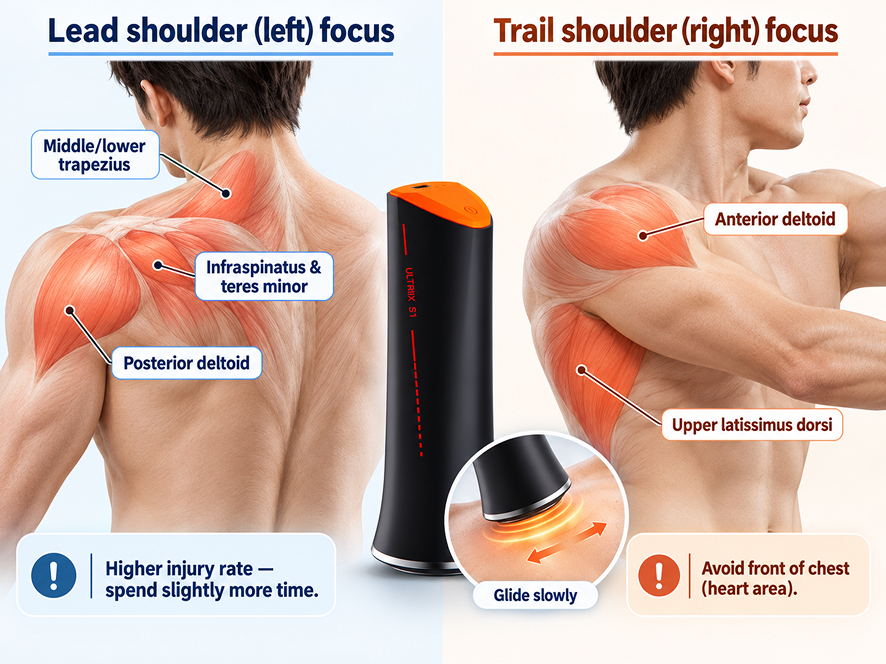
Lead shoulder (left shoulder) focus
Goal: Release posterior rotator cuff and relieve posterior tightness. Start with infraspinatus and teres minor bellies (behind scapula), glide slowly along posterior scapula to ease persistent posterior rotator cuff tension. Next work on posterior deltoid belly (thick muscle on back shoulder), glide along muscle fibers; keep the massage head moving when passing over bony acromion. Finish with mid-lower trapezius (above and between scapulae) to release swing-induced shrugging tension.
Operation tip: The lead shoulder has higher injury risk. You may extend treatment time, focusing on rotator cuff muscles behind the scapula.
Trail shoulder (right shoulder) focus
Goal: Relax muscles surrounding the anterior shoulder joint and reduce pull on the shoulder. Start on anterior deltoid belly (thick muscle on front shoulder), glide slowly. Then treat upper latissimus dorsi (behind armpit near inferior scapular border) to reduce shoulder load caused by muscle tightness.
Operation tip: Avoid the chest / heart region. Focus on muscles surrounding the shoulder joint.
11. Key operational guidelines for using Ultriix S1 on shoulder recovery
① Apply enough ultrasound conductive gel
Gel is the medium for ultrasound energy transmission. Insufficient gel prevents effective deep tissue penetration and has no therapeutic effect. This is why many users feel ultrasound massage devices are ineffective — not the device itself, but insufficient gel blocking deep energy delivery.
Adequate gel is the first and most critical step for ultrasound recovery.
② Glide massage head steadily and slowly or in gentle circles along muscle fibers
Slow movement allows even energy coverage over target tissue, fully penetrating deep soft tissue, releasing muscle adhesions, easing persistent tightness, improving local circulation and lowering tensile stress on the rotator cuff.
③ Target soft tissue surrounding the shoulder joint
Including anterior/middle/posterior deltoid bellies, mid-lower trapezius, upper latissimus dorsi and teres major bellies. Releasing upstream muscles relieves tightness, improves circulation and reduces burden on the rotator cuff.
④ Recommended duration: 8–10 minutes per shoulder; 1 session daily per treatment area
12. Is Ultriix S1 rotator cuff care better before or after a golf round?
It can be used both pre-round and post-round, with different objectives:
Pre-round (warm-up phase)
Use Ultriix S1 to preheat shoulder soft tissue, improve tendon and fascia extensibility, increase shoulder mobility and reduce swing strain risk. Focus on large shoulder muscle bellies (deltoids, mid-lower traps, upper lats). Start at low power setting, 3–5 minutes per side. Complete dynamic shoulder warm-up after using Ultriix S1.
Post-round (recovery phase)
Use Ultriix S1 to ease accumulated swing fatigue, reduce tendon inflammatory soreness and support recovery from micro soft tissue damage. Treatment time may be increased to 5–8 minutes per side. Focus on releasing posterior rotator cuff of lead shoulder and anterior chest muscles of trail shoulder.
If you feel shoulder tightness or soreness mid-round, you can use Ultriix S1 briefly between holes to ease immediate tightness and delay fatigue build-up. 2–3 minutes per side is sufficient.
13. Shoulder injury rehab for golfers: Full framework from release to strengthening
For golfers’ shoulder injuries, training follows the principle: release first, stabilize second, strengthen last. Protocols differ between injury phase and daily prevention.
Early injury phase: “No pain” is the top priority
If shoulder pain is present, the primary goal is to protect damaged tissue and reduce pain. Pendulum exercises and cross-body stretches are recommended for relief. Important reminder: Avoid arm circles, wall climbs, ring pull-ups or aggressive massage during the acute phase, as these may worsen injury.
Daily prevention: Focus on “stabilizer muscles”
When no active shoulder pain exists, training targets rotator cuff and scapular stabilizers, which keep the shoulder stable during swings.
Rotator cuff & scapular stability training: Banded external rotation, prone Y-T-W, wall angels. Prioritize infraspinatus, teres minor, mid-lower trapezius and serratus anterior. Shoulder activation: Arm circles and straight-arm band pulls to activate periscapular muscles. Training frequency: Train on non-golf days, 2–3 sessions weekly, gradually increase resistance.
Focus on the entire kinetic chain
Shoulder stability does not rely only on the shoulder itself. Building core strength (plank, side plank) and glute & leg strength (glute bridges) creates a stable base during swings and reduces shoulder compensation. Meanwhile, limited thoracic or hip mobility forces the shoulder to compensate, so thoracic rotation and hip mobility drills are also essential.
Do not skip post-training release
Strength training creates micro-fatigue in shoulder muscles. Use Ultriix S1 after training to massage shoulder regions, release tight muscles and clear accumulated micro-trauma. This ensures training protects rather than creating new overuse strain.
14. Can golfers continue playing after shoulder injury?
Do not play blindly. Judge based on injury stage.
● Acute phase (obvious pain, limited movement, pain with arm elevation, within 1–2 weeks after injury)
❌ No golf allowed. Swinging subjects the shoulder to impact, rotation and tensile load. Micro-damage to rotator cuff tendons and joint capsule will keep being irritated, worsening inflammation, extending recovery time and potentially developing chronic rotator cuff strain.
● Subacute phase / mild overuse strain (only mild soreness after play, no pain with daily arm movement, no night pain)
Limited play is permitted under strict conditions:
1. Consult a sports medicine physician or physical therapist first to rule out structural tears in rotator cuff or glenohumeral joint;
2. Reduce intensity drastically: shorten playing time, limit swing count, avoid full-power driver, use short irons only;
3. Complete full dynamic warm-up before play, prioritize rotator cuff and scapular stabilizer activation. After play, use Ultriix S1 over large shoulder muscle groups with slow gliding motion to release tight periscapular soft tissue and reduce sustained tensile stress on rotator cuff;
4. Stop immediately if sharp pain or catching sensation occurs during play. Do not push through pain.
● Stable chronic strain phase (almost no spontaneous pain, no discomfort during strength training)
Regular golf can resume, but long-term rotator cuff and scapular stabilizer strength training is required. Check swing mechanics for compensatory patterns (e.g. swinging with shrugging). Poor mechanics continuously load the shoulder. After every round, use Ultriix S1 to treat shoulder muscles, ease accumulated muscle tightness and reduce recurrence risk.
15. Golf shoulder pain: Daily movements that worsen symptoms
When golfers already experience shoulder discomfort, many daily movements besides swinging keep stretching and compressing rotator cuff and periscapular soft tissue, amplifying soreness and inflammation and should be avoided:
1. Prolonged sitting with rounded chest, looking down at phone / computer. Shortened pectoralis minor pulls scapulae forward, narrows subacromial space. The rotator cuff stays in chronic unbalanced tension, amplifying swing-related strain.
2. Repeated overhead arm movements: lifting heavy objects, high storage, hanging laundry. Overhead motion raises intra-articular shoulder pressure, abrades rotator cuff tendons and triggers impingement.
3. Carrying heavy items on one hand, single-shoulder backpack: unilateral load instantly tenses shoulder muscles and shifts scapulae, increasing rotator cuff tensile load.
4. Sleeping on the painful side: side-lying compresses the affected shoulder, narrows subacromial space and continuously irritates damaged soft tissue overnight, often causing night pain.
5. Forcibly pulling arms backward or aggressive shoulder stretching: forcing extreme shoulder extension and external rotation overstretches labrum and rotator cuff tendons and worsens micro-damage.
6. Sudden heavy pulling or dragging objects: abrupt pulling force creates instant shear stress on rotator cuff and may trigger acute sharp pain.
7. Sustained shrugging (tense posture, working at computer with raised shoulders): constant shrugging directly narrows subacromial space and repeatedly abrades rotator cuff tendons.
16. When should you seek immediate medical consultation?
If you have golf-related shoulder discomfort and any of the symptoms below, structural injuries such as rotator cuff tear or labral damage may be present. Stop golf and visit a sports medicine specialist for assessment promptly:
● Audible pop / tearing sensation at injury moment, followed by weakness; unable to swing or lift arm
● Obvious swelling, warmth or visible shoulder deformity
● Shoulder locking or catching during movement, requiring arm shaking to release
● Spontaneous night shoulder pain waking you from sleep, not relieved by normal rest
● Persistent sharp shoulder pain lasting more than 3–5 days with no improvement or worsening despite rest
● History of shoulder dislocation, with renewed feeling of instability or impending dislocation