
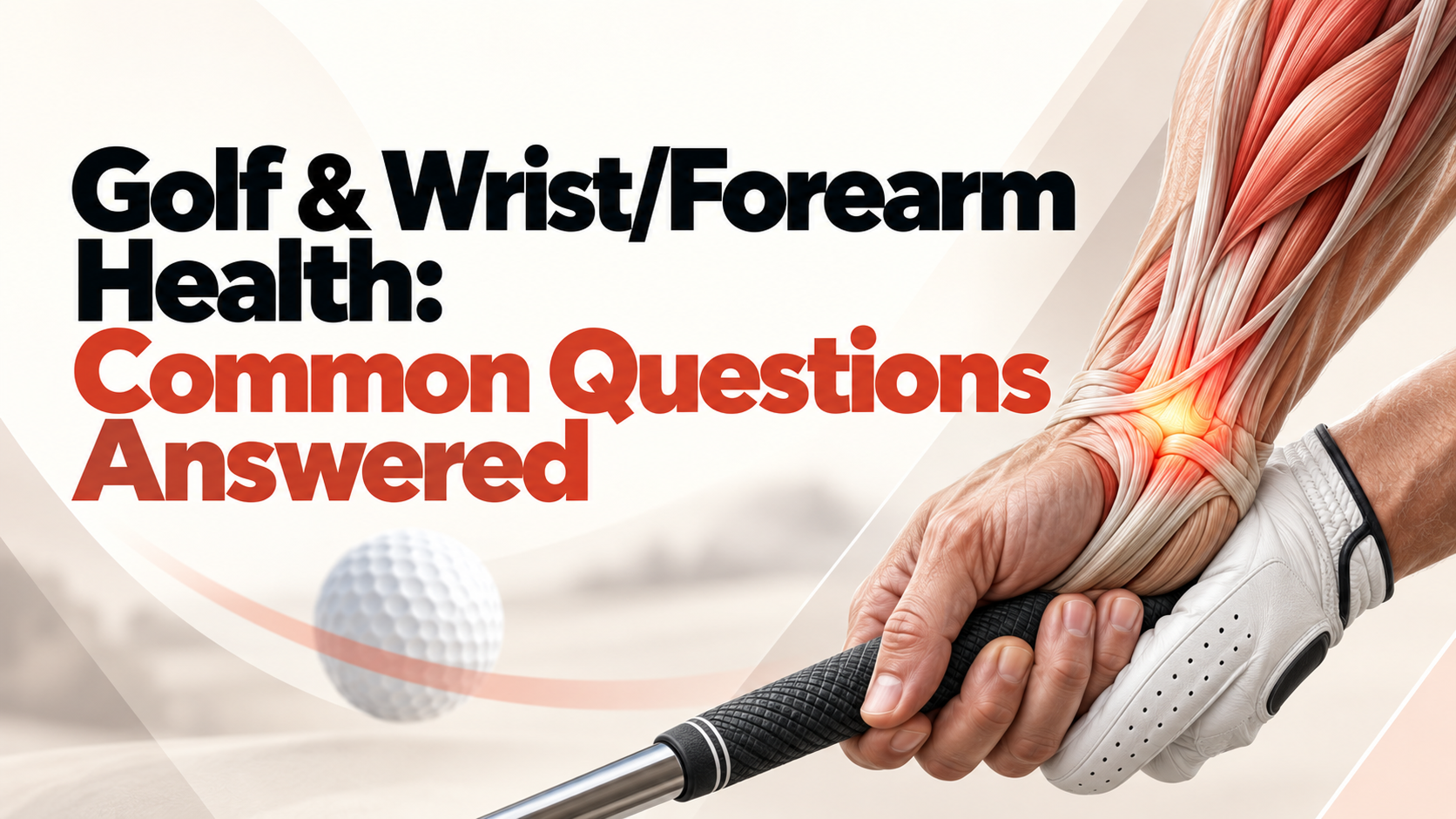
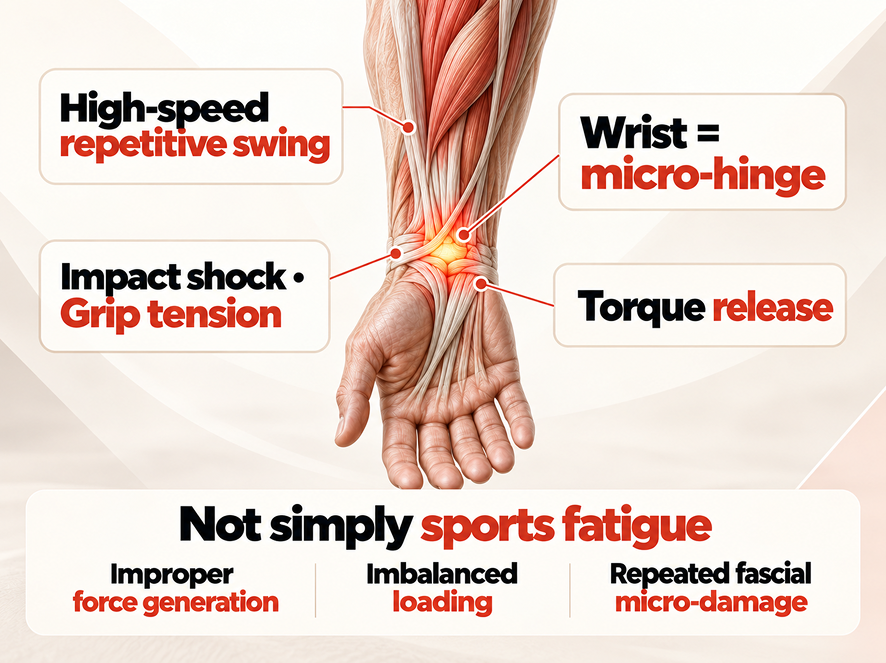
A golf swing is a high‑speed, repetitive lever‑driven movement. As the miniature pivot connecting the club shaft to your body, your wrists endure three major loads: impact shock from ball contact, sustained grip tension, and rapid torsional release. For most golfers, wrist soreness, power loss, and forearm stiffness are not merely ordinary exercise fatigue. They stem from long‑term flawed swing mechanics, uneven joint loading, and accumulated micro‑tears in the fascia.
This blog addresses frequently‑asked questions from golfers, offering science‑backed insights into wrist and forearm overuse injuries to help players avoid pitfalls and practice evidence‑based recovery.
Q1. Why are wrists more prone to injury than elbows or shoulders in golf?
The wrist is the thinnest upper‑limb joint with the shortest load‑bearing lever arm. It must perform four simultaneous functions: maintaining grip stability, controlling swing angles, releasing torque instantaneously, and absorbing club‑head impact shock. Shoulders and elbows have large muscle groups to buffer force, but the wrist has delicate anatomy and weak supporting musculature with little built‑in shock absorption. All micro‑vibrations and torsional forces concentrate in the wrist joint and forearm muscles, making wrist overuse far more common than injuries to other upper‑body regions.
Q2. Can impact shock at ball‑strike cause permanent wrist damage?
Single mild impacts rarely produce permanent wrist injury. However, repeated high‑frequency, unbuffered shock from ball‑strike irritates the triangular fibrocartilage complex, tendon sheaths, and deep forearm fascia. This leads to recurring micro‑tears and inflammatory buildup. Over time, thickened tendon sheaths, cartilage wear, and fascial adhesions develop. Symptoms progress from post‑round aching to chronic overuse injury, resulting in persistent pain during movement and tenderness on palpation.
Q3. Is post‑round wrist weakness and reduced grip strength normal fatigue or an injury warning sign?
Temporary grip weakness and wrist soreness after an intense round represent normal muscular fatigue and resolve within 1‑2 days of rest. If you experience wrist weakness after every round, failure to recover grip strength by the next day, or weakness when making a loose fist, these are early warning signs of overuse injury. Your wrist soft‑tissues can no longer withstand swing‑related stress and chronic damage is developing.
Q4. Can air‑swing practice cause wrist and forearm overuse injuries?
Incorrect air swings can injure your wrists. Without ball resistance, many golfers over‑release their wrists, creating exaggerated wrist motion beyond real‑world swing ranges and placing excessive tensile stress on tendons. Air swing drills should replicate real‑life ball‑strike wrist mechanics; avoid artificially amplifying wrist flicking.
Q5. How does Ultriix S1 support recovery from golf‑related wrist and forearm overuse?
Most golf‑related wrist and forearm injuries arise from sustained gripping tension and ball‑strike shock, creating tight forearm flexors/extensors and chronic tendon irritation. Common symptoms include forearm aching, wrist pain during force application, and discomfort from tendon sheath inflammation. Ultriix S1 releases 1.1 MHz pulsed ultrasound, delivering energy 3‑6 cm beneath the skin to target deep forearm and wrist muscles, fascia and soft‑tissues. It alleviates deep‑tissue fatigue and reduces cumulative injury risk.
Its core benefits are three‑fold:
1. Relieve tight forearm and wrist musculature: Reduces muscle spasm and tension in forearm and wrist‑surrounding muscles caused by prolonged club‑gripping. Boosts local blood circulation to clear metabolic waste, easing post‑round forearm heaviness and aching. It lowers mechanical pull exerted by muscles on wrist tendons at the source.
2. Improve the soft‑tissue environment around tendons: Promotes circulation to reduce edema and inflammatory buildup around forearm and wrist tendons from chronic overuse. It eases pulling pain during gripping and force application, and improves discomfort linked to tendon‑sheath inflammation.
3. Pre‑ and post‑activity supportive care: Pre‑round use raises soft‑tissue temperature in the forearms and wrists, improving extensibility of tendons, fascia and wrist ligaments for greater wrist mobility. Post‑round use relieves accumulated forearm and wrist exercise‑related fatigue, improves local circulation, reduces persistent wrist stiffness and lowers repeat‑injury risk.
Q6. How do you use Ultriix S1 for forearm care?
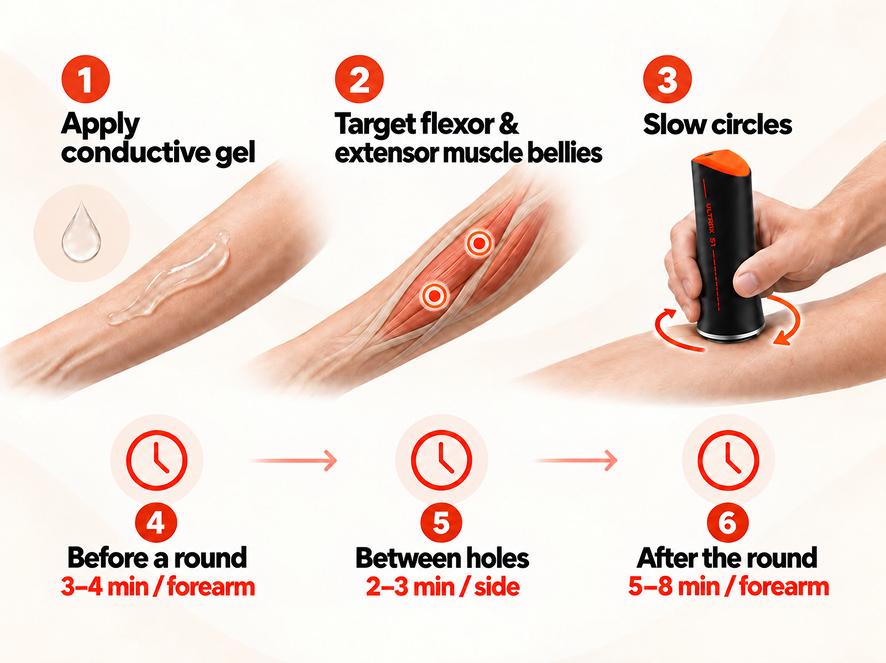
Apply sufficient conductive gel to the device probe or skin surface. Focus the probe over the muscle bellies of forearm flexors and extensors, keeping at least 5‑7 cm away from the wrist crease. Move the probe slowly in circular motions; avoid prolonged static holding in one spot.
✅ Pre‑round warm‑up phase
Goal: Raise forearm soft‑tissue temperature, improve tendon‑fascia extensibility and lower strain‑injury risk. 3‑4 minutes per forearm, total 6‑8 minutes for both sides. Tip: After warming‑up with Ultriix S1, complete dynamic wrist and torso warm‑ups before hitting shots.
✅ In‑round break care
Goal: Ease immediate muscular tightness and slow forearm fatigue accumulation. If forearms feel tight and achy mid‑round, apply brief treatment: 2‑3 minutes per forearm.
✅ Post‑round recovery phase
Goal: Clear exercise‑induced fatigue, release tight muscles and reduce tendon pulling stress to lower overuse risk. 5‑8 minutes per forearm, total 10‑16 minutes for both sides, once daily.
Ultriix S1 relieves forearm muscular stiffness, reduces persistent muscle pull on wrist tendons, and eases upstream muscular tension to indirectly reduce wrist loading.
Q7. Are left‑hand and right‑hand wrist injuries identical for golfers?
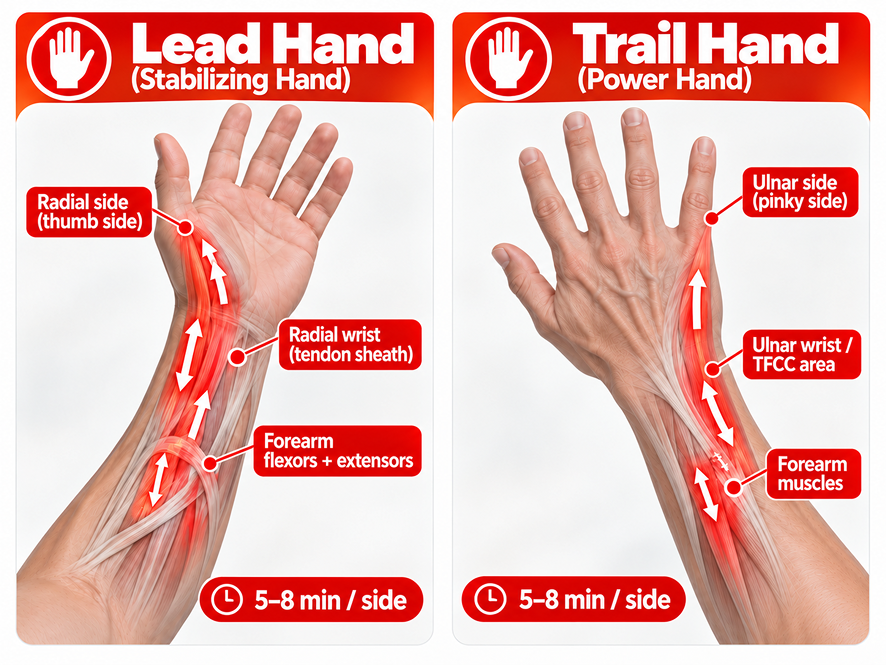
They are not identical; each side has distinct injury patterns. For a right‑handed golfer: The lead hand (left) acts as the stabilizing hand. It maintains wrist angle and club‑shaft stability throughout the swing. Tendons and tendon sheaths on the radial side of the wrist sustain constant static tension, with associated tightness in forearm radial muscles. This commonly causes radial‑side wrist pain during force application, irritation at the radial styloid, and forearm stiffness and aching. The trail hand (right) delivers power and release. During impact, the wrist rotates rapidly and absorbs ball‑strike shock. The triangular fibrocartilage complex on the ulnar side of the wrist bears significant compressive load. Rotational tendons rub repeatedly, often causing ulnar‑side wrist tenderness, limited rotational movement and deep‑layer wrist overuse injury. Due to differing functional roles, injury locations and underlying causes differ between hands.
Golf wrist care requires differentiating tension patterns on radial and ulnar sides, targeting injury sites on the wrist itself, rather than only relaxing forearm muscles. When using Ultriix S1:
‑ Lead hand (left): Glide slowly along the forearm radial (thumb) side down toward the wrist radial region (from base of thumb to wrist crease). Follow tendon‑sheath pathways. This releases static forearm‑muscle tension while directly treating radial‑side wrist tendons and sheaths, loosening fascial adhesions and easing chronic irritation to reduce grip‑related wrist tightness and movement‑related pain.
‑ Trail hand (right): Focus treatment on the wrist ulnar (little‑finger) side, over the surface corresponding to the triangular fibrocartilage complex. Apply the probe with slow small‑range glides or brief light stationary holds. Ultrasound energy penetrates deep wrist soft‑tissues, easing deep compressive strain from rotational force and impact shock, and reducing pain during wrist rotation.
Different functions, different injuries: Precision ultrasound care delivers targeted relief for each wrist side.
Q8. How to use Ultriix S1 for wrist care?
Ultriix S1’s 1.1 MHz pulsed ultrasound delivers millions of high‑frequency acoustic vibrations per second, creating micro‑mechanical stimulation within deep wrist and forearm soft‑tissues. It helps release fascial adhesions, boost local circulation and accelerate waste‑product removal. Gentle deep‑tissue energy delivery avoids extra stress on delicate wrist cartilage and nerves, suited for the fine anatomy of the wrist.
Operation steps:
● Preparation: Apply ample conductive gel covering the mid‑lower forearm and entire wrist area, including dorsal, lateral sides and wrist crease.
● Lead‑hand (stabilizing hand) care: Glide the probe slowly over forearm radial‑side flexor and extensor muscle bellies to release forearm muscular tension. Then move down to the wrist radial zone (radial styloid to thumb‑base tendon sheath). Glide back‑and‑forth along tendon‑sheath pathways to release chronic adhesions and tension, 5‑8 minutes total per side.
● Trail‑hand (power‑release hand) care: First glide to relax forearm ulnar muscles. Then focus the probe over the wrist ulnar region (overlying the triangular fibrocartilage complex at the ulnar head‑wrist joint gap). Glide slowly over rotational tendon pathways with small movements, or use brief light stationary holds over areas of soreness to reach deep wrist soft‑tissues, 5‑8 minutes total per side.
Important notes:
● Always keep probe moving slowly for even energy distribution across target areas.
● Do not hold probe stationary for long durations over the central volar wrist (carpal tunnel) or ulnar‑nerve pathways. Do not apply extra pressure beyond the probe’s own weight, to avoid irritating median and ulnar nerves.
● Do not use on broken or damaged skin.
Q9. Do wrist braces prevent wrist injuries?
They offer partial benefit but should not be over‑relied on. Compression wrist braces reduce tensile stress at tendon attachment points and relieve mild overuse symptoms. However, they cannot replace forearm strength and wrist‑stability training. Long‑term brace‑use while golfing diminishes proprioception and muscular control, much like relying on crutches weakens leg strength.
Q10. Can club changes reduce wrist loading?
Yes. These club parameters influence wrist stress:
● Shaft stiffness: Over‑stiff shafts transmit greater impact to wrists; overly‑flexible shafts reduce stability. Select stiffness matching your swing speed.
● Shaft weight: Excessive weight increases continuous wrist‑forearm load; overly‑light shafts can cause uncontrolled “flicking”.
● Grip size: Too‑small grips force excessive squeezing and muscular tension; overly‑large grips impair feel. Ideal fit: fingers just touch palm when gripping.
● Shaft material: Vibration‑dampening shafts (carbon‑fiber) reduce impact shock transmission to wrists.
Q11. What are the most common wrist injury sites and prevention strategies?
Two high‑risk wrist injury sites for golfers:
● Ulnar‑side wrist (little‑finger side): Triangular fibrocartilage complex This is a classic golf‑related injury. Down‑swing impact and torsional rotation compress this structure. Typical symptoms: deep‑sided pain on little‑finger side, worsening with wrist internal rotation, weight‑bearing on hands, and gripping force. This is a high‑risk site for triangular fibrocartilage wear and micro‑tears.
● Volar‑side wrist (palm‑side): Wrist flexor tendons and tendon sheaths Caused by prolonged tight club‑gripping, high‑tension forearm flexors and repetitive tendon‑sheath friction leading to tendon‑sheath inflammation. Symptoms: volar‑side wrist aching, pain with gripping or twisting movements, worsening after golf rounds.
Note: Dorsal‑side (back‑of‑hand) wrist injuries also occur, mostly from excessive wrist release and cupping, causing extensor‑tendon overuse. They are less prevalent than the two sites above.
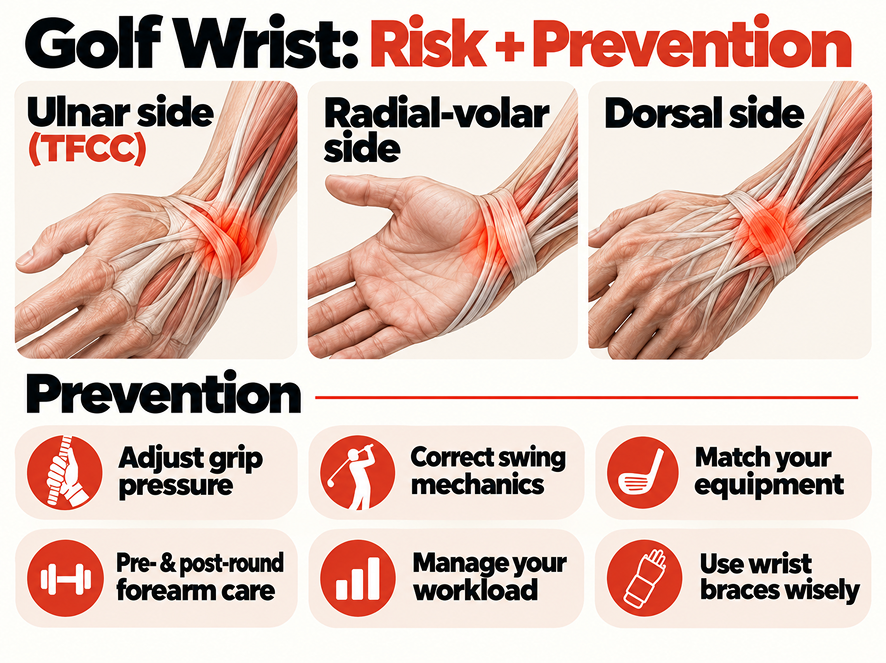
Prevention strategies
✅ Adjust grip pressure: Avoid death‑gripping the club. Maintain a “firm‑but‑not‑tight” hold, as if holding a fragile egg. Tighter grips multiply impact forces on forearm tendons and wrists.
✅ Correct swing mechanics: Generate power from hip and torso rotation. Avoid power‑driven wrist and arm flicking. Wrist‑dominated “whipping” transfers all impact onto wrist soft‑tissues. Dry‑swings must replicate real‑ball mechanics; avoid exaggerated wrist flicking.
✅ Properly‑matched equipment: Over‑stiff or heavy shafts amplify impact shock; overly‑flexible shafts force constant wrist muscular control. Choose shafts suited to your swing speed to minimize extra wrist stress. Replace worn non‑slip gloves; slipping gloves trigger involuntary tighter gripping.
✅ Pre‑ and post‑round soft‑tissue care for wrists and forearms: Perform dynamic forearm‑wrist stretching pre‑round to improve tendon‑fascia extensibility. Post‑round, focus on releasing forearm flexors and extensors. Use Ultriix S1 on forearm muscle bellies and wrist‑joint surroundings to ease muscular‑fascial tension and reduce muscle‑driven pull on wrist tendons.
✅ Manage training volume: Do not abruptly increase round frequency or practice load. Rest when wrists feel heavy or achy, do not push through pain. Avoid activities like weight‑bearing on one hand or forceful twisting that worsen wrist compression and rotation when discomfort exists.
✅ Appropriate brace‑use: Use supportive wrist braces for existing overuse injuries to limit excessive wrist bending and reduce shear forces. Healthy golfers should avoid long‑term brace‑reliance to prevent forearm‑muscle deconditioning.
Q12. Does complete rest fully heal wrist overuse injuries?
Pure rest alone is insufficient for full recovery. Short‑term superficial muscular fatigue from golf usually resolves with adequate rest. For chronic overuse affecting tendon sheaths, cartilage and deep fascia, rest only temporarily reduces inflammatory pain. It cannot release fascial adhesions or repair existing micro‑injuries. Complete immobilization for long periods degrades forearm muscle strength and endurance, and reduces wrist‑joint mobility. When returning to golf, swing‑related forces recur at vulnerable sites, causing recurring pain.
When using Ultriix S1 for care, treatment covers the whole wrist‑forearm region, with site‑specific focus:
Forearm area: Apply ultrasound probe over safe muscle‑belly zones of forearm flexors and extensors (minimum 5‑7 cm away from wrist crease). Apply ample gel and glide in slow circular motions. 5‑8 minutes per forearm, total 10‑16 minutes for both sides, once daily. This relaxes tight forearm muscles, improves circulation, reduces muscular pull on wrist tendons, and creates optimal conditions for damaged wrist soft‑tissue repair.
Peri‑wrist‑joint area: Gentle Ultriix S1 care is suitable for soft‑tissues surrounding the wrist joint. Glide probe slowly along wrist‑joint sides to ease per‑wrist fascial tension and boost circulation. Important: Do not hold probe stationary for long periods over joint gaps, triangular fibrocartilage, or dense nerve‑vascular zones; keep continuous slow gliding.
Q13. Are golf‑related wrist tendon‑sheath inflammation different from smartphone‑induced tendon‑sheath inflammation?
The underlying pathology is tendon‑sheath friction‑induced tendinopathy, yet triggers differ. Smartphone‑related tendon‑sheath inflammation stems from static sustained wrist flexion. Golf‑related injury involves repeated explosive impact plus rotational loading. Wrist cartilage is also stressed, frequently combining with triangular fibrocartilage damage, leading to longer recovery timelines.
Q14. What targeted warm‑up exercises protect the wrists?
Perform these before every round (avoid circular wrist‑swinging):
1. Flexion‑extension stretches: Extend arm, palm forward, pull fingers backward with opposite hand, hold 15 seconds. Flip palm downward, press back of hand, hold 15 seconds.
2. Forearm rotation: Elbow bent 90 °, rotate forearm outward and inward slowly, 10 repetitions each direction, maintain slow controlled movement.
3. Light‑load grip activation: Squeeze‑release soft resistance ball or rubber ring, avoid forceful squeezing.
Q15. Is wrist care limited to the wrist joint itself?
Care should not focus only on the wrist joint. Roughly 90 % of golf‑related wrist overuse originates in forearm musculature; the wrist is merely the load‑bearing endpoint. Tight forearm fascia, muscular adhesions and muscular‑tension imbalance continuously pull on the wrist joint, causing recurring discomfort. Effective care centers on the entire forearm paired with wrist‑joint release to resolve overuse at source and prevent recurrence.
Q16. Does weak forearm muscle strength cause recurring wrist overuse?
Not entirely. Most golfers are not simply weak; they suffer muscular‑strength imbalance and compensatory movement patterns: over‑tight forearm flexors, under‑active extensors, plus limited wrist mobility. Forces meant to be absorbed by torso and shoulders are transferred onto wrists and forearms. Isolated wrist‑strength training may worsen tightness. Instead combine release of tight muscles, activation of weak muscles, and swing‑mechanics correction.
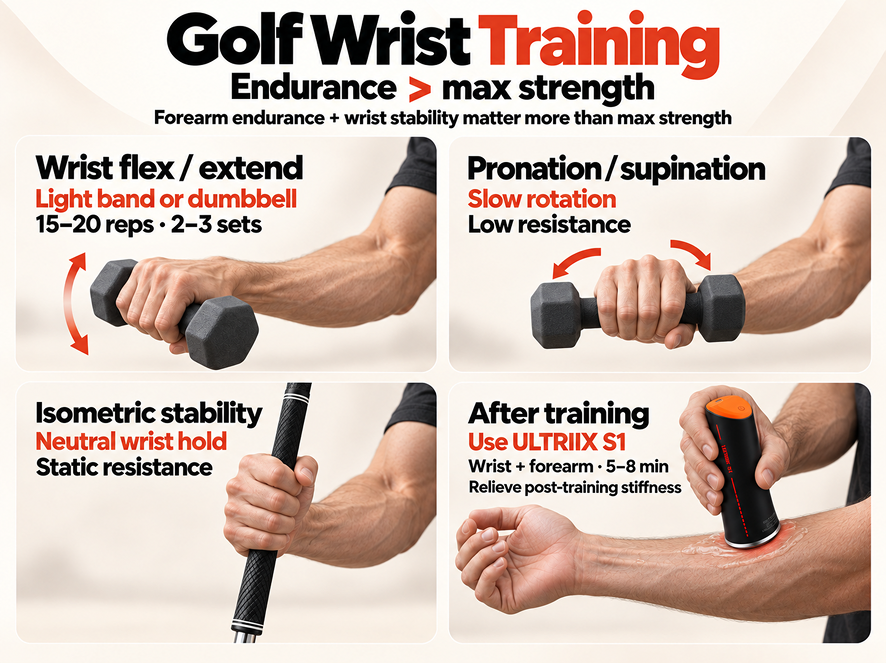
Q17. Should wrists undergo strength training?
Yes. For golf’s repetitive movement patterns, forearm muscular endurance and wrist stability are more important than raw maximum strength. Golf‑appropriate foundational training: low‑load, endurance‑focused
1. Wrist flexion‑extension resistance (light resistance band / small dumbbell): Small slow movements, focus on forearm muscle activation, moderate range‑of‑motion, endurance‑oriented, 15‑20 reps per set, 2‑3 sets; avoid heavy weights.
2. Pronation‑supination drills: Rotate wrists inwards and outwards to strengthen forearm‑wrist rotational stability, mimicking swing‑rotation loading; slow speed, low resistance.
3. Isometric static stability: Maintain neutral wrist position under static resistance, avoid large bending motions. This maximizes joint stability with minimal wrist‑joint stress.
4. Always use Ultriix S1 after strength‑training sessions. Strength training creates micro‑fatigue and local muscular tightness. Without proper release, cumulative stress can trigger tendon‑overuse injury. Post‑training, glide Ultriix S1 over wrists and forearms for 5‑8 minutes. Its 1.1 MHz ultrasound penetrates deep fascia, clearing exercise‑generated metabolic waste and easing post‑training stiffness and aching. Strength training becomes protective rather than another source of overuse injury.
Q18. What are symptom differences between golf‑related wrist tendon‑sheath inflammation and triangular fibrocartilage injury?
● Tendon‑sheath inflammation is concentrated on volar and radial (thumb‑side) wrist. Symptoms include pain during gripping, tenderness, and mild catching sensations with movement. It is inflammatory overuse of fascia and tendons.
● Triangular fibrocartilage injury affects ulnar‑side (little‑finger) wrist. Typical symptoms: sharp pain with wrist rotation, weight‑bearing on hands, and reverse‑direction force. No pain during dry‑swings; pain spikes at ball‑impact. This is damage to the wrist‑joint’s cartilaginous buffer structure, requiring longer recovery.
Q19. How do early or late swing release worsen wrist loading?
Correct swing release comes from body‑driven club‑shaft movement, with passive wrist unloading. Early release causes club‑head to over‑take, creating reverse wrist bending and torsional stress. Late release forces wrists to lock angles and resist club‑shaft inertia. Both faulty timing turn wrists from passive load‑bearers into active load‑bearers, exceeding tissue tolerance and accelerating overuse injury.
Q20. What symptoms require stopping golf and consulting an orthopedic / sports‑medicine physician?
① Persistent deep‑sided pain on little‑finger‑side wrist, severe pain with weight‑bearing or wrist rotation.
② Wrist weakness, inability to hold a club.
③ Wrist swelling, persistent night‑time pain.
④ Restricted movement following traumatic impact.
These may indicate triangular fibrocartilage tears or severe tendon damage. Cease golf play; do not rely solely on home‑based therapy. Medical imaging evaluation is required.
Conclusion
Most golf‑related wrist and forearm injuries are not acute trauma from single accidents, but "silent overuse" accumulated across countless swings. Many golfers rest when sore and return to play once pain subsides, ignoring root‑causes including muscular‑tension imbalance, grip habits and equipment mismatch. Minor discomfort evolves into stubborn chronic pain.
Wrist care is not limited to the wrist joint. True protection starts in the forearm musculature. Complete pre‑round warm‑ups for wrists and forearms, properly‑matched equipment, controlled practice volume, evidence‑based deep‑soft‑tissue release and endurance training, paired with at‑home supportive care using Ultriix S1 on forearm muscle bellies and wrist‑joint areas, effectively reduce extra tensile and impact stress on tendons and cartilage.
Therapeutic devices and braces are supplementary tools and cannot replace proper swing mechanics or professional medical diagnosis. Seek sports‑medicine evaluation if you experience persistent deep‑sided sharp pain or marked grip‑strength loss. The purpose of sport is long‑term enjoyment of golf. Rather than playing through pain, proactive prevention and listening to your body’s warning signals support long‑term play.