

When playing badminton, we usually focus on our racket work and footwork — chasing sharp smashes, delicate net plays and light, quick steps. Yet the lower back, our core power hub and stabilizer, is often overlooked. It is also one of the first areas to send warning signals from accumulated fatigue.
It might be a dull ache after a quick direction change, numbness across your lower back right after landing from a full-power jump smash, or stiffness that leaves you rigid the morning after a two-hour session. Many players dismiss this as normal fatigue, slap on a plaster and get back on court, until simple movements like tying shoelaces become painful.
Badminton puts extremely high stress on the lower back. During a jump smash, the lumbar spine faces compressive loads several times your body weight. Sudden stops and direction changes for desperate retrievals trigger intense eccentric contractions in the quadratus lumborum and erector spinae. Backhand defensive shots from deep court force you to generate power with your spine hyperextended — one of the biomechanically weakest positions for the lumbar region.
This guide covers frequent back complaints among badminton players. We will walk you through pre-game activation, core stability drills, pain assessment, and how to use Ultriix S1 for gentle deep soft-tissue care, forming a complete back maintenance routine.
1. Why badminton is so hard on your lower back?
Badminton relies heavily on unilateral power and frequent direction shifts. Every shot challenges your spine mechanically:
● Extreme rotation and bending: Clears and overhead smashes require hyperextension plus sharp trunk rotation; low net shots force forward flexion. When you lose balance reaching for a shot, your lower back absorbs massive shear force.
● Compensation overload: Most recreational players lack glute activation and core stability. When hips and glutes fail to drive power, stabilizer muscles (erector spinae, quadratus lumborum) are forced to compensate for rotation and explosive force.
Every poorly executed shot adds excessive eccentric stress to back muscles. Tiny micro-traumas build up and turn into chronic deep strain. Biomechanical data shows nearly 80% of back injuries in badminton players are overuse injuries, not one-off acute traumas.
Simple rest or superficial stretching often cannot fully release deep muscle tightness and fascial adhesions. That is why we recommend Ultriix S1 ultrasound massage device for regular recovery.
Operating at 1.1 MHz with a maximum acoustic power of 15W, the S1 penetrates 3–6 cm under the skin. It creates deep warming to boost local circulation. More importantly, its cavitation and microstreaming effects create gentle microscopic mechanical action deep in the tissue. No harsh pressing is needed. This micro-level “flushing” softens locked, tight fascia built up from compensation, clears pain-causing metabolic waste, and restores flexibility to overworked muscles.
2. How much load hits your lumbar spine during a jump smash?
Far more than you may expect.
Biomechanical studies show the compression force on the lumbar spine during a full jump smash can reach 5–8 times your body weight at landing.
For a 70 kg person, the spine may endure 350–560 kg of vertical load on impact.
Crucially, this force is not evenly distributed. It concentrates while the spine is flexed or extended.
The spine tolerates shear stress much worse outside neutral alignment. This explains why a smash with bad form hurts your back far more than not smashing at all.
3. Why backward reaching shots are a major trigger for back pain?
When you step backward to reach a shot, your body is in a conflicting position:
Your feet move back while your torso arches to reach the shuttle and generate power.
The lumbar spine is placed in hyperextension combined with rotation, sharply raising stress on the facet joints.
Weak core stability forces the erector spinae and quadratus lumborum to contract hard to hold you steady. Strain builds slowly, not from one single twist.
After these shots, you can use Ultriix S1, gliding the applicator slowly along both sides of your back. Its 1.1 MHz ultrasound reaches 3–6 cm deep, delivering warming and microstreaming effects to release fascial adhesions and reduce compensatory tension.
4. How to tell chronic strain apart from an acute sprain & how to care for each?
1. Chronic strain (gradual tightness built over time)
● Self-check: No single moment where you “twisted your back sharply”. Ache and stiffness appear the day after playing; it worsens with sitting or bending and eases slightly after moving. Pain usually spreads over a wider area. Root cause: long-held deep fascial tension and adhesions.
● Ultriix S1 care:
Apply plenty of conductive gel, then glide the S1 slowly over tight erector spinae and quadratus lumborum. Ultrasound penetrates deep soft tissue to ease fascial tightness and recurring stiffness. Recommendation: Adjust intensity based on your comfort, 5–8 minutes per side, once daily.
2. Acute sprain
● Self-check: Sharp pain strikes instantly during a shot or recovery movement. You cannot rotate or stand up easily; even coughing or sneezing pulls on the injury. This often comes with deep muscle tear or facet joint irritation.
● Ultriix S1 guidance:
First 48 hours (acute phase): Prioritize rest and cold therapy to reduce inflammation. Do not use any massage device in this window.
After 48 hours (recovery phase): Once sharp acute pain fades, healing tissue tends to form scar adhesions which lead to long-term stiffness. You may start with low intensity on Ultriix S1. Deep micro-vibration and warming energy soften new scar adhesions, improve circulation, and support tissue repair, preventing acute injury from becoming persistent chronic tightness.

5. Net kills look easy — so why do they still wreck your lower back?
Net kills look compact, yet it carries hidden strain. Your trunk leans far forward with arms stretched out, putting the lumbar spine in flexion.
Without solid core support, pressure spikes behind the intervertebral discs. A common feeling: you cannot straighten up after diving for the shuttle. The erector spinae suddenly lock in a protective spasm to shield the spine under extreme stretch.
Do not force stretches when this protective spasm hits. After leaving the court, apply conductive gel and glide Ultriix S1 over the erector spinae for 3–5 minutes. The 1.1 MHz ultrasound delivers gentle deep warming and micro-vibration to unlock spasmed muscle fibers, boost circulation and clear pain metabolites, helping your back relax and regain flexibility.
6. Pre-game back warm-up for badminton — is simple twisting enough?
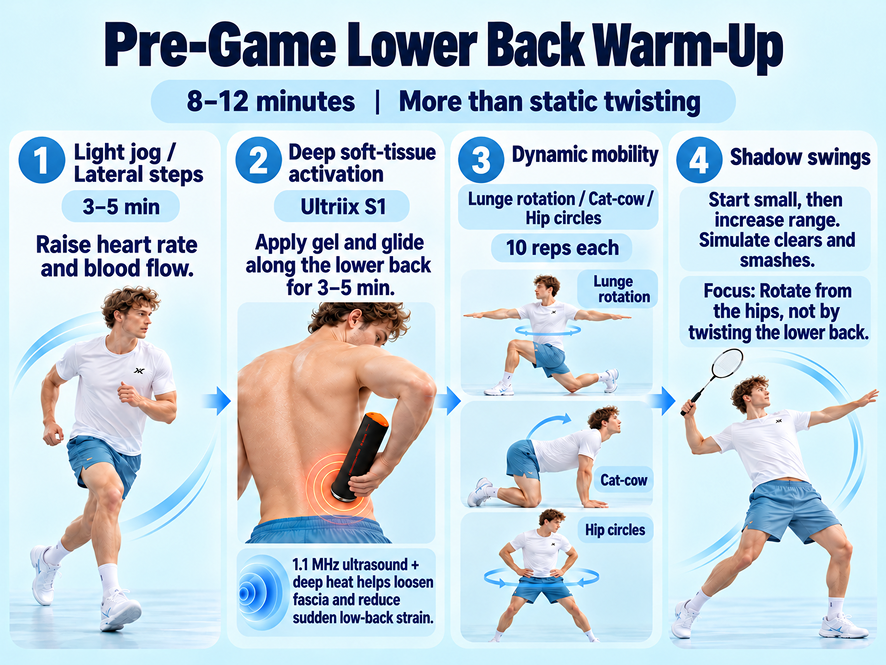
Just twisting your torso is not sufficient. The goal of back warm-up is raising tissue temperature, activating glutes and transverse abdominis, and linking hip and back movement so your lower back does not take over all the load. Recommended duration: 8–12 minutes, in this order:
1. Light jogging or side crossover steps for 3–5 minutes to raise heart rate and blood flow.
2. Deep soft-tissue activation with Ultriix S1: Apply gel before going on court and glide S1 along your back muscles for 3–5 minutes. Deep warming and micro-action loosen fascia in advance and lower your risk of straining your back during sudden direction changes.
3. Dynamic mobility: Lunge rotations, cat-cow, hip circles, 10 reps each.
4. Shadow swings: Start small and gradually increase range. Practice clears and smashes, focusing on rotating from your hips instead of twisting your lower back.
7. What kind of overhead smash leaves your back sore?
The main culprit is the arched, hollow-back smash.
Risks of smashing with a hyperextended spine: In this position, the back of your discs get squeezed hard, while the erector spinae contract intensely to hold your trunk.
● Short-term effect: Severe soreness and stiffness after playing.
● Long-term effect: Repeated abnormal loading wears down facet joints, creates tight trigger points in the erector spinae, and raises disc herniation risk.
Correct power sequence:
Push through feet → Rotate hips → Brace core to stabilize trunk → Let your arm follow naturally. Remember: A good smash comes from core stability and hip rotation. You do not need to arch your lower back drastically.
If you are still working on fixing this habit or feel stiff after intense matches, post-session recovery matters. Apply conductive gel and use Ultriix S1 along the erector spinae for 5 minutes of deep release. Its 1.1 MHz deep ultrasound helps soften tight trigger points from eccentric contraction, clear inflammatory metabolites, and restore muscle elasticity, stopping acute soreness from turning into chronic back strain.
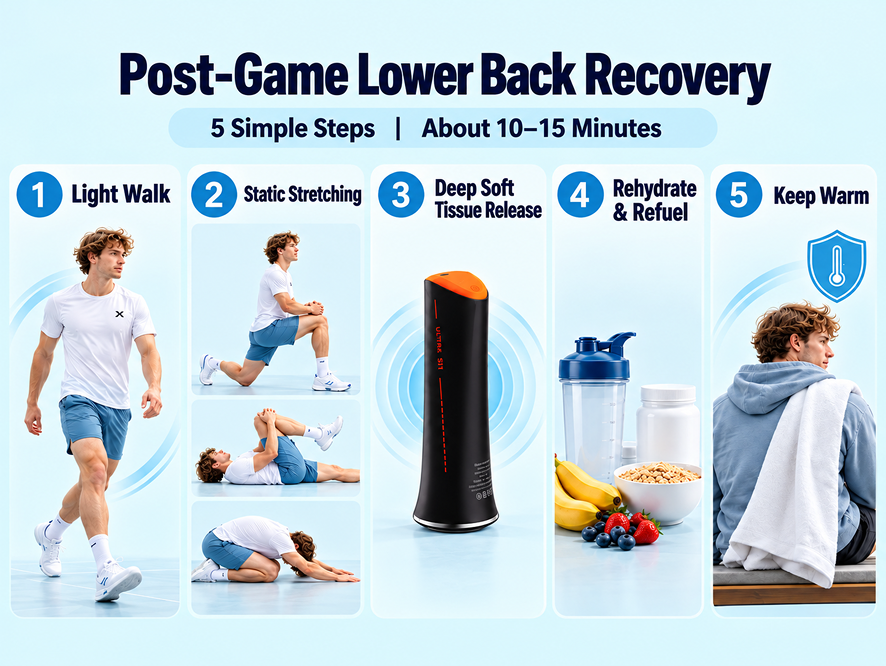
8. Standard post-play recovery routine for sore lower back.
1. Light cool-down (2–3 minutes): Slow walk on the sideline to bring heart rate down gradually.
2. Static stretching (around 3 minutes): Stretch lower back, hip flexors and glutes. Hold 20–30 seconds for 2 sets to ease initial muscle tightness.
3. Deep soft-tissue release with Ultriix S1, targeting erector spinae, quadratus lumborum and surrounding back muscles;
Instructions:
● Spread a generous layer of S1 conductive gel over your back muscles;
● Long press to power on, select a comfortable intensity, and glide the applicator slowly in circular motions;
● 5–8 minutes per session for the lower back, once daily;
4. Rehydrate and replenish protein and carbs to support muscle repair;
5. Keep your back warm. Cold drafts tighten fascia and worsen spasms.
9. Soreness on both sides of your waist: Quadratus lumborum tension and badminton back pain?
The quadratus lumborum sits along your flank, connecting ribs, lumbar spine and ilium. It stabilizes your trunk during side steps, reaches and rotational shots. Many players feel pain along the waist because this muscle overworks and develops trigger points, causing sharp pain when sitting, turning or stepping. Pre- and post-play stretching paired with deep release using Ultriix S1 is key to easing this type of flank pain.
10. Should you wear a back brace while playing?
It depends on the scenario:
1. When to wear one (temporary support)
If you are recovering from an acute back episode or about to play a high-intensity match, a rigid brace worn for a short time limits excessive spinal rotation and gives passive support.
2. Not recommended for regular training (risk of disuse weakness)
A brace acts like an external exoskeleton. Relying on it long-term makes your core and back muscles weaker. Once you take it off, your unprotected spine faces much higher injury risk.
Your best natural back brace is your own muscles.
Train glutes and core consistently, and release fatigued back muscles with Ultriix S1 after training. The 1.1 MHz pulsed ultrasound reaches deep tissue to soften hidden trigger points, preserving the flexibility of this natural muscular support system. This is the sustainable way to reduce strain.
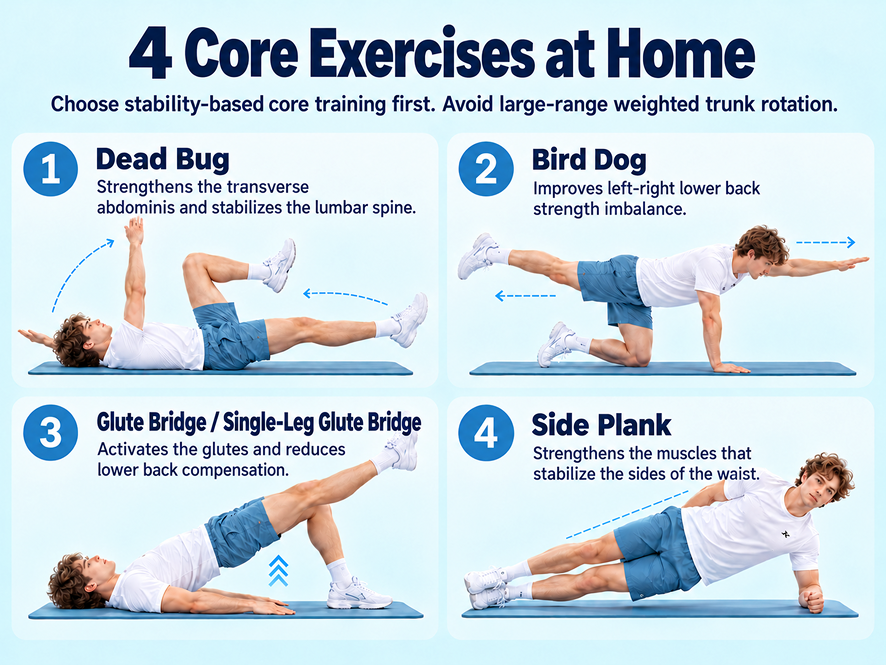
11. Four home core exercises to stabilize your back and reduce lumbar compensation.
Focus on stability work; avoid heavy twisting movements:
1. Dead bug: Strengthen transverse abdominis and stabilize the lumbar spine;
2. Bird-dog: Fix asymmetric strength imbalance along the back;
3. Glute bridge / Single-leg glute bridge: Activate glutes and reduce back compensation (glutes are the hidden solution for back pain);
4. Side plank: Build stabilizers on the flank. 2–3 sessions per week, around 15 minutes each. Important: Keep your spine neutral through the whole movement; do not arch your lower back.
Pro tip: Combine training with Ultriix S1 for better results
Pair strength training with Ultriix S1 to build your “muscular brace” faster:
● Before training (fascia release & muscle activation): Glide S1 slowly over quadratus lumborum and erector spinae for 3 minutes. Warming and micro-release dissolve stiffness built from sitting, so your back muscles engage more clearly during training.
● After training (relieve tightness & speed recovery): Core work often leaves tightness and lactic acid in the lower back. Use S1 for a 5-minute deep ultrasound session right after training to boost circulation, ease healthy training fatigue and keep muscles supportive instead of stiff.
12. Mattress & sleeping posture — do they affect your back for badminton?
Yes. If you already have back strain, an overly soft mattress lets your spine bend or curve overnight, leaving you stiff for the next match. A medium-firm mattress, a pillow between knees when side-sleeping, or a pillow under your knees on your back helps keep your spine near neutral. Sleep is the prime repair window. Poor rest for your back cannot be fully fixed by warm-up the next day.
13. If you already have back soreness from sitting: How to lower injury risk before playing?
Chronic soreness from desk work means your abdominal and glute muscles are stuck in a cycle of tightness plus weakness. Jumping straight into intense badminton raises injury risk greatly.
● At work: Do not sit for hours nonstop. Stand once every hour for one minute, stretch gently or do simple glute bridges and cat-cow to wake up sleepy glute and back muscles.
● On game day: Before dynamic stretches, use Ultriix S1 for 3–5 minutes to release tight back muscles, then move into lunging rotations and other dynamic warm-ups to fire up glutes and core.
14. Long-term goals for back care — how to tell it is working.
Long-term goal: Rebuild your kinetic chain. Let hips and glutes generate power while your back only stabilizes, without forced compensation. Signs of improvement:
1. No persistent back soreness after playing;
2. No pulling sensation in the lower back during deep-court shots; power comes from glutes and legs;
3. Morning stiffness disappears; bending and turning feel free;
4. Trigger points soften and recurring back pain happens less often.
Conclusion
Back injuries in badminton are not an unavoidable price of playing. Most chronic lower back pain comes from poor technique, skipped warm-up and incomplete recovery. Many players focus only on skill improvement and ignore soft tissue health until pain becomes persistent.
Build a complete back-care routine: Pre-game activation with Ultriix S1 plus dynamic warm-up, hip-led rotation while hitting, post-play stretching paired with deep fascial release on Ultriix S1, plus regular core and glute training. As a deep fascia release tool, Ultriix S1 targets tight trigger points in the erector spinae, quadratus lumborum and other back muscles, filling the gap left by stretching and foam rollers. Care for your back, and unlock better performance on court.