
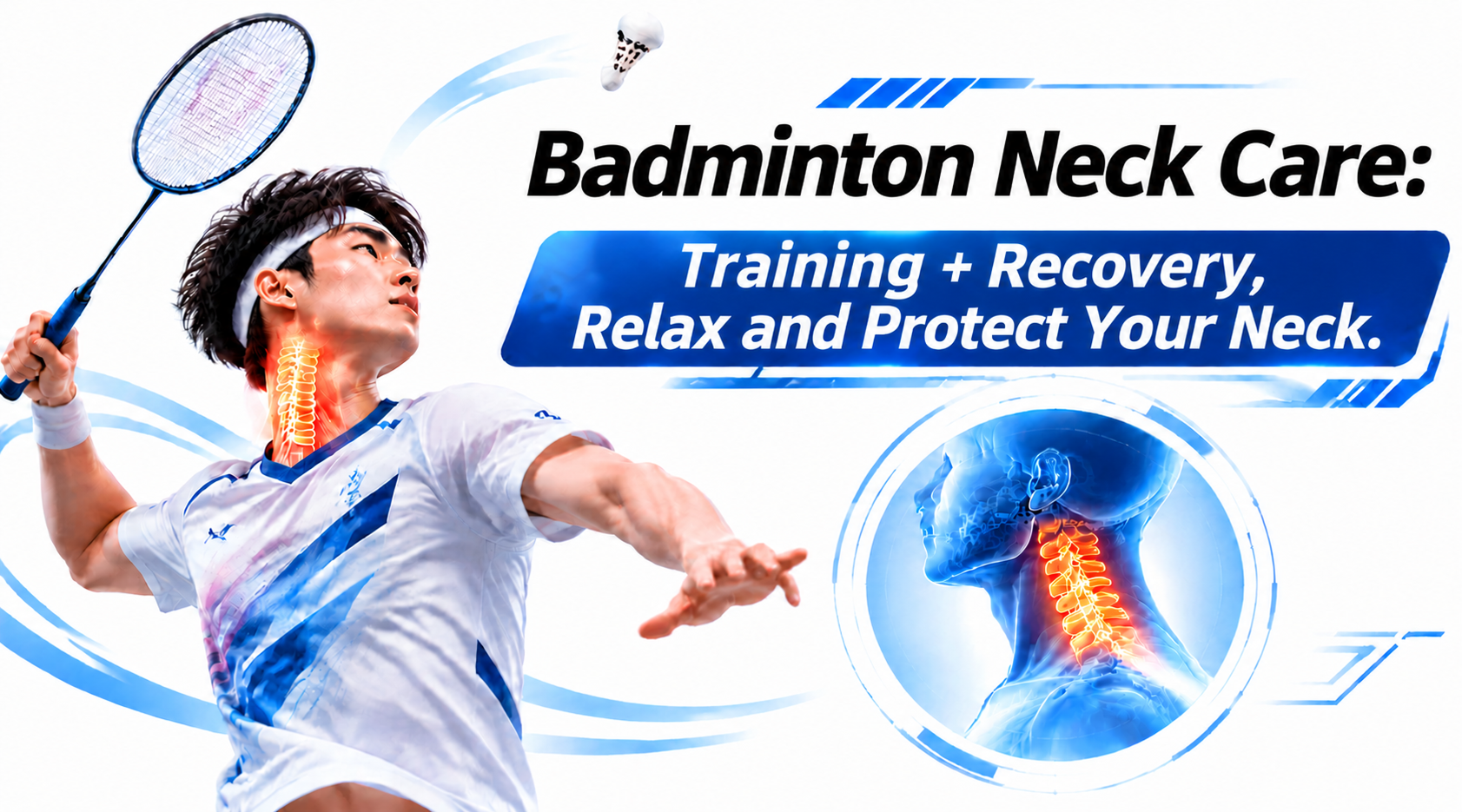
After an energetic badminton session, sore arms and tired thighs are expected. But there is a quiet fatigue that builds subtly with every upward gaze to track the shuttle and every rotational swing— strain in your cervical spine.
Many players believe “badminton cures neck pain.” This is only partially true. For those who spend long hours at a desk with stiff neck and shoulder muscles, moderate badminton can help loosen tight tissue. However, if you already have structural cervical issues, repeated rapid backward tilting, rotation and sudden stops during play can worsen symptoms.
1. Why does badminton so often lead to neck soreness?
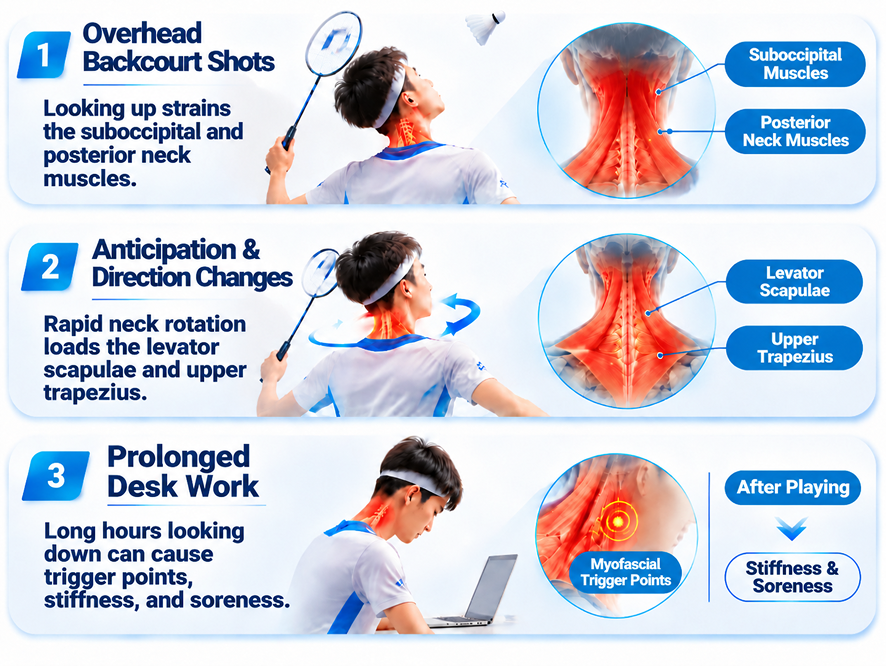
Neck strain from badminton comes from three main types of repeated mechanical load:
First, sustained upward tilting during backcourt shots keeps the suboccipital and posterior neck muscles lengthened and tense for long periods.
Second, fast, large neck rotations when anticipating the shuttle and stretching to retrieve wide shots trigger repeated eccentric contraction of the levator scapulae and upper trapezius.
Third, most players sit hunched over screens daily with weak foundational neck muscles. Poor muscle endurance means fatigue sets in faster on court. Persistent muscle tension creates fascial knots, leaving you stiff and sore after play.
2. Can casual “social badminton” still hurt my neck?
Risk in casual play lies not in intensity, but in movement habits. Even during gentle rallies, if you frequently overreach — craning your neck far back to reach a shuttle that is already overhead — that single extreme backward tilt can place more stress on the cervical spine than a well-executed smash. Many recreational players also skip warm-up. Cold neck muscles forced into fast movement have a higher risk of strain.
3. Which movements carry the highest neck injury risk?
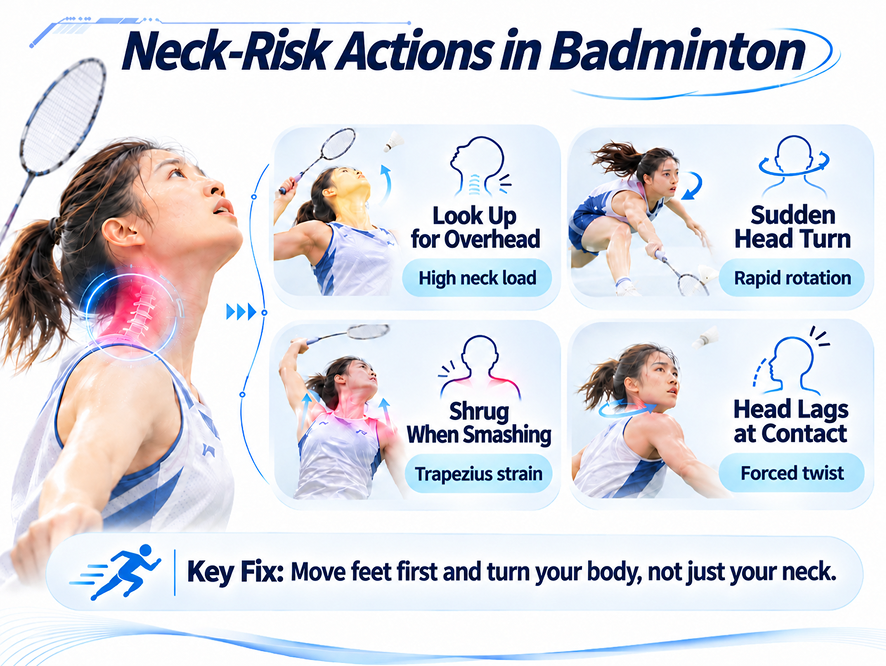
1. Staying anchored and tilting far back to receive high clears: constant backward tilt overloads suboccipital muscles.
2. Sharp, sudden head turns when diving for wide shots.
3. Shrugging while powering smashes, with the trapezius working overtime to compensate.
4. Reaching the shuttle with your body but lagging your head, forcing a hard twist to track the shuttle.
Key point: Move your feet first, turn your torso sideways, and avoid relying purely on neck rotation to line up the shuttle.
4. Is badminton a cure for cervical problems?
Therapeutic exercise can help in the right scenario. For cervical spondylosis limited to neck stiffness and soreness without nerve compression, low‑intensity badminton during symptom‑free phases, paired with proper form, can strengthen neck‑back muscles and counteract poor posture.
Risks are very different for radiculopathy, myelopathy or vertebral artery issues. If you experience hand numbness, a “cotton‑wool” walking sensation, or dizziness and nausea when turning your head, fast rotational sports like badminton will not heal your neck and may trigger acute flare‑ups.
To unlock real benefits from exercise, training alone is not enough. Neck and back muscles need both conditioning and recovery.
Alongside low‑intensity badminton, use ULTRIIX S1 for post‑session deep soft tissue release and ongoing maintenance. It relaxes tight neck‑back muscles and preserves fascial elasticity, balancing muscle loading and recovery.
5. Why overstretching the neck can cause harm?
The safe range for neck stretching is narrow. When you force your head sideways and feel sharp pulling instead of gentle lengthening, your muscles are already in protective contraction. Pushing further will backfire. Good neck stretching should be slow, sustained and pain‑free. Guide your head gently with your hands; do not yank it.
6. Why ULTRIIX S1 offers a much safer margin on the posterior neck than massage guns?
The neck is a delicate region. The front contains the carotid sinus, trachea and thyroid. The posterior neck sits over bony spinous processes and the spinal canal. High‑impact percussion from massage guns near bony prominences or major blood vessels carries risk.
ULTRIIX S1 ultrasonic energy creates no mechanical impact. Its 1.1 MHz ultrasound penetrates gently into deeper soft tissue. Even resting the massage head near bone will not create jarring, collision‑style trauma. A faint tingling sensation over periosteum is normal standing‑wave feedback from sound meeting bone, not tissue damage.
Operation is also easy to control. Apply plenty of conductive gel, glide the head slowly over posterior neck muscles, and target the upper trapezius, levator scapulae muscle belly and suboccipital area. There are 8 adjustable power levels. Start low and adjust based on your comfort.
ULTRIIX S1 uses sound waves for gentle penetration. With no physical impact, it won’t harm bones or irritate the skin, making it ideal for the delicately structured neck.
7. Recommended & Restriced Neck Areas for ULTRIIX S1
Simple rule: Focus on the back neck; avoid the front neck. The nuchal ligament, upper trapezius and splenius muscles at the back are where badminton strain most commonly builds. These areas respond well to slow, gentle ultrasonic release. The front neck, including the anterior side where carotid arteries run and the midline tracheal area, is strictly off‑limits for all massage devices.
8. Science‑based pre‑game neck warm‑up to prevent strain
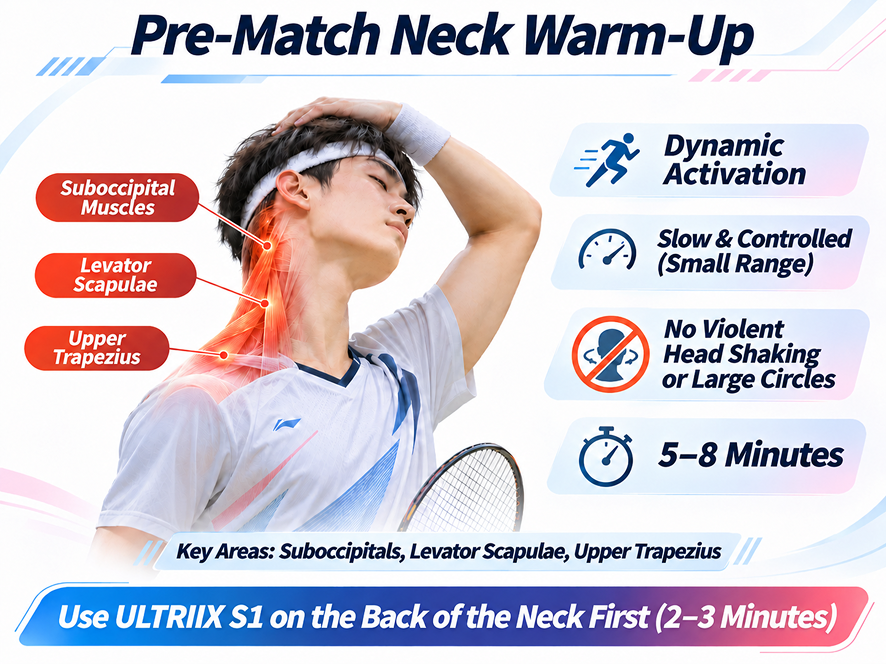
Warm‑up principle: dynamic activation, small slow movements. Never whip your head or make large circular neck rolls. The full sequence takes 5–8 minutes.
Before dynamic warm‑up, spend 2–3 minutes on the suboccipital region, levator scapulae and upper trapezius with ULTRIIX S1. This relaxes pre‑existing tightness and improves soft tissue elasticity to prepare your neck.
Dynamic warm‑up drills:
1. Chin tucks (activate deep neck flexors): Look straight ahead, pull your chin horizontally back to make a double chin, hold 5 seconds, 10 reps.
2. Slow controlled head rotations: only to roughly 70% of your maximum range, pause 2 seconds each side, 8 reps.
3. Gentle side flexion: bring your ear slowly toward your shoulder without shrugging, 8 reps each side.
4. Shoulder girdle circles: roll shoulders forward, up and back to release linked neck‑shoulder tension.
5. Mild suboccipital activation: tiny, slow nodding motions.
The goal is to boost blood flow and improve tissue quality, not chase maximum range of motion.
9. Correct post‑session routine for stiff necks with ULTRIIX S1
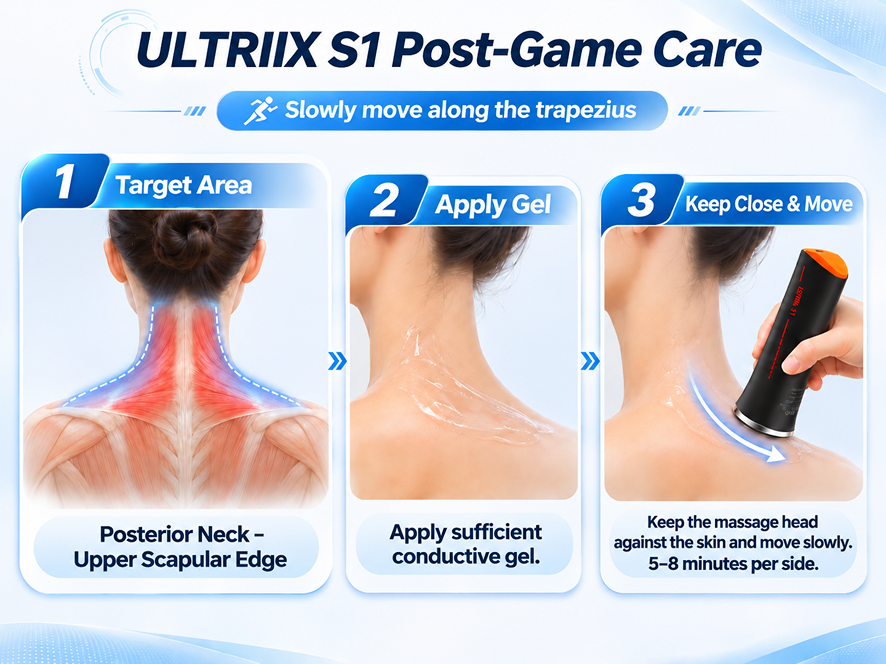
If you only have stiffness and soreness, no swelling, heat or sharp nerve pain, wait until your heart rate settles after play before using ULTRIIX S1. It delivers gentle deep release to fatigued muscles and improves local circulation.
Step‑by‑step guide:
1. Apply a generous layer of conductive gel.
2. Keep the massage head in contact with skin. Focus on the zone from the base of the occipital bone down toward the upper scapular edge, following the trapezius. 5–8 minutes per side.
If you suffer an acute neck sprain, swelling, heat or nerve symptoms after play, seek medical help immediately and do not self‑treat.
10. Ice or heat for post‑play neck soreness?
It depends on the injury type. For sudden sharp pain during play with swelling or limited movement, use ice within 48 hours for 15 minutes at a time to reduce inflammation by constricting blood vessels. For dull, widespread stiffness and soreness that develops the next day — delayed onset muscle soreness or accumulated chronic strain — heat therapy works better. Moist heat outperforms dry heat. Use a warm damp towel or moist heat pack at 40–50°C for 10–15 minutes over the posterior neck to ease muscle tone and boost blood flow.
Follow heat therapy with gentle deep release using ULTRIIX S1. Apply gel, glide slowly over posterior neck muscles, 3–5 minutes per side. Heat opens superficial circulation, while ultrasound reaches deeper fascia. Combined, they outperform heat alone.
Skip this during acute inflamed pain and swelling; rest first.
11. Long‑term maintenance for chronic neck strain from badminton.
Chronic neck strain comes from persistent tightness and fascial adhesions in posterior neck muscles, creating recurring stiffness. Rest alone only eases discomfort temporarily. If swing patterns remain unchanged, neck tissue gets pulled repeatedly, and soreness quickly returns once you play again.
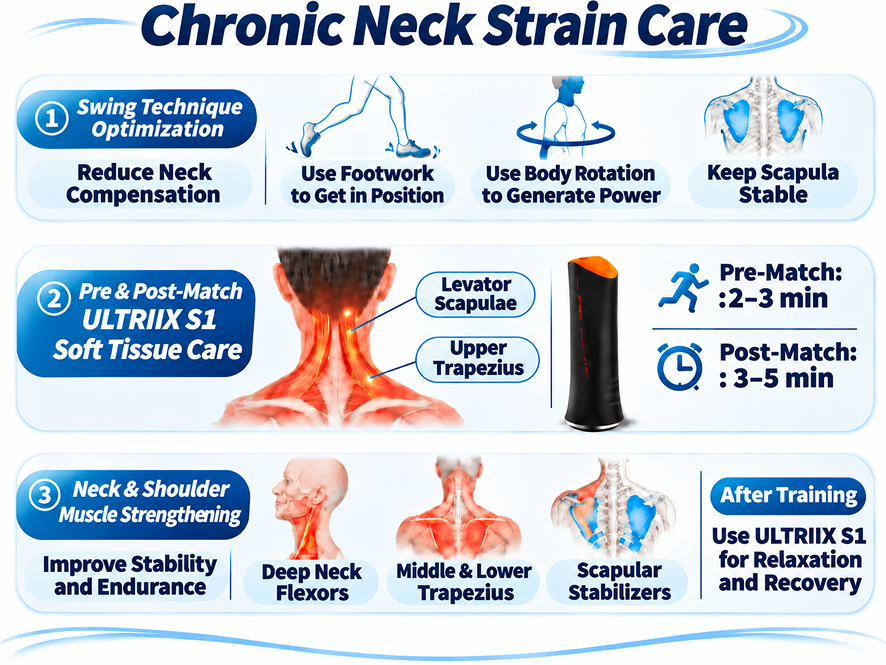
Effective maintenance relies on three pillars:
① Refine swing mechanics
Reduce neck compensation. Position yourself with footwork and torso rotation instead of craning or twisting your neck to reach the shuttle. A stable scapula means your neck muscles do not need to overwork.
② Pre‑game and post‑game soft tissue care with ULTRIIX S1
Pre‑game: Glide slowly over upper trapezius and levator scapulae for 2–3 minutes to boost tissue readiness for swinging.
Post‑game: Deep release to ease tightness and improve circulation, 3–5 minutes per side.
③ Strengthen neck and shoulder stabilizers
Focus on deep neck flexors, lower and middle trapezius and scapular stabilizers. Strong supporting muscles absorb load during swings and reduce neck compensation. Use ULTRIIX S1 after strength training to release training‑induced tightness and support recovery.
12. Why scapular stability matters more than “strong neck muscles”?
This is a commonly overlooked connection. The scapula is the foundation for all arm movement. Poor scapular control creates misaligned force vectors on every swing, forcing neck muscles to compensate for stability. Case observations on badminton athletes show that four weeks of scapular motor control training significantly reduces neck‑shoulder pain, with benefits lasting through follow‑up.
After scapular stability drills, use ULTRIIX S1 to release the mid‑lower trapezius and periscapular soft tissue. This relieves training tightness and supports circulation, so your strength training actually protects your neck.
13. How much does sleep posture affect neck recovery?
A great deal. After intense badminton, neck muscles are fatigued and mildly irritated. Sleeping face down (forcing your head to twist for breathing) or using an overly high pillow that locks your neck in forward flexion turns seven hours of rest into seven hours of static strain.
Use ULTRIIX S1 for gentle neck release before bed, 3–5 minutes per side, to shift your neck out of tension mode and support overnight repair. Sleep guidance: On your back, choose a pillow that fills the hollow behind your neck and keeps your head neutral. On your side, pillow height should match your shoulder width to keep the cervical and thoracic spine aligned.
Relax before bed and fix your posture — only then does seven hours sleep become true recovery.
14. Red flags that mean you must stop playing immediately
Stop right away if you notice any of these: radiating numbness down your arms or fingers during or after play; sudden vertigo or blurred vision when turning your head; severe neck pain paired with headache or fever; the feeling of walking on cotton, or poor grip control. These are not simple muscle aches — they are warning signs from nerves or blood vessels.
15. Three common mistakes badminton players make with neck care.
Mistake 1: Aggressive deep massage or forceful neck manipulation when stiff. Relief may feel instant, but blood vessels and ligaments can be damaged.
Mistake 2: Skipping warm‑up, or warming up with violent head circles.
Mistake 3: Relying only on massage tools and skipping deep neck strengthening. Release relieves symptoms temporarily; without strength, strain comes back quickly once you play.
16. When should you see the doctor?
Seek prompt care if you experience any of the following:
● Pain radiating into your arm or fingers with numbness, tingling or electric‑like sensations
● Dizziness or blackouts triggered by turning or tilting your head to track the shuttle
● Severe neck pain that does not improve after 1–2 days of rest, or pain waking you at night ● Noticeable loss of hand strength
● Persistent abnormal sensations in the neck
● Acute neck trauma
● Additional systemic warning symptoms
Closing
On court, we focus on every shot: footwork, power, placement. Yet few give the same care to the cervical spine that twists, tilts and resets for every swing.
It is not the flashiest structure, but it carries quiet, constant load.
Start today: add two minutes of chin tucks and scapular retraction to your warm‑up. After a smash, consciously tuck your chin instead of letting your head fling back. On the evening after your game, use ULTRIIX S1 to give your posterior neck a quiet moment of release.
Your neck cannot speak, but it remembers every kind choice you make for it. In return, it lets you turn freely, track the shuttle clearly and keep playing longer.