

Whether you sit at a desk for long hours, bend frequently in daily life, or twist and jump during sports, many of us have experienced this: even without an acute sprain, your lower back often feels tight and achy. It may stiffen up when you stand after sitting, or linger with dull discomfort after exercise. Back pain is no longer just an issue for older adults. Office workers and sports enthusiasts frequently struggle with lower back discomfort. Many simply dismiss back soreness as fatigue, easing it with a quick rub or heat pack, only for the discomfort to return again and again.
The lower back is prone to soreness, stiffness and discomfort mainly due to the conflict between human evolutionary structure and modern lifestyles. Simply put, the lumbar region acts as the body’s central load-bearing hub, yet it must also maintain high mobility — a structural design that comes with inherent challenges.
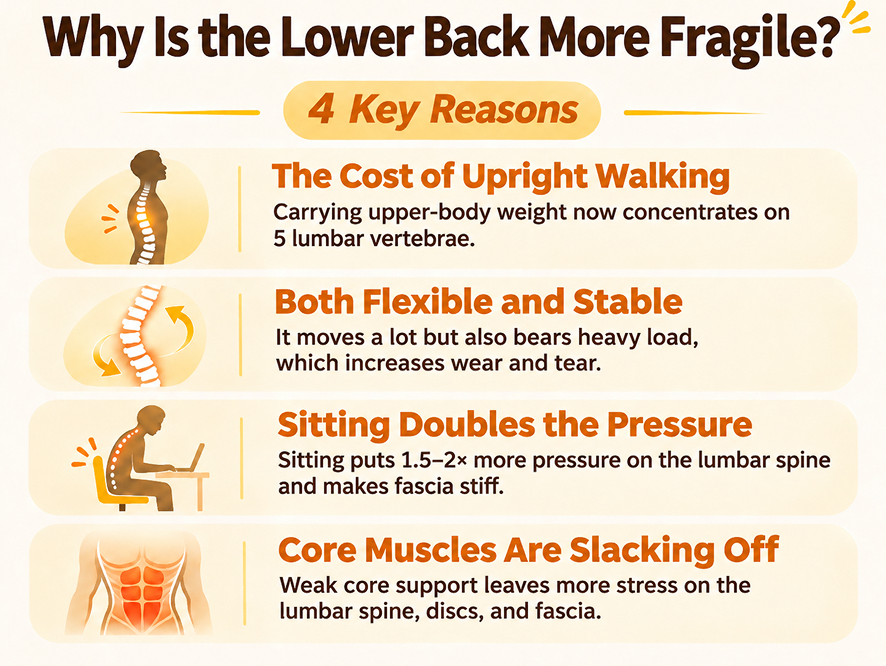
The evolutionary cost of bipedal walking:
As humans evolved from quadrupedal crawling to upright walking, the spine shifted from functioning like a horizontal beam to a vertical load-bearing pillar. The lumbar spine sits at the bottom of this pillar. It supports the weight of the entire upper body and absorbs impact forces from the ground when we walk, run, jump and land. When walking on all fours, body weight is shared across four limbs. Once upright, all upper-body load falls onto the five lumbar vertebrae, which are inherently under greater stress.
The conflict between mobility and stability:
The lumbar spine (L1-L5) is a highly flexible joint complex that enables bending, backward extension and rotation. Everyday movements such as picking up objects, as well as volleyball spikes and rotational serves, require large ranges of lumbar motion. Yet while moving, the lumbar spine also bears loads of dozens of kilograms. A structure that must bend and rotate freely while continuously supporting heavy weight is like a bracket repeatedly flexing under load. The more mobile a structure is and the greater the force it carries, the higher the chance of wear and strain.
Increased pressure from prolonged sitting:
Many people believe sitting or lying down is easiest on the back, but this is not true. Intervertebral discs endure 1.5 times more pressure when seated compared to standing. Poor sitting postures such as slouching or leaning forward can push disc pressure to over twice that of standing. Sustained high pressure accelerates the loss of water content and degeneration of intervertebral discs. When sitting for hours, the fascia of the lower back stays fixed in one length. Synovial fluid within fascia slows down, and adhesions gradually form — this is why many people feel stiff the moment they stand up after sitting.
Underactive core muscles:
The lumbar spine does not function in isolation. It relies on the abdominal muscles, back muscles, transverse abdominis and multifidus to act like a natural supportive corset and stabilise the spine. Many modern people lack consistent training, leaving these deep core muscles weak and poorly activated. When muscles cannot provide adequate support, stress transfers directly to the lumbar vertebrae, intervertebral discs and back fascia. This triggers compensatory muscle spasms (lumbar strain), fascial adhesions, and in severe cases, herniated discs.
Why is it recommended to use ULTRIIX S1 for targeted care?
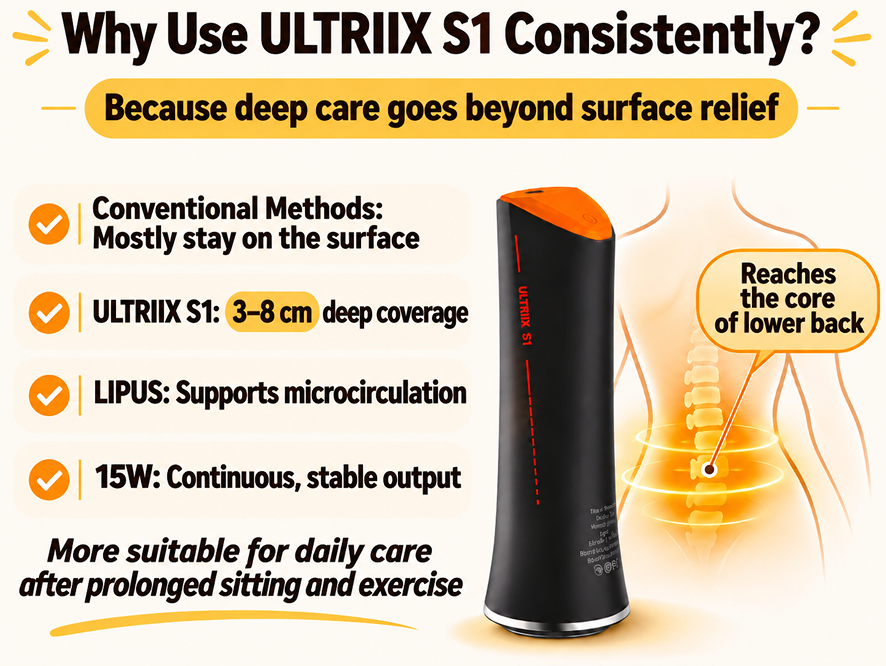
Most lumbar strain develops in deep muscles (such as the multifidus) and around the lumbar joints. Common tools like massage guns, manual kneading and heat therapy mostly work only on the skin surface and shallow fascia. They can hardly reach tense deep muscles around the spine and only relieve superficial soreness temporarily — which is often described as “treating the symptoms but not the root cause”. To truly ease persistent deep tension, a shift in underlying technology is needed. This is why consistent daily care with ULTRIIX S1 ultrasound massager is recommended.
Operating at 1.1MHz, ULTRIIX S1 delivers strong physical penetration, guiding acoustic energy 3–8 cm beneath the skin. It relaxes not only superficial latissimus dorsi muscles but also deep core muscles surrounding the lumbar spine, targeting the source of stiffness and adhesions directly.
Unlike impact massage guns, manual pressure or simple surface heat, pulsed ultrasound (LIPUS) creates microscopic mechanical stress and deep warming effects inside tissues. It effectively boosts local microcirculation, supports cellular metabolism of damaged muscle fibers, accelerates the clearance of aseptic inflammatory factors that cause soreness, and gradually releases deep fascial adhesions.
ULTRIIX S1 delivers a maximum effective acoustic power of 15W for stable, consistent energy output. For stubborn muscle spasms and fascial tightness built up from long hours of sitting or sports, this controlled deep energy safely helps break adhesions and restore the natural elasticity of fascia.
Discomfort in the lower back rarely stems from one single severe injury. It accumulates gradually day after day. Traditional ultrasound devices are usually bulky and wired, limited to clinic use. The wireless, portable design of ULTRIIX S1 removes location restrictions. You can enjoy deep relaxation at the office, at home or during leisure time, and intervene early before minor strains turn into long‑term, irreversible discomfort.
ULTRIIX S1 Usage Guide
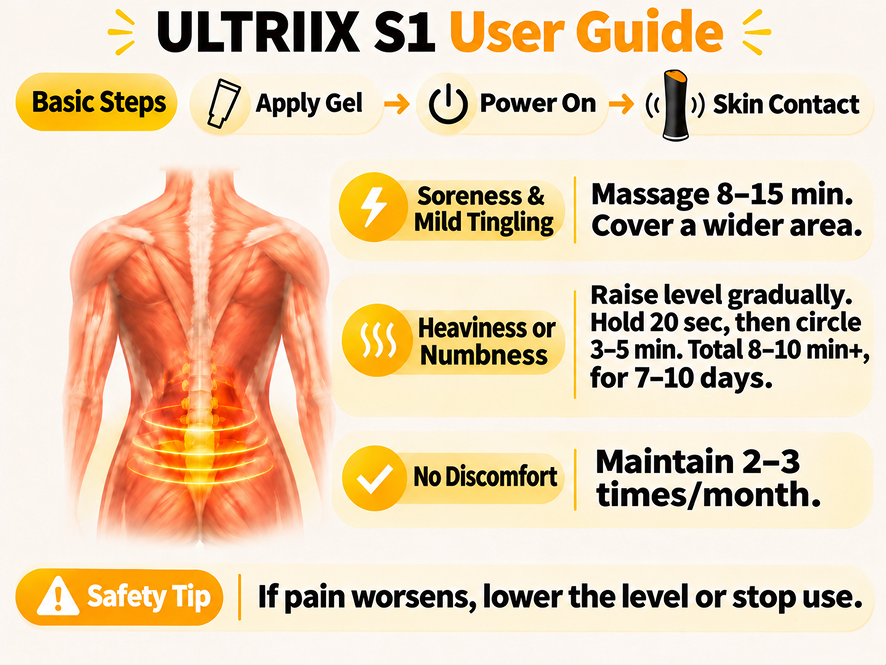
✅ Basic operation steps: Apply sufficient ULTRIIX S1 conductive gel ➔ Long press to power on ➔ Place against skin to start massage
Three typical sensory responses may appear depending on the condition of your muscles and fascia, with corresponding adjustments below:
🔹 Sensation 1: Obvious soreness or mild tingling (common in strained areas or old injuries)
This is a normal response when ultrasound acts on damaged soft tissue. If the tingling and soreness are tolerable, stay at the current level and massage for 8–15 minutes. 💡 Tip: Do not only focus on the most painful spot. Expand your massage range to cover connected muscles and fascia around the tender area.
🔹 Sensation 2: Dull discomfort normally, yet only warmth or almost no feeling during massage (common with deep stiffness and severe fascial adhesions)
This happens when fascia stays tight for a long time and nerve endings become less sensitive. It is a type of chronic strain easily overlooked.
● Adjust intensity: Increase the level gradually (8 levels total, max effective acoustic power 15W)
● Technique: Hold the probe steady on the uncomfortable area for about 20 seconds, then move in small circles. After 3–5 minutes, expand the range outward. A single session should last at least 8–10 minutes.
● Expected progress: Deep adhesions cannot be released in one session. Use it consistently for 7–10 days, and most users will feel the tightness ease gradually.
🔹 Sensation 3: No obvious discomfort (healthy soft tissue, preventive maintenance)
If your lower back moves freely with no painful trigger points, this is maintenance mode and frequent use is unnecessary. Deep fascial care 2–3 times per month is enough.
💡Tip: Zero pain does not mean fascia carries no load. Regular deep relaxation is key to preventing future strain.
⚠️ Critical rule: Conductive gel is an indispensable medium.
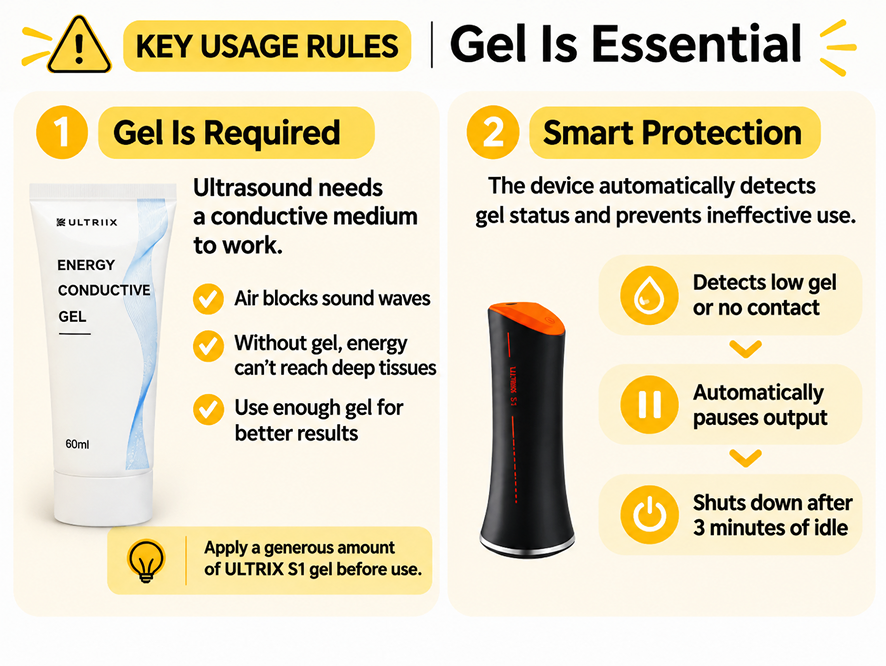
Gel is an essential medium Ultrasound energy relies on conductive media for transmission. Air blocks sound waves. Without gel or with insufficient gel, energy cannot penetrate deep under the skin, and the relaxing effect will be greatly reduced. Always apply enough ULTRIIX S1 conductive gel before use. The device features an intelligent no‑load protection system that detects gel coverage. It automatically pauses ultrasound output when gel is insufficient or the probe is not properly attached. If the no‑load state lasts more than 3 minutes, the unit will shut down automatically to avoid ineffective sessions.
Conclusion
The vulnerability of the lumbar spine is built into our upright anatomy, and it is worsened by long hours of sitting, compensatory movement patterns and sports loads. Heat therapy and massage guns relieve surface discomfort, yet the root of many lumbar issues lies deep below, within muscles and fascia. Using ULTRIIX S1 to release deep tight tissues, paired with good posture habits and regular core activation training, creates a two-pronged strategy to reduce recurring fascial adhesions. Back care should not only start when pain appears. Understanding how load impacts the lumbar spine and integrating deep tissue release and stability training into daily routines lowers the risk of chronic strain, helping your lower back handle work and sport with greater ease.