
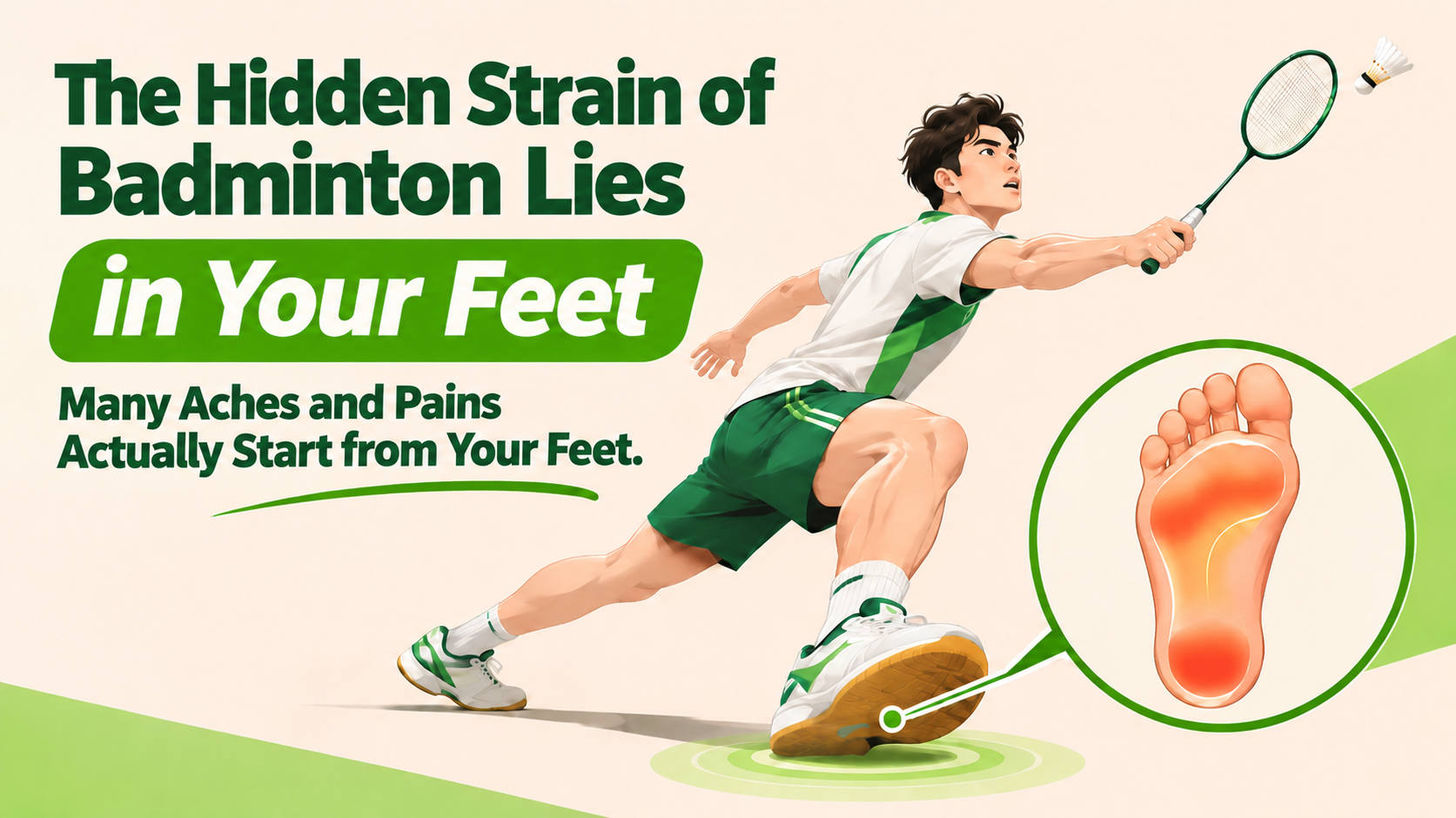
If you have finished an intense badminton match, you know the feeling: sore thighs, heavy shoulders and tight calves. Few people notice that your feet bear the biggest load on the court.
Badminton puts constant, invisible strain on your feet. You may cover 3–4 km in one session, mostly through sudden stops, pivots, lunges and jump landings. Your plantar fascia, Achilles tendon and small muscles around the ankles repeatedly absorb impact and stretching force.
We stretch sore legs and shake tight shoulders, but what about our feet? Most players pack up and leave right after the game. Heavy feet, aching arches and dull heel pain get pushed aside for “later”. Over time, these accumulated strains turn into plantar fasciitis, Achilles tendinopathy and chronic arch strain.
This article covers how to recover your feet after badminton, and how ULTRIIX S1 ultrasonic massager supports soft tissue recovery and deep foot care.
1. Foot loading in badminton: sudden stops, direction changes and landing absorption
Let’s understand where the stress comes from. The lunge is fundamental to badminton footwork. With every lunge to reach the shuttle, the plantar fascia stretches, the Achilles is pulled, and the ankle receives shear forces several times your body weight. Pivoting means you push off with your toes, lift your heel and rotate your torso, instantly spiking tension along the inner foot and arch. Every jump landing sends shock through the heel and arch.
Poor movement patterns during repeated pivots keep high tension on the long plantar ligament. The plantar fascia and triceps surae form a bowstring structure connected via the calcaneus, and they influence each other. Tight plantar fascia often comes with tight calves; tight calves in turn add extra load to the Achilles and heel.
For post-game foot care, you cannot only treat the sole. The plantar fascia, posterior calf, Achilles tendon and ankle soft tissues form a connected stress chain that needs holistic care.
2. High-arched feet: common injury risks for badminton players
A high arch means less contact area between the foot and ground, with naturally weaker shock absorption. The frequent lunges, jumps and landings in badminton create these risks:
● Landing force concentrates on the heel and forefoot, raising the chance of plantar fascia strain and metatarsal pressure pain
● Reduced ankle stability, higher risk of ankle sprains during jumps and direction changes
● Uneven weight distribution on forefoot metatarsal heads, leading to calluses, tenderness and metatarsalgia
● Calf muscles tend to stay tight, continuously pulling the Achilles and increasing the risk of Achilles tendinopathy
💡 Recommendation: Custom cushioned insoles help distribute pressure. Pair with ankle balance training to lower injury risk.
3. Flat feet: common injury risks for badminton players
Flat feet have collapsed arches. During frequent stops, pivots, lunges and jumps, the foot tends to overpronate (roll inward), disrupting lower-limb alignment and bringing multiple risks:
● Reduced arch shock absorption. The plantar fascia gets stretched repeatedly, which easily triggers plantar fasciitis
● Poor foot stability. Ankle control drops during fast net movement and lunges, significantly increasing sprain risk
● Overpronation pulls continuously on the calf and Achilles, raising the chance of Achilles tendinopathy and tibialis posterior strain
● Abnormal force travels upward to the knees, which may lead to shin splints and medial knee pain
● Foot and calf muscles work overtime to maintain stability, fatiguing quickly and accumulating strain during long rallies
💡 Recommendation: Use ULTRIIX S1 regularly to release small foot muscles. Wear badminton shoes with arch support while playing.
4. A widespread badminton foot complaint: plantar fasciitis
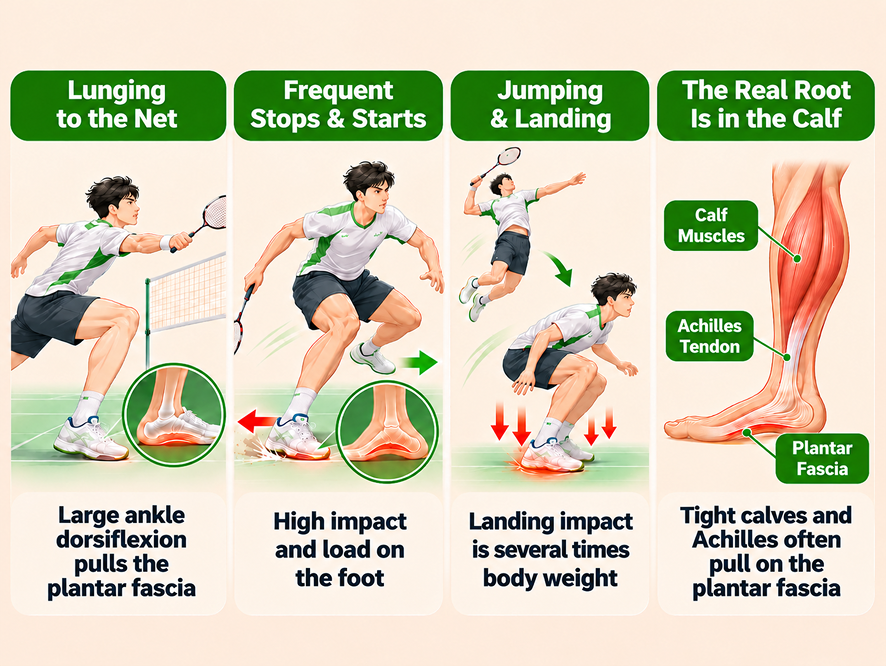
The plantar fascia is a thick band running from the heel to the toes. It acts like a bowstring to support the arch and absorb impact. Several key badminton movements repeatedly pull it:
Forward lunges to the net: this is the most common trigger. A deep lunge requires heavy ankle dorsiflexion, tightening the fascia and causing tiny micro-tears at its attachment point over time.
Frequent starts and stops: Badminton demands instant acceleration and braking. The plantar fascia must absorb shock and stabilize the foot under heavy load.
Jump landings: when you land after a smash, force on the plantar fascia can reach multiple times your body weight, accelerating tissue wear.
Plantar fasciitis is not always a foot-only problem. Tight calf muscles and a stiff Achilles are major contributors. The gastrocnemius and soleus connect to the heel through the Achilles tendon, and the plantar fascia attaches to the same bone. Chronically tight calves act like a taut rope, constantly pulling the plantar fascia origin and causing repeated micro-damage and irritation.
5. From micro-tears to rupture: 7 warning signs of Achilles injury in badminton
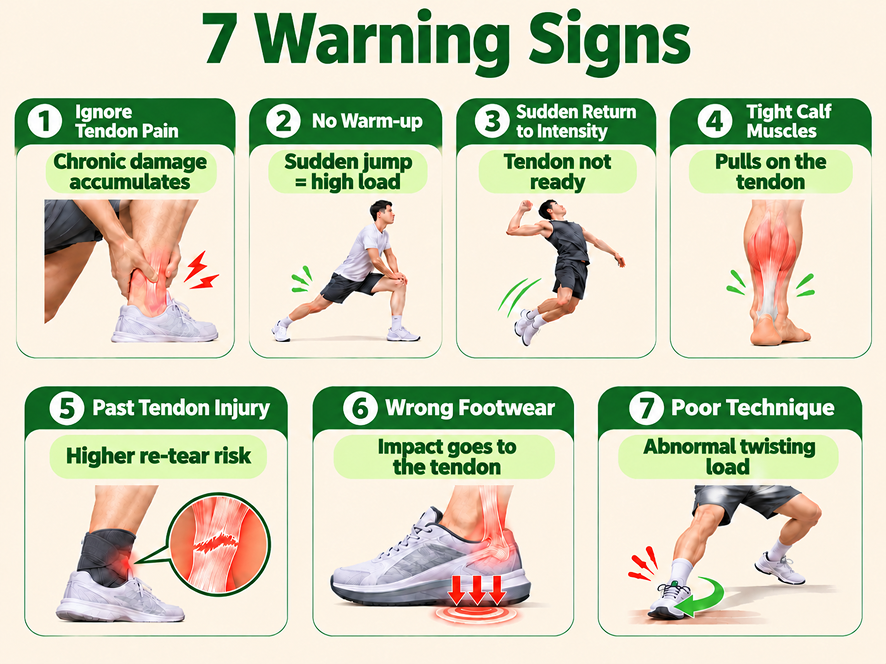
Most Achilles ruptures happen when the tendon already has unseen micro-damage, combined with sudden explosive force. Badminton’s jumping and lunging movements are high-risk. Common triggering scenarios:
● Playing through chronic Achilles soreness: repeated discomfort, tendon thickening and unhealed micro-tears weaken tendon fibre strength
● Jumping hard without adequate warm-up: cold calves and Achilles have low elasticity, unable to handle sudden peak tension
● Returning to intense play after a long break: tendons lose adaptability and are vulnerable during continuous jumping and pivoting
● Persistently tight calf muscles: the gastrocnemius stays contracted and pulls the Achilles, reducing its shock-absorbing capacity
● Previous Achilles injury history: healed tendon tissue is less flexible than original tendon, with higher rupture risk
● Unsuitable footwear: poor cushioning or stiff soles send landing shock straight into the Achilles
● Broken movement patterns: messy footwork or unstable centre of gravity creates abnormal twisting force on the Achilles during landing
Recommendation: Use ULTRIIX S1 for Achilles care. Release chronically tight calf muscles to reduce persistent pull on the Achilles, lower cumulative strain and maintain soft tissue elasticity. Glide the massage head slowly over soft tissue around the Achilles and the posterior calf (gastrocnemius and soleus). 3–5 minutes per side, 2–3 times weekly.
6. Pre-game foot warm-up routine
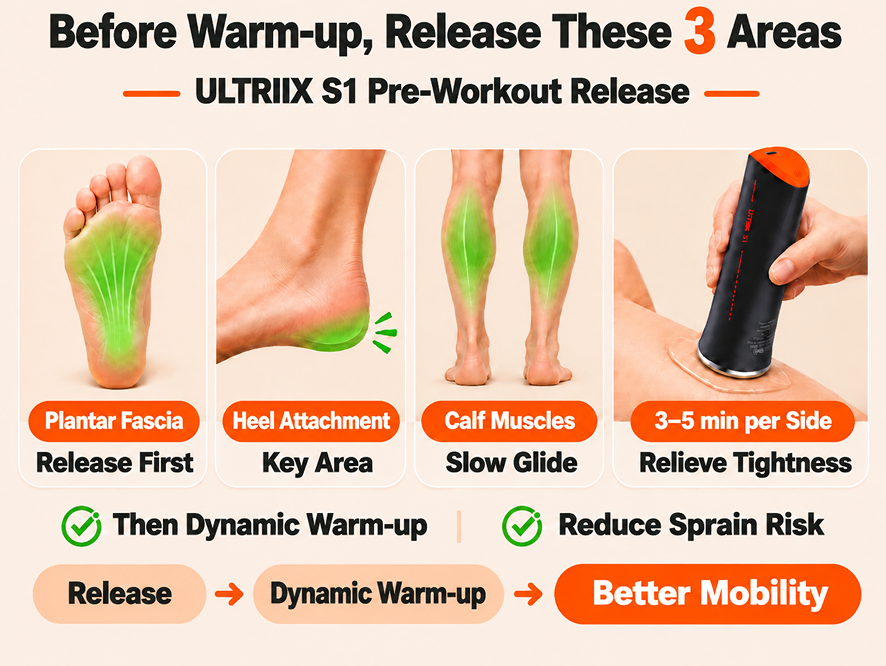
Before dynamic foot warm-up, use ULTRIIX S1 for pre-activity release. It softens stiff deep soft tissue and helps your warm-up work better. Focus on three high-tension zones: plantar fascia, heel attachment points, gastrocnemius and soleus. Glide the head slowly for 3–5 minutes per side. Ultrasonic relief eases pre-existing fascia tightness and tendon stiffness, reduces soft tissue adhesion and restores ankle mobility and arch flexibility.
After deep release with S1, move on to dynamic activation. This prevents stiff, restricted movement and greatly lowers the risk of foot strains and ankle sprains during lunges, stops and direction changes.
Full foot warm-up sequence:
1. Ankle circles (activate ankle joint)
● How to: Stand on one foot, lift the other, draw slow, large circles clockwise and counterclockwise (10 each). Switch feet.
● Tip: Move slowly, explore your full ankle range; avoid jerky shaking.
2. Plantar rolling (release plantar fascia)
● How to: Roll a tennis ball, golf ball or foot roller slowly under your foot from heel to forefoot for 1–2 minutes. Switch feet.
● Tip: Pause gently on tender spots, stay comfortable. This wakes small foot muscles for stopping and pivoting.
3. Calf raises and toe pulls (activate front and rear calves)
● Calf raise: Feet shoulder-width apart, lift heels slowly, hold 1 second, lower slowly. 15–20 reps.
● Toe pull: Stand with weight on heels, pull toes upward to feel front calf contraction, hold 1 second and release. 15–20 reps.
● Tip: Control the movement; do not bounce with momentum.
4. Toe curls (activate foot arch)
● How to: Barefoot or in thin socks, curl toes repeatedly as if grabbing a towel, 30 seconds–1 minute. Switch feet.
● Tip: Fully flex and extend toes to strengthen arch support.
5. Walking lunge calf stretch (dynamic posterior calf stretch)
● How to: Lunge forward, front knee bent, back leg straight with heel flat on the ground. Feel the calf stretch. Hold 15–20 seconds, switch legs, repeat 2 sets.
● Tip: Keep the back knee straight and heel down, shift weight gently forward.
6. Lateral activation drills (simulate badminton movement)
● How to: Short side shuffles, cross steps or backward jogging for 10–15 seconds each direction.
● Tip: Build intensity gradually, let ankles and feet adapt to coming stops and turns.
Notes
● Sequence: circles and rolling first, then dynamic stretching, then sport-specific footwork.
● Footwear: wear well-fitted supportive badminton shoes, laced snugly without squeezing the instep.
● Old injuries: players with recurring sprains can add resistance band ankle inversion/eversion drills or single-leg balance practice.
● Short-on-time minimum: ankle circles, calf raises and side shuffles give the best return.
Warm-up is not a formality. Your feet are your only contact point with the court. Good pre-game preparation means more stable movement and fewer injuries.
7. Three-step post-game foot recovery routine
Follow these three steps after playing:
Step 1: Static stretching (immediately after the game)
Do not sit down right away. Spend 3–5 minutes on simple static stretches: plantar fascia stretch (seated, pull toes toward your shin) and calf stretch (wall lunge, straight back leg with heel flat). Stretching helps overloaded surface muscles return to resting length, preparing tissues for deeper work.
Step 2: Deep release with ULTRIIX S1 (after stretching)
Target areas hard to reach with stretching: deep plantar fascia attachments, soft tissue around the Achilles and small overloaded muscles near the ankle. Stretching and hand massage often cannot reach these deep layers. The 1.1 MHz ultrasonic energy penetrates past the skin for deep soft tissue care, easing fatigue and micro-strain. 3–5 minutes per area is recommended.
Step 3: Daily maintenance (the next day and ongoing)
Foot care is not a one-time post-game massage. Arch tension and calf stiffness build slowly over time and require regular attention. Use ULTRIIX S1 on your feet and calves weekly.
8. ULTRIIX S1 for chronic plantar fasciitis
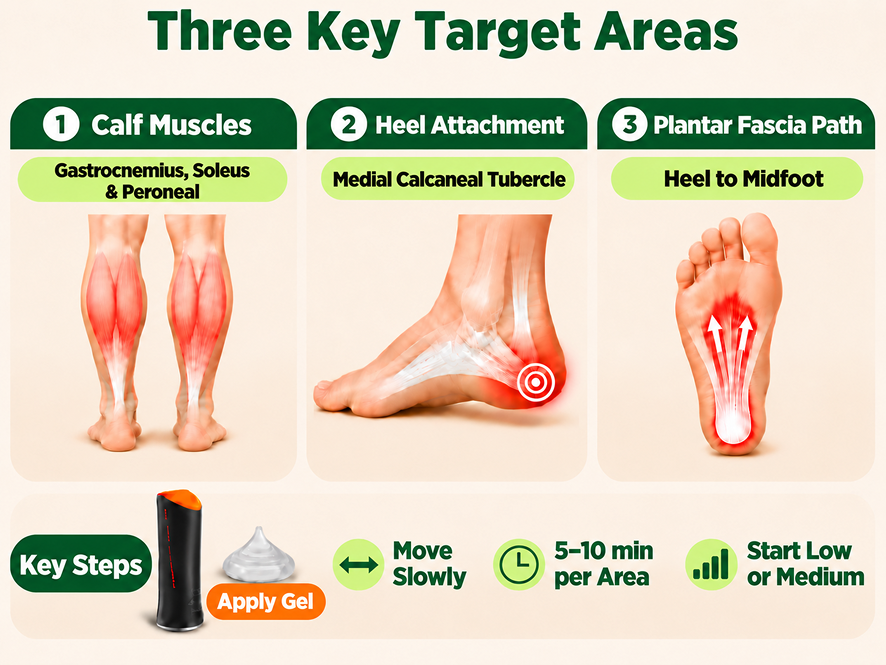
The S1's core approach for chronic plantar fasciitis: release upstream tension first. Work on posterior and outer calf muscles to reduce pulling force on the plantar fascia, then gently treat the sole.
Three key target zones
1. Posterior and lateral calf muscles (gastrocnemius, soleus, peroneals) Releasing calves breaks the tension chain and relieves deep persistent tightness.
2. Heel fascia attachment (medial calcaneal tubercle) This is where the plantar fascia bears the most load and often develops thickening. Targeted care here helps reduce local tension and discomfort.
3. Plantar fascia band (from calcaneus to midfoot) Glide along the longitudinal direction of the fascia, covering the central and medial bundles.
Operation tips: Apply a generous layer of conductive gel. Move the probe at a steady slow pace. Treat each zone for 5–10 minutes. Start on low or medium intensity for the sole.
9. Can you use ULTRIIX S1 for an ankle sprain after badminton?
Lunging for the shuttle or landing off-balance often causes an ankle sprain, which refers to injury to the lateral ankle ligaments. Management differs between the acute phase and recovery phase.
① Acute sprain (within 48 hours, swelling, redness, sharp pain when pressed)
✅ Follow the RICE principle immediately:
● Rest: Stop playing right away, avoid weight-bearing walking to prevent further ligament strain
● Ice: Apply intermittent ice to reduce swelling and inflammation
● Compression: Wrap gently with an elastic bandage
● Elevation: Sit or lie down, raise your foot above heart level to reduce swelling
If you heard a pop at injury, cannot stand or have severe swelling, seek medical help promptly to rule out ligament tear or fracture.
② Recovery phase (after 48 hours, swelling fades, skin is no longer red, subacute phase)
You may start soft tissue care once swelling subsides. After a sprain, peroneal calf muscles tend to stay tight and spasmed, continuously pulling the injured lateral ligament. This may lead to chronic ankle instability and repeated sprains.
ULTRIIX S1 guidelines: adjust intensity based on your comfort. Do not place the probe directly on the damaged ligament site. Work on calf and surrounding ankle soft tissue with conductive gel. Ultrasonic energy helps relax tight calf muscles, lowers persistent pulling force on ankle ligaments, improves the condition of peri-ankle soft tissue and reduces the chance of re-spraining.
Long-term protection tips:
● Add ankle strength training during recovery to boost stability
● Stick to regular deep soft tissue care with ULTRIIX S1
● Complete dynamic ankle and calf warm-up before play, wear professional badminton shoes
● Wear an ankle brace during play if you have chronic instability
● Visit a rehabilitation specialist if you keep spraining your ankle or feel unstable while walking
10. Can you use ULTRIIX S1 directly over bony ankle bumps?
Foot muscles are thin, so you may wonder if the device can touch bone. Yes. ULTRIIX S1 can safely contact ankle bony prominences and will not harm bone. Ultrasonic energy is gentle and safe over bone. However, bone does not absorb ultrasonic energy, so you will not get a care effect directly on bone. Focus the massage head on ligaments, tendons and fascia around the bone, where soft tissue can absorb the energy.
11. Can ULTRIIX S1 be used on blisters, scrapes or broken skin?
If you have blisters, cuts or abrasions, your skin barrier is compromised. Do not use any massage device over broken skin, including ULTRIIX S1. Avoid damaged areas completely, or wait until the skin is fully healed before using it for soft tissue care.
12. Four warm-up drills to reduce Achilles injury risk
These four drills greatly lower Achilles injury chances:
① Ankle rotations, 20 reps × 5 sets
② Wall calf raises for Achilles stretch, 20 reps × 5 sets
③ Seated ankle dorsiflexion stretch, 30 seconds × 5 times
④ Light jogging beside court for 5–10 minutes
Core idea: boost blood flow and improve tendon flexibility before heavy loading.
13. Core principles for foot injury prevention beyond device care
① Wear dedicated badminton shoes; running shoes are not a substitute
② Fully warm up ankles, calves and feet before playing
③ Keep up ankle balance and strength training to improve stability
④ Reduce training load when pain appears, do not push through
⑤ Try to avoid heavy heel strikes when landing, cushion impacts
Conclusion
Most badminton foot injuries are not caused by one single collision. They are chronic strains accumulated from countless lunges, jumps and sudden stops. Proper footwear, sufficient warm-up and ankle strength training are your foundation. ULTRIIX S1 is a home-based deep soft tissue care tool. Regular use helps relax tight plantar fascia, calves and peritendinous ankle tissues, speeds post-game soft tissue recovery and prevents minor strains from turning into long-term issues.
Important reminder: seek medical help promptly if you have persistent severe foot pain, inability to walk normally or obvious swelling. Good foot care lets you enjoy badminton for years to come.