
Many people assume joint care is only for the elderly or those recovering from sports injuries. In reality, joints bear constant load from daily walking, prolonged sitting, stair climbing and carrying heavy objects. Chronic strain never occurs suddenly; it builds up gradually through years of poor posture and repeated micro-impacts.
True systematic joint care does not rely on expensive supplements or complicated professional procedures. The core principle is clear: reduce wear and tear + strengthen support + relieve tension in a timely manner. Integrate these habits into daily life to lower the risk of strain at the source.
This article shares a practical joint care routine that anyone can follow, covering five dimensions: correcting misconceptions, adjusting daily habits, building muscle strength, sports protection, and regular home maintenance.
1. Avoid These 3 Common Joint Care Misconceptions
Many people take the wrong approach to joint care, wasting time and money with little effect. Let’s clarify these three typical misunderstandings.
Misconception 1: Supplements alone can protect joints
Joint wear is mostly caused by mechanical imbalance: insufficient muscle strength and improper movement create continuous impact and friction. Calcium supplements and joint nutrients can only serve as auxiliary support; they cannot resolve fundamental mechanical issues. Instead of blindly taking supplements, prioritizing posture adjustment and strengthening surrounding muscles delivers far better results.
Misconception 2: The longer you wear braces, the safer your joints are
Knee braces, lumbar supports and similar gear temporarily disperse pressure and stabilize joints. Relying on braces all day long gradually weakens surrounding muscles and reduces the joints' natural stability. Braces are suitable for short-term use during intense exercise or acute discomfort, and cannot replace muscle support.
Misconception 3: Complete rest “nourishes joints”
Prolonged inactivity leads to muscle atrophy, less synovial fluid secretion and insufficient cartilage nourishment, making joints even more vulnerable. Moderate movement provides healthy stimulation for joints. The key is to choose suitable exercise and control intensity, rather than staying completely still.
2. Fix Hidden Daily Habits That Harm Joints
Most chronic joint strain comes from persistent pressure caused by bad posture. This zero-cost step can be implemented immediately. Reducing unnecessary joint load is the most effective form of maintenance.
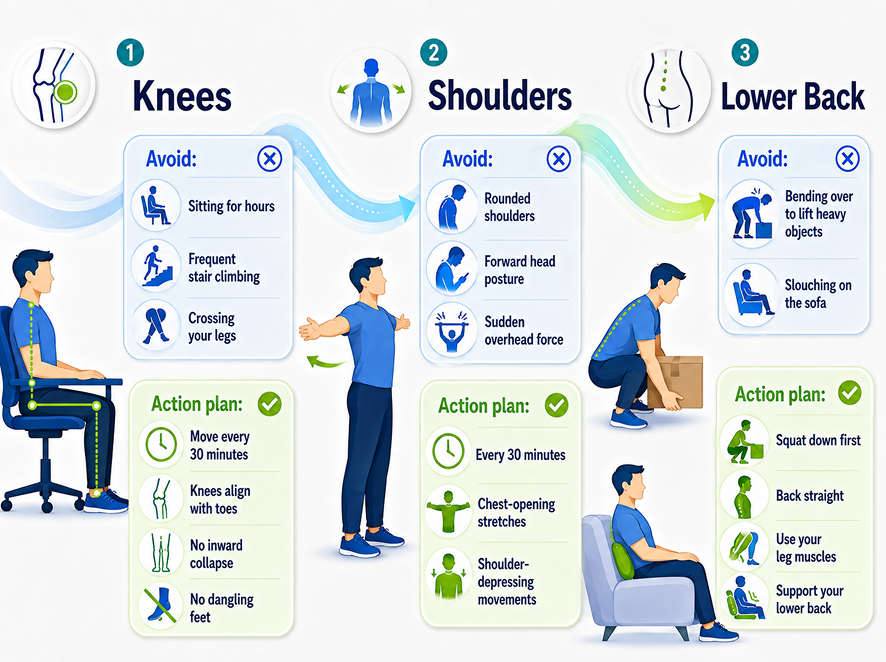
✅ Knees
Avoid prolonged sitting, frequent stair climbing and crossing legs. Sitting for long periods strains the patellar tendon; knees bear multiple times your body weight when squatting or walking downstairs. Stand up every 30 minutes. Keep knees aligned with toes, avoid knee valgus and do not let your feet hang in the air while seated.
✅ Shoulders
Avoid slouching and sudden overhead lifting. Chronic slouching narrows the subacromial space and raises the risk of rotator cuff friction injury. Do not use brute force when hanging laundry or lifting heavy items. Do chest expansions and shoulder retraction every 30 minutes while sitting to release tight shoulder tissues.
✅ Lower Back
Do not lift heavy objects with a straight bend at the waist or slump deeply on sofas. Bend your knees and squat when lifting items, use leg strength to stand up and reduce lumbar pressure. Sit with your back straight and lean against the chair to share upper body weight.
3. Strengthen Surrounding Muscles: Build Natural Cushions for Joints
Around 80% of joint stability depends on surrounding muscles. Strong muscles absorb impact and prevent abnormal wear — this is the most fundamental long-term solution for joint health.
Below are simple, equipment-free exercises you can do at home, targeting knees, shoulders and lower back.
Tip: Move slowly and steadily. Proper form matters more than repetitions. Stop immediately if you feel sharp pain.
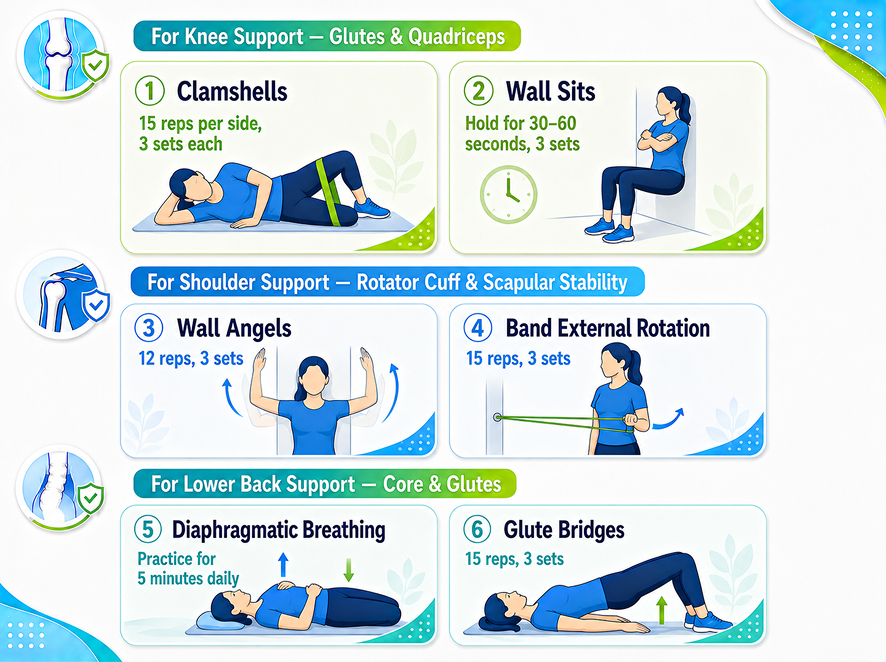
▶ For knees | Strengthen glutes & quadriceps
1. Clamshell: Lie on your side with knees bent, heels touching. Slowly lift the top knee and lower it back. 15 reps per side, 3 sets. Strengthen gluteus medius, correct knee valgus and reduce patellofemoral pressure.
2. Wall sit: Lean back against the wall, knees not extending past toes. Keep the knee angle above 90 degrees. Hold 30–60 seconds per set, 3 sets. Improve quadriceps eccentric strength and shock absorption.
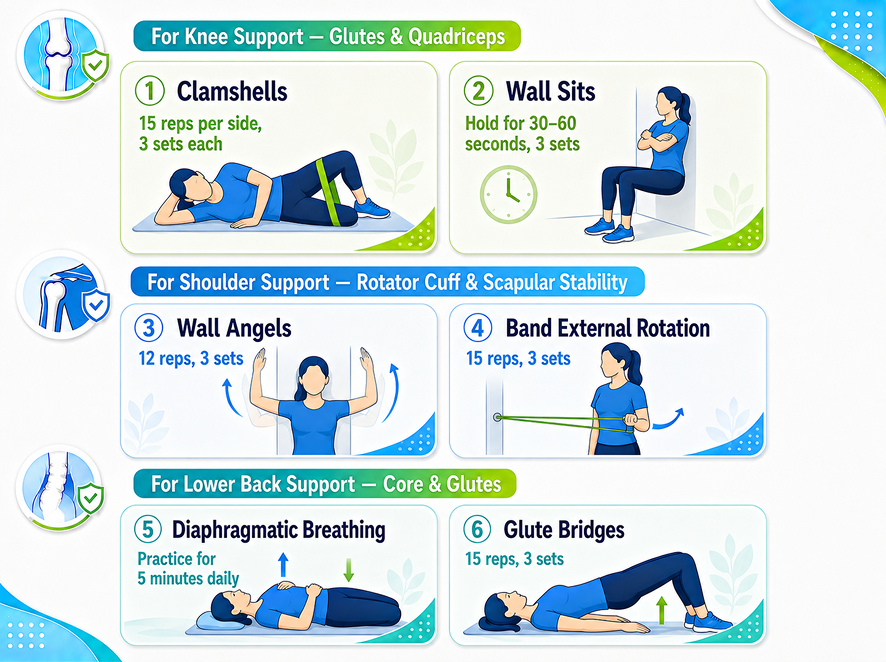
▶ For shoulders | Strengthen rotator cuff & stabilize scapulae
1. Wall angel: Lean against the wall, arms form a “W” shape against the wall. Slide arms upward slowly and lower back down. 12 reps, 3 sets. Improve slouched posture and expand subacromial space.
2. Resistance band external rotation: Keep elbows tight to your torso, rotate arms outward with the band. 15 reps, 3 sets. Activate deep rotator cuff muscles and boost shoulder stability.
▶ For lower back | Activate core & glutes
1. Diaphragmatic breathing: Inhale to expand your belly, exhale and engage your core. Practice 5 minutes daily to activate deep core muscles and stabilize the lumbar spine.
2. Glute bridge: Lie flat with knees bent, lift hips slowly and lower evenly. 15 reps, 3 sets. Strengthen glutes and reduce compensatory strain on the lower back.
4. Scientific Pre & Post-Workout Protection to Stop Cumulative Strain
People who run, play ball sports or work out place higher load on joints. Proper warm-up and recovery greatly lower the chance of chronic strain.
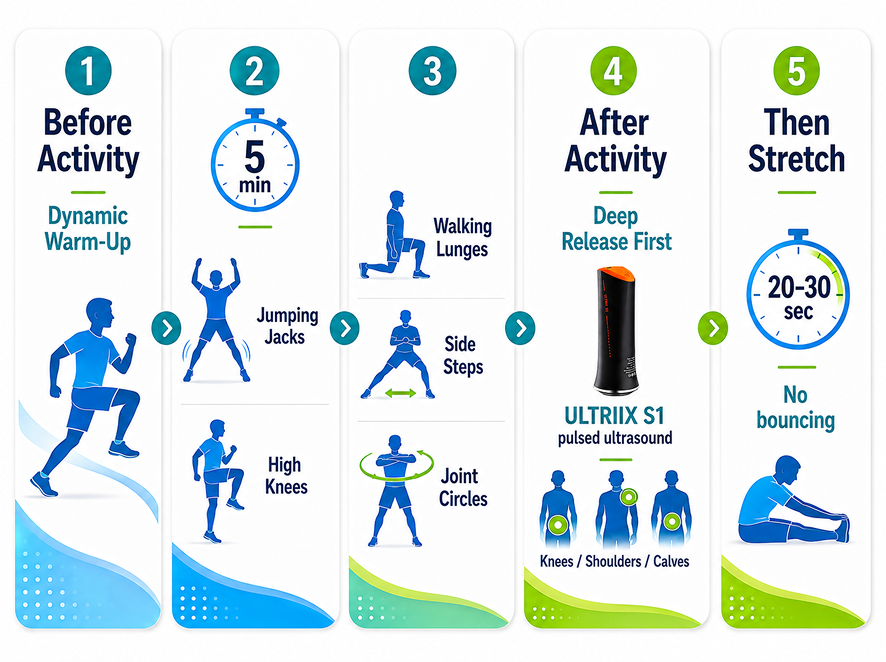
Before exercise: Dynamic warm-up, not just static stretching
Warm-up goals: raise muscle temperature, boost synovial fluid production and activate your movement chain. Start with 5 minutes of jumping jacks or high knees to lift heart rate. Follow with dynamic lunges, side steps and joint rotations. Do not jump straight into high-intensity training.
After exercise: Deep soft tissue relief first, then static stretching
Many people finish workouts with simple stretching only. Tension deep within fascia and tendons cannot be fully released by hand massage, foam rollers or massage guns. If left unaddressed, it accumulates into chronic strain.
Recommended recovery routine: After your heart rate calms down, use the ULTRIIX S1 Pulsed Ultrasound Massager and glide it slowly around knees, shoulders, calves and other areas. The pulsed energy penetrates deep fascia and tendons to ease tightness and fatigue, outperforming surface massage. Follow deep tissue relief with static stretching for longer-lasting comfort and less recurring soreness.
5. Regular Daily Maintenance to Block Fatigue Build-up
Joint strain prevention is critical. Most people feel no obvious discomfort until injuries have already formed. Routine maintenance is far easier than treating pain later.
After long hours of work or housework, if you feel tightness around joints and stiff muscles, use the ULTRIIX S1 for 3–5 minutes of home relief.
The ULTRIIX S1 is ideal for daily home care. You do not need to pinpoint exact pain points; slow gliding motions cover broad soft tissue areas. Short daily sessions release muscle fatigue and prevent strain from accumulating.
Joint care is a long-term commitment. It requires no large investment or excessive time. Simply pay attention to posture in daily life, spend more than ten minutes weekly on strength training, recover with ULTRIIX S1 after workouts, and ease stiffness regularly. Stick to these small habits, reduce unnecessary joint wear, and maintain great physical condition long-term.