
Basketball is a beloved sport for countless people. Many players experience knee soreness and swelling after games, weakness when climbing stairs, and even joint popping and dull pain around the patella.
Why does basketball easily cause knee injuries? It is not that knees are inherently fragile. Instead, basketball’s movement patterns subject knees to constant heavy stress. Understanding the causes and implementing proper post‑activity care allows your knees to support you in playing basketball for years to come.
I. Three Major Stresses Basketball Places on Knees
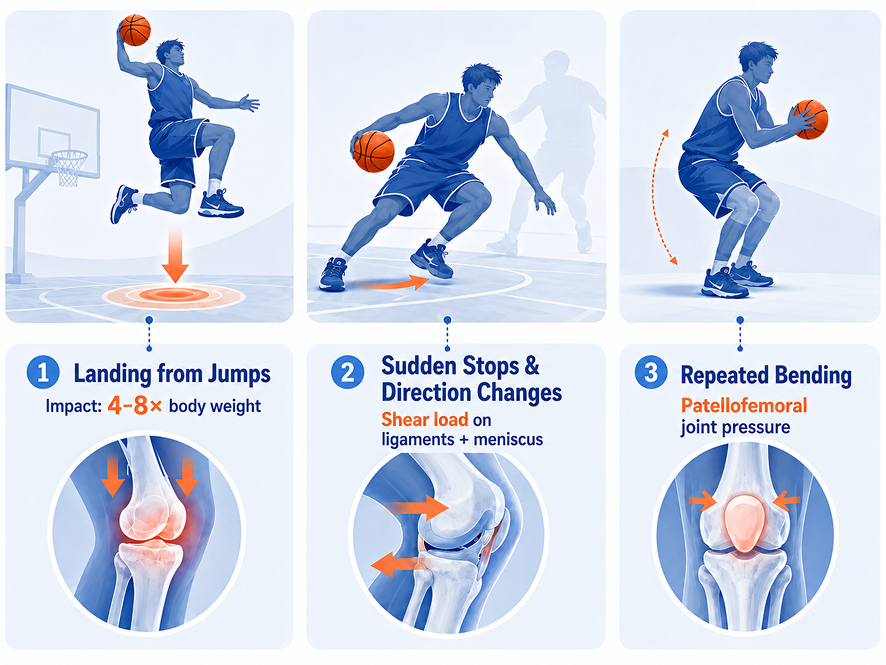
1. Landing from Jumps:Instant impact multiple times your body weight
When jumping for rebounds or shooting and landing, knees absorb ground reaction force. Upon hard landing, knee joints endure impact forces 4‑8 times body weight. Poor landing posture or fatigued muscles can lead to gradual wear on patellar cartilage and menisci from repeated compression.
2. Sudden Stops and Direction Changes:Shearing force endangers ligaments and menisci
Basketball involves frequent sudden stops, direction shifts, turns, and drives. Knees bear shearing force while bent and rotated. The anterior cruciate ligament, medial‑lateral collateral ligaments and menisci are highly vulnerable to this “twisting‑towel‑like” force. Many non‑contact knee injuries happen during defensive lateral slides or explosive drives.
3. Repetitive Flexion‑Extension:Persistent pressure buildup on the patellofemoral joint
During defensive shuffles and half‑crouch positioning, knees stay flexed for long periods, greatly raising pressure between the patella and femur. Tight quadriceps or imbalanced medial‑lateral muscle strength disrupt patellar tracking, triggering chronic issues such as runner’s knee and patellar tendinitis.
II. An Overlooked Step: Insufficient Deep‑Tissue Recovery After Exercise
Many players perform basic stretching after basketball, yet deep‑layer muscles and fascia around the knees remain inadequately released. Chronically tight quadriceps, hamstrings and iliotibial bands narrow joint space and create uneven pressure distribution, which eventually brings on chronic pain.
Foam rollers, massage guns or manual massage mostly work on superficial muscles, while deep fascia stays tense. This explains why soreness around knees keeps recurring even after stretching and massage.
III. How to Reduce Knee Burden After Play — Try ULTRIIX S1
Besides strength training, thorough warm‑ups and proper bracing, deep post‑workout release plays a vital role in basketball‑related knee care. The ULTRIIX S1 Pulsed Ultrasound Massager is a home‑use device designed for deep‑tissue relaxation after sports.
Equipped with high‑frequency ultrasound vibration technology targeting deep muscle‑fascia tissue. After basketball sessions, glide the ULTRIIX S1 slowly over quadriceps, hamstrings and calf muscles for 10‑15 minutes. You will feel tight muscle groups soften, and per‑knee soreness and swelling ease noticeably.
Why is it suitable for basketball enthusiasts?
Knee discomfort from basketball arises from a combination of deep fascia tightness, tendon fatigue and overloaded kinetic chains. Ordinary relaxation tools only reach superficial tissue and cannot fully resolve underlying problems — this is the core advantage of the ULTRIIX S1 for basketball‑related recovery.
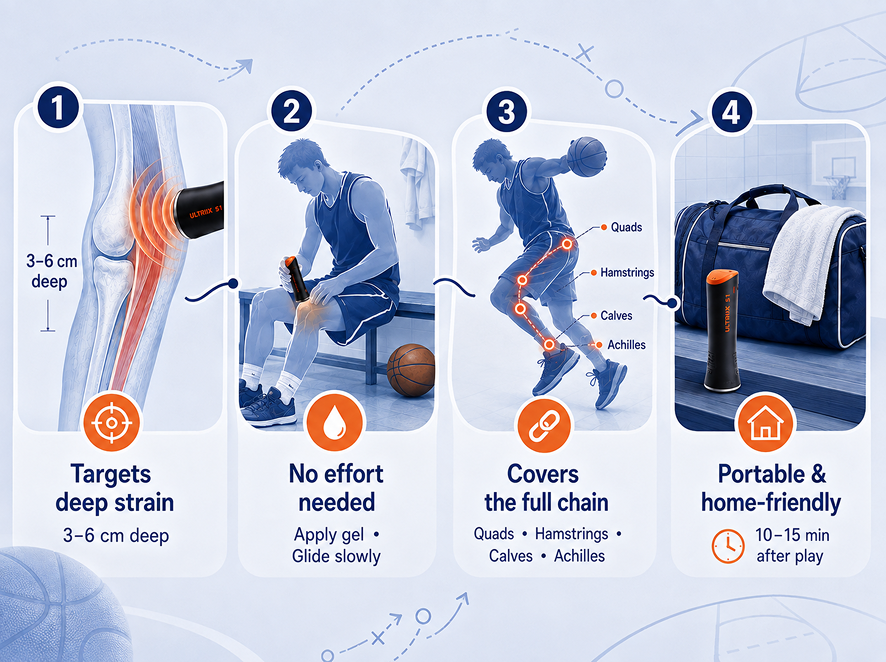
1. Deep Penetration Targets Basketball‑Induced Strain at Its Source
Stiffness and deep‑seated soreness around the knees from basketball mostly originate from the patellar tendon, peri‑articular fascia and deep soft tissues. Through ultrasound energy transmission, the ULTRIIX S1 reaches 3‑6 centimeters beneath the skin. It eases deep‑layer tension and adhesions around the knees and relieves the frustrating issue of “still feeling tight even after stretching”.
2. No Physical Effort Required — Usable Even When Exhausted Post‑Game
After high‑intensity competitive games, most users are physically drained. Many skip recovery work because foam‑rolling and manual massage feel too tiring. The ULTRIIX S1 requires no manual pressing force. Simply apply conductive gel and glide the probe slowly along muscle fibers. You can fully release your thighs, knee surroundings and calves while seated. Its low‑barrier operation makes consistent long‑term use far easier.
3. Full Coverage of the Entire Lower‑Body Kinetic Chain
Knee stress caused by basketball works in a chain reaction: tight quadriceps and hamstrings above, as well as tight triceps surae and Achilles tendon below, will collectively increase knee load. The flexible probe of the ULTRIIX S1 glides along the full lower‑body kinetic chain to relieve tension area by area. Multiple auxiliary tools are not needed. One single session covers all common basketball‑related strain zones for higher efficiency.
4. Portable for Home Use, Stop Fatigue From Building Up
Over Time there is no need for trips to rehabilitation clinics. The device can be quickly used at home or even in stadium lounges. For enthusiasts who play basketball every week, spending ten‑plus minutes after each game to release fatigue reduces cumulative strain. Integrating recovery into your regular sports routine helps athletes maintain long‑term athletic performance.
IV. Knee Care: Treat Deep‑Tissue Recovery As Part Of Training
Basketball‑related knee injuries are largely preventable. Build joint stability with wall sits, glute bridges and Bulgarian split squats. Complete dynamic warm‑ups before play. Do not rush off‑court right after finishing games. Stretch first, then use the ULTRIIX S1 Pulsed Ultrasound Massager for deep‑tissue release. Loosening tight muscles effectively reduces next‑day stiffness and soreness.
Knees are the "engine" for basketball and deserve consistent daily care. Do not wait until pain stops you from walking. Learn injury mechanisms, stick to strength training, and use ULTRIIX S1 for post‑activity deep tissue relief. This will help you run faster and jump more steadily on the court for longer.