

Anyone who has played golf regularly over the past couple of years will have noticed a clear shift: golf courses are welcoming many new faces.
The crowd is no longer dominated solely by seasoned business professionals. Twenty‑something office workers, new‑to‑the‑sport enthusiasts, and groups of friends heading out for weekend rounds have become increasingly common.
Golf used to be stereotyped as “high‑end” and “for business entertaining”. Now, many describe it as “stress‑relieving”, “enjoyable”, and “a sport you can play for life”.
Another quiet trend has emerged: in the side pockets of more and more golf bags, alongside gloves, tees and water bottles, sits an Ultrifix S1 ultrasonic massage device. Many seasoned golfers even keep two units on hand.
I. Why Have We Fallen for Golf?
Golf’s growing popularity does not stem from an elite image. It matches exactly what modern people look for in sports and lifestyle.
1. A sport you can enjoy your whole life
People who have suffered knee injuries from running or sprains from other sports understand golf’s unique value.
There is no high‑impact running‑and‑jumping, no physical collisions. You set your own pace. Young adults in their twenties and seniors in their seventies can share the same fairway.
Many take up golf for a simple reason: they want to avoid getting injured every time they exercise and find a sustainable hobby that does not push the body to its limits.
2. Stress relief found in every swing
An 18‑hole round easily covers four to five kilometres.
Throughout the game, you judge distances, read wind, adjust posture and control your swing rhythm. Your mind focuses fully on each shot, leaving little room for work‑related worries and anxiety.
By the end of the round, built‑up stress melts away out on the grass. For office workers who sit long hours, this immersive focus in nature acts as mental therapy, more rewarding than repetitive gym workouts.
3. The Most Natural Social Setting
Social interaction is baked into golf.
A round lasts four to five hours, filled with casual conversation as you walk. There is no pressured toasting at dinner tables, no tense boardroom atmosphere. It works for business talks, making friends and family outings alike.
Many players organise weekly games. What matters is not low scores, but relaxed time with like‑minded people.
Conversation flows naturally as you stroll along the course, with no need for forced small talk.
4. The Great Outdoors — Nature's Best Recovery
Spending hours outdoors on open grass, soaking up sunlight and fresh air, is restorative for anyone stuck behind office screens.
You build core strength, balance and concentration without gruelling effort. Physical activity happens naturally as you walk.
II. Behind Elegant Swings: Strain Along the Full Kinetic Chain
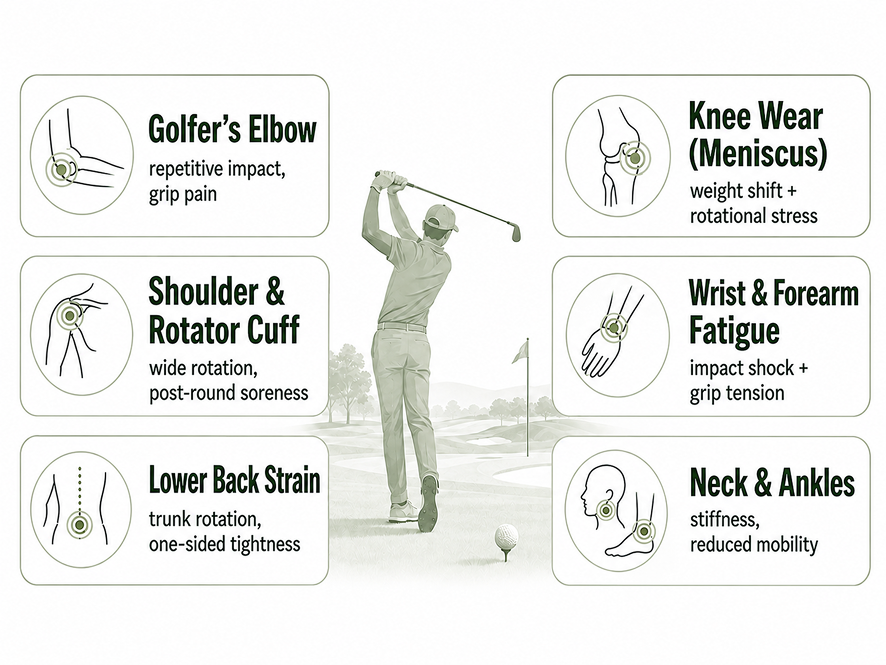
Many beginners mistakenly think golf is slow and cannot cause injury. On the contrary, golf relies on repeated unilateral twisting movements. Force travels sequentially from foot push‑off, through knees, hips, torso, shoulders and elbows down to the wrists. Repeated torsion and explosive loading on one side of the body gradually lead to accumulated strain. Most golfers know the stiff feeling after a round, yet many ignore it until pain interferes with their swing.
● Golfer’s elbow:
A very common complaint among regular players. At impact, the tendons on the inner forearm endure sudden tension. Repetitive motion may trigger aseptic inflammation. Symptoms range from dull inner‑elbow soreness to pain when gripping clubs, wringing towels or steering.
● Shoulder and rotator‑cuff injuries:
At the top of the backswing and through follow‑through, the shoulder rotates widely. Repeated strain on rotator‑cuff tendons can cause impingement and tendinitis. Early signs include post‑round arm aching; over time, everyday movements become painful.
● Lumbar strain and spinal stress:
Torso rotation generates core swing power, placing the lower back at the centre of the kinetic chain. Weak core muscles or flawed technique force the lower back to compensate. Unilateral lower‑back tightness after a round is commonplace, and may lead to chronic lumbar strain and facet‑joint irritation.
● Meniscus and knee degeneration:
Weight shifts rapidly from the rear to forward leg at impact. Knees bear both vertical compression and shear torsion. Repeated stress wears the medial meniscus, bringing soreness during squatting and weight‑bearing movements.
● Wrist and forearm overuse:
Shock from club‑ball impact travels to the wrists, compounded by constant grip tension. Wrist tenosynovitis and triangular‑fibrocartilage complex injuries are frequent. Wrist fatigue and soreness signal soft‑tissue overloading.
● Neck and ankle issues:
The head stays fixed while the torso twists violently during swings, keeping neck muscles under sustained tension and resulting in post‑round stiffness. Ankles also endure lateral stress from stance‑holding and weight transfer, leading to soreness and reduced joint stability over time.
III. From “Rest When It Hurts” to "Care Before It Hurts"
In the past, soreness was managed with rest, plasters, or simply playing less when pain flared.
Dedicated golfers have learned that pushing through discomfort does not support long‑term play. Chronic injuries build up little by little.
Gradually, the Ultrifix S1 ultrasonic massage device has become a staple in many golf bags.
It is not empty status‑seeking. For deep tendon strain typical of golf, it outperforms manual massage and topical plasters.
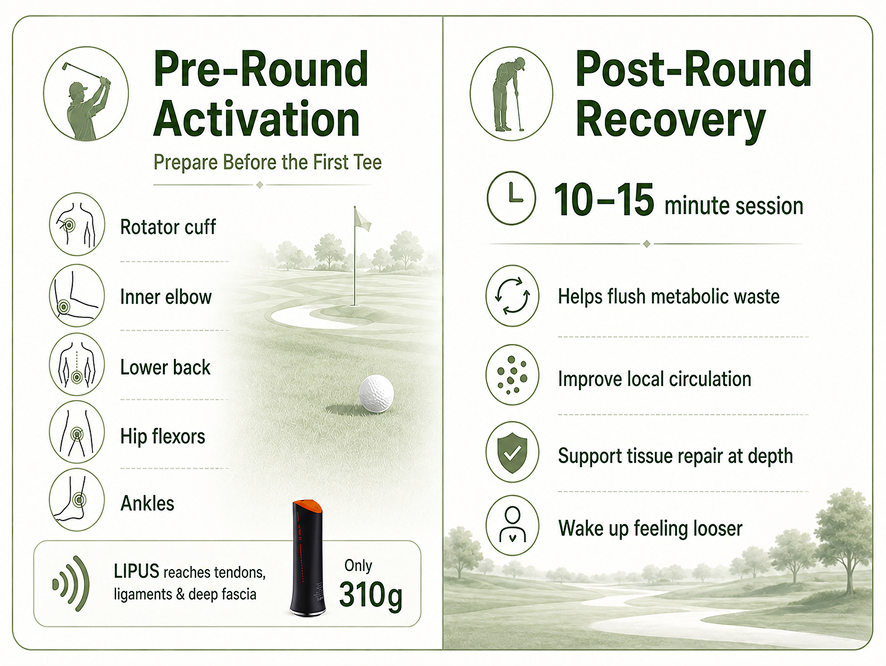
✅ Pre‑round activation: prevent injury before it occurs
While waiting to tee off, spend three to five minutes treating the rotator cuff, inner elbows, lateral torso muscles, inner thighs and ankles.
Its LIPUS (Low‑Intensity Pulsed Ultrasound) penetrates superficial muscle layers to reach deep tendons and ligaments. It improves tissue elasticity and local blood circulation, preparing the whole kinetic chain for sport.
Unlike static stretching alone, it addresses golf‑specific unilateral loading. It reduces muscle viscosity, minimises compensatory movement caused by muscular tightness, and lowers injury risk from the outset.
Weighing only 310 g, its compact form fits easily into golf‑bag side pockets for instant access.
✅ Post‑round recovery: resolve micro‑damage on‑site
Aching shoulders, elbows, knees and hips after 18 holes stem from micro‑tears in muscle‑tendon tissue and accumulated inflammatory metabolites.
Sleep‑only recovery clears waste slowly. Unresolved micro‑injuries accumulate and turn chronic.
Use the device for 10‑15 minutes on sore areas after play. Ultrasound energy reaches deep tissues, boosting microcirculation, accelerating metabolic waste removal and stimulating intrinsic tissue repair.
You will wake up without widespread stiffness, ready for your next week’s game.
✅Advanced tip: carrying two Ultrifix S1 units — a new social currency on the green

You may have noticed an interesting trend: many quality‑oriented golf enthusiasts keep one or two Ultrifix S1 units in their bags.
They are not only for personal use; they enable thoughtful, high‑level wellness‑focused social interaction.
Golf is inherently social. After a satisfying round, players gather in the clubhouse for tea and review their game, usually carrying some degree of muscular soreness. A simple “good work today” feels superficial.
By contrast, take out two sleek Ultrifix S1 devices: use one yourself to ease shoulder tension, and pass the second to your playing partner or client: “Those drives were really powerful today. Your wrists and lower back took a lot of force. Try this ultrasonic device; it works great for golfer’s elbow and is pain‑free.”
This creates a premium shared experience. While enjoying deep‑tissue relief, you can discuss putts and shots together.
Sharing wellness builds rapport far more genuinely than toasting at banquets. It subtly demonstrates your sport‑specific knowledge, self‑care awareness, and thoughtful consideration for others.
Golf is a sport for a lifetime. In the long run, what counts is not how expensive your clubs are, but how well you preserve your physical health and cultivate genuine connections. Before your next tee‑off, keep two Ultrifix S1 units in your bag — safeguard your body and elevate your social refinement.