

Golf is a sport enjoyed by millions around the world. While swinging through fairways brings great joy, repetitive rotational movements, repeated gripping and sudden force transfers during every swing put constant strain on your elbows. Many golfers struggle with lingering elbow soreness, tennis elbow or golf elbow without fully understanding what triggers the discomfort, how to differentiate these injuries, and what safe at‑home maintenance they can perform.
In this blog, we break down common elbow‑related questions for golf players, cover symptoms, self‑assessment, swing adjustments, warm‑up routines, equipment tips, and how to use ULTRIIX S1 - ultrasonic massager for deep soft‑tissue recovery.
Q&A Section
Q1: Is post‑round elbow soreness normal after playing golf?
Occasional mild fatigue that fades quickly after rest is usually caused by a temporary increase in exercise load.
However, pay close attention if you experience any of the following signs:
● Soreness appears every time you finish a round
● Noticeable tightness remains the next day
● Discomfort occurs even with simple movements such as holding a cup or twisting a towel
● Pain triggers at a fixed spot the moment you swing
● Your recovery time keeps getting longer the more you play.
These signs indicate overuse of forearm muscles, tendons and surrounding elbow soft tissues.
Q2: What is Golfer’s Elbow?
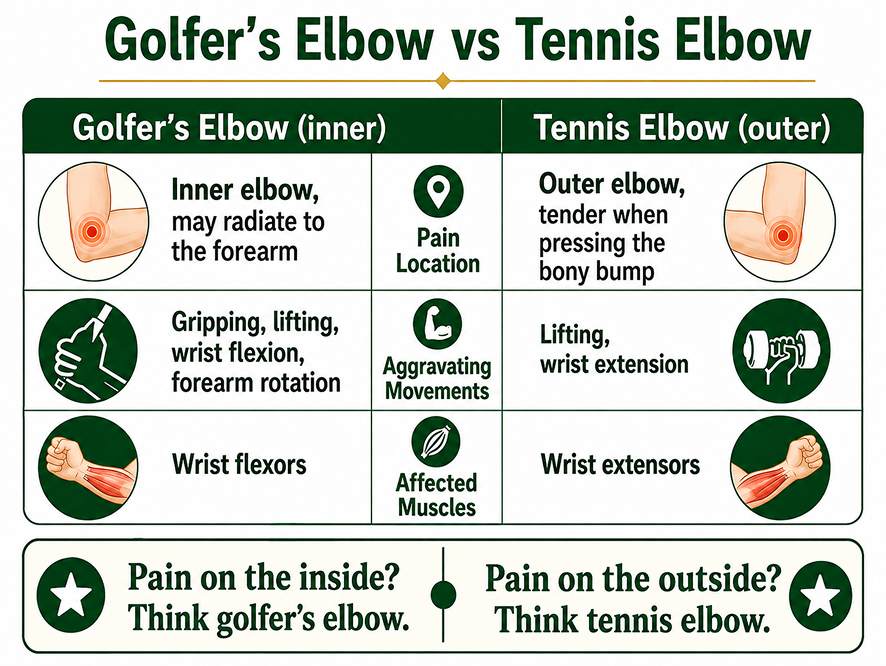
Commonly referred to as golfer’s elbow, this condition is medically known as medial epicondylitis or medial epicondyle tendinopathy. It produces pain or tenderness on the inner side of the elbow.
It develops from repeated, long‑term contraction of the forearm flexor and pronator muscle groups. Typical sensations include soreness and tightness on the inner elbow, which worsen when gripping clubs or flexing your wrist.
Q3: How do I tell Golfer’s Elbow apart from Tennis Elbow?
The simplest method is locating where your pain occurs:
● Pain on the outer elbow = Tennis Elbow
● Pain on the inner elbow = Golfer’s Elbow
Q4: Which condition is more common among golfers, Golfer’s Elbow or Tennis Elbow?
Interestingly, tennis elbow occurs more frequently in golfers. This happens because your lead wrist bears repeated overload on extensor muscle groups through every swing. Golfer’s elbow is more often triggered by sudden unexpected force impacts.
Q5: What are typical symptoms of Golfer’s Elbow?
Core symptoms are pain and tenderness over the medial elbow:
● Pain may radiate down the palm‑side forearm
● Pain intensifies with gripping, lifting, wrist flexion or forearm rotation ‑
● Stiffness and reduced grip strength; unstable holding of objects
● In rare cases, tingling or numbness in the ring and little finger, a warning sign for ulnar‑nerve compression.
Q6: What are typical symptoms of Tennis Elbow?
Pain concentrates on the outer elbow; pressing on the prominent outer bony bump causes sharp tenderness. Pain worsens when lifting heavy items or extending your wrist. In severe cases, your forearm and hand will ache and weaken, making gripping difficult.
Q7: How can I self‑test for Golfer’s Elbow and Tennis Elbow at home?
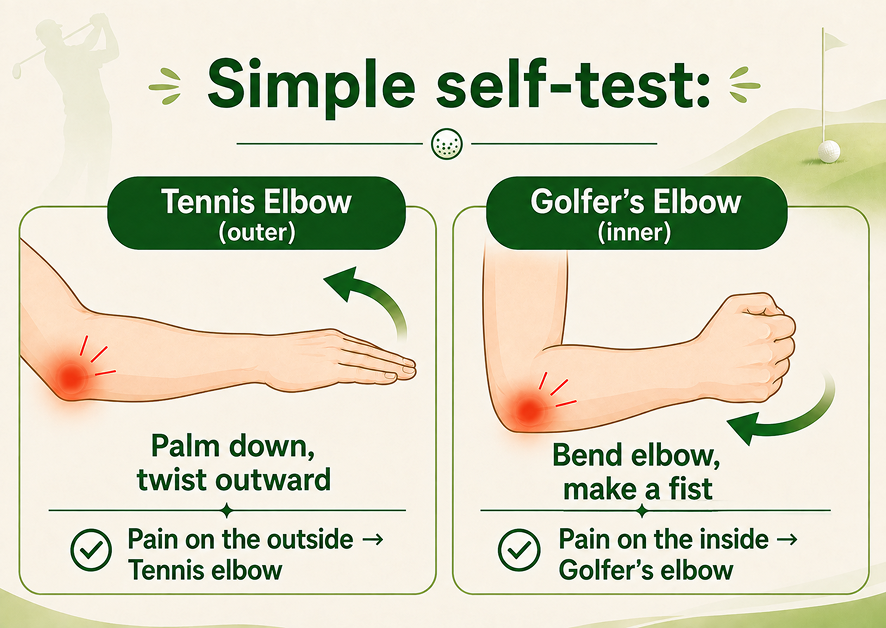
● Extend your arm with palm facing down, twist outward as if wringing a towel. Pain on the outer elbow → Tennis Elbow.
● Bend your elbow and make a fist, twist inward with gripping force. Pain on inner elbow → Golfer’s Elbow.
As supplementary reference: pain triggered by twisting bottle caps or lifting weights that eases with rest and flares with exertion generally points to overuse‑related tendon strain. You may use the Ultriix S1 consistently for deep‑level soft‑tissue repair to ease soreness and exertion‑related pain.
If neither test provokes obvious elbow pain yet discomfort persists, look into other possible causes: nerve entrapment, referred pain originating from the cervical spine, myofascial strain or intrinsic elbow joint inflammation. Do not treat symptoms blindly as tendon overuse injury.
Q8: Will switching from steel shafts to graphite shafts prevent elbow strain?
A graphite shaft delivers partial protective benefits. Lighter graphite absorbs more vibration upon ball impact, lowering shock transmitted toward elbows. It is a great upgrade option for senior golfers already showing early signs of strain.
Q9: What negative impacts does excessively tight gripping have on elbows?
Squeezing the club tightly throughout your full swing keeps forearm flexor muscles under constant extreme tension from address all the way through follow‑through. This ruins smooth swing release and drastically accelerates tendon fatigue and overuse damage.
Q10: Does wearing elbow braces while playing prevent golfer’s elbow from worsening?
Compressive elbow sleeves offer auxiliary protection. They dampen impact vibration and reduce pulling tension on tendons, yet they cannot repair existing damage. Wear braces during play for protection; after your round use the Ultriix S1 for deep tendon maintenance. Combining protection and recovery delivers better outcomes.
Q11: Apart from swing mechanics, what other factors contribute to elbow overuse injury?
Beyond swing technique, multiple elements create cumulative micro‑damage via persistent pulling, compensatory load and poor local circulation:
1. Repetitive daily activities: long‑hours mouse work, frequent twisting motions, heavy one‑handed lifting continuously pull elbow tendon attachment points, building baseline micro‑injuries over time.
2. Upper‑body muscle imbalance: weak shoulders, core and back muscles, plus asymmetric forearm flexor‑extensor strength force elbows to bear extra compensatory stress.
3. Poor posture: rounded shoulders and improper arm positioning misalign upper‑body force chains, making tendons rub and pull over bony prominences.
4. Tissue degeneration and incomplete healing: ageing lowers tendon elasticity; incompletely healed sprains easily progress into chronic irritation.
5. Poor local circulation: cold elbows and skipped post‑play relaxation slow metabolite clearance and amplify sterile inflammation.
Superficial massage cannot reach these deep tendon injuries. The Ultriix S1 ultrasonic device supports deep‑level maintenance, targeting tendon attachment points, improving local circulation and supporting recovery of strained soft tissue.
Q12: What swing adjustments protect your elbows?
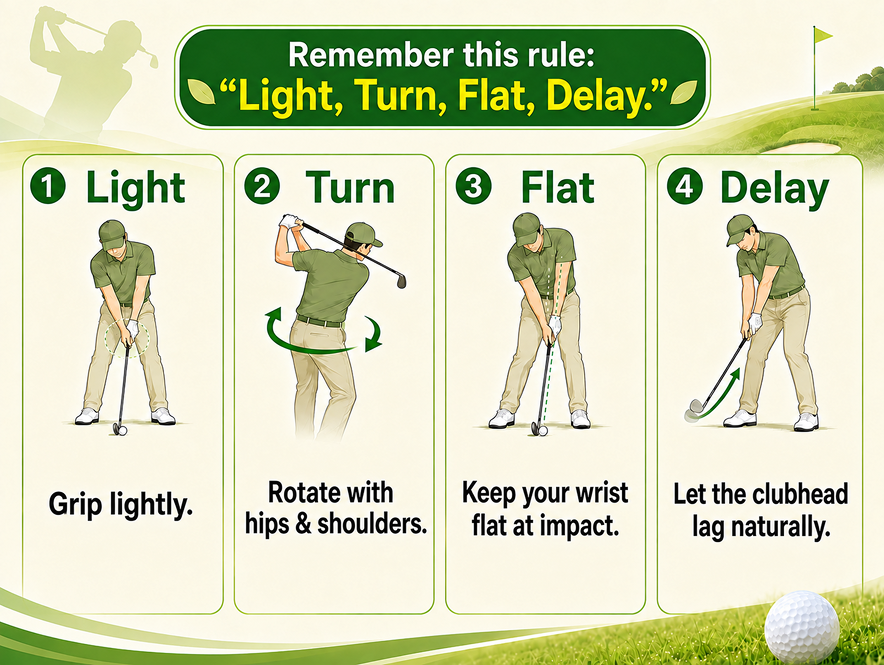
Keep these four key principles in mind:
✅ Light: hold the club gently. Imagine holding a raw egg without cracking or dropping it.
✅ Turn: generate power through hip and shoulder rotation instead of arm‑pulling.
✅ Flat: keep wrists stable at impact. Avoid snapping wrists for extra speed, this movement puts massive stress on elbows.
✅ Delay: do not release wrist cock too early; let the clubhead release naturally to reduce elbow shock.
One frequently overlooked detail: grip size matters. If you have large hands paired with thin grips, you will involuntarily squeeze harder and fatigue forearm muscles faster. Adding extra grip tape to thicken the grip can reduce required grip force.
Even with perfect swing adjustments, repeated swing traction may still trigger soreness once tendons are already in compromised, adhesive sub‑health states. Rest alone rarely restores original tendon elasticity.
Build the habit of using Ultriix S1 after playing. It helps break accumulated micro‑damage and adhesions, boosts local blood flow and guides tendons back toward healthier condition.
Q13: How should I warm‑up properly before teeing‑off to avoid elbow injuries?
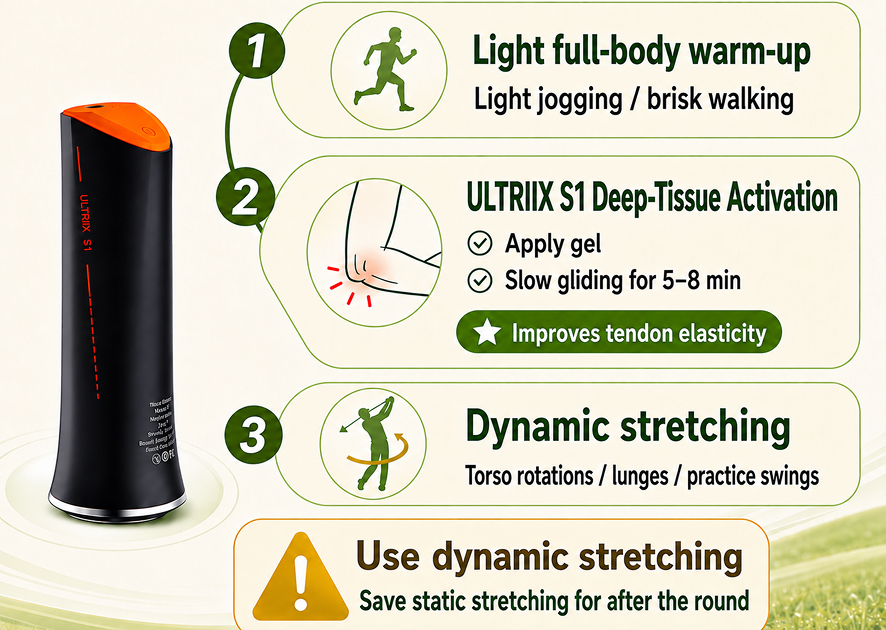
Recommended warm‑up sequence:
1. General full‑body warm‑up: several minutes of brisk walking or light jogging to raise core body temperature.
2. Deep pre‑activity activation with Ultriix S1: apply sufficient conductive gel around elbows. Glide the device slowly over forearm flexor muscle groups for 5‑8 minutes. Its 1.1 MHz ultrasonic energy penetrates 3‑6 cm beneath skin, reaching deep tendons that conventional warm‑up cannot access, boosting soft‑tissue extensibility.
3. Dynamic stretching: trunk rotation, lunges and light dry swings with your club to activate muscles and nervous system.
Note: Prioritize dynamic movement, avoid static cold stretching before you tee off.
Q14: Should I apply ice or heat when elbows feel hot and swollen post‑round?
Ice for acute phase; heat / ultrasonic therapy for recovery phase.
● Immediate post‑play window (0‑6 hours): if your elbow feels hot, swollen or stinging, apply ice. Wrap ice packs inside cloth and hold over affected area for 15 minutes.
● After one night of rest (6‑24 hours): icing offers limited benefit. Use Ultriix S1 for deep soft‑tissue care, releasing deep adhesions, improving micro‑circulation and speeding metabolic waste removal for recovery.
Q15: Can I use a percussion massage gun or hand kneading for elbow pain?
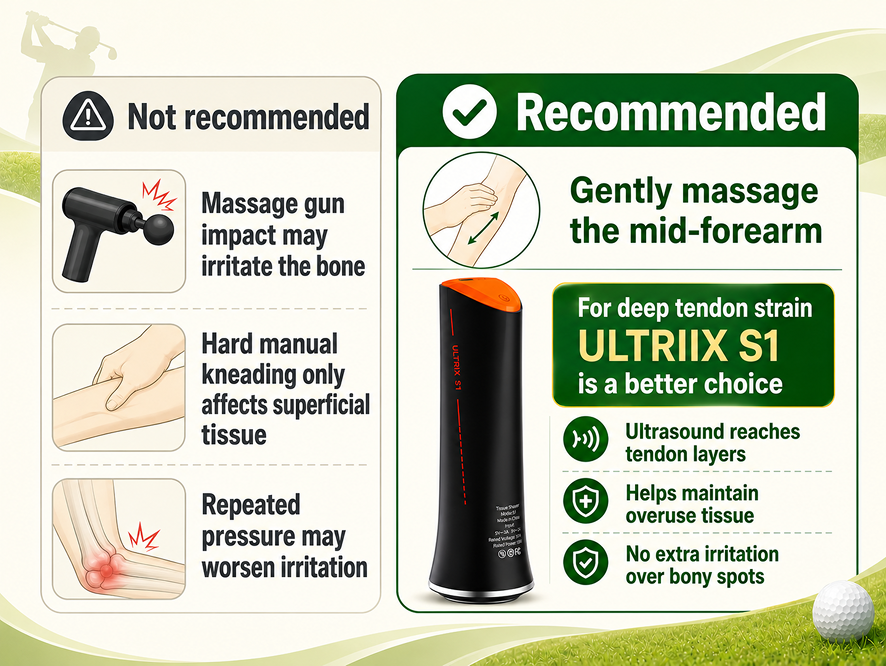
Direct massage gun strikes over painful elbow spots are not advised; hard manual kneading over bony elbow protrusions is also not recommended.Elbow pain usually originates from tendon‑attachment overuse. Skin and soft‑tissue layers are very thin here. Strong percussion gun impact may irritate periosteum and worsen micro‑tears. Manual kneading only affects superficial muscle layers and cannot reach deep tendons; hard pressing over bony bumps may further increase sterile inflammation.
You may gently massage the mid‑section of your forearms. For deep‑lying tendon strain, the Ultriix S1 ultrasonic massager is more suitable. Energy penetrates safely to tendon layers for maintenance without extra irritation over bone points.
Q16: Why is the Ultriix S1 wireless ultrasonic massager well‑suited for elbow rehabilitation?
Golfer’s elbow and tennis elbow are chronic cumulative injuries requiring consistent long‑term care. Many recovery methods are either inconvenient or work only superficially, making consistent upkeep difficult.The portable, wireless design of Ultriix S1 enables convenient use both at home and in the office, lowering barriers to regular maintenance. Instead of temporary surface‑level pain relief, ultrasonic energy acts upon deep tendon tissue to improve tissue condition. Consistent long‑term use helps rehabilitate strained elbow tendons and lowers recurrence risk, ideal for managing chronic elbow discomfort.
Q17: For golfer’s elbow treatment with Ultriix S1, should I focus on the sharp bony bump?
Do not hold the transducer stationary directly on the bony prominence. Apply adequate conductive gel. Glide and make slow circular motions over surrounding painful regions and the upper segment of inner forearm flexor muscles. Ultrasound energy disperses and penetrates, fully covering the complete injured tendon complex.
Q18: What is the ideal usage frequency for Ultriix S1? Can I bring it to the golf course?
During elbow‑strain recovery phase: use 1‑2 times daily, 8‑15 minutes per session. Its compact wireless build fits easily inside your golf bag. Use it right after finishing your round in the clubhouse or on your way home to relieve fatigue and contain micro‑injuries before they turn chronic.
Q19: Is mild forearm soreness after using Ultriix S1 normal?
Yes. Ultrasonic energy deeply activates fatigued tendon tissue and accelerates metabolic repair. Mild forearm achiness or slight weakness for 1‑2 hours post‑treatment is a normal tissue‑repair response and will fade after rest.
Q20: Will elbow discomfort come back? How can I prevent recurrence?
Relapses are possible. Risk stays high if you return to play without improving muscle strength or correcting flawed swing mechanics.
Key prevention tips:
● Stick to forearm‑focused strength training and stretching routines
● Maintain technically correct swing patterns
● Avoid sudden sharp increases in playing intensity
● Perform regular deep soft‑tissue maintenance with Ultriix S1 to preserve tendon elasticity
● Rest immediately at the first onset of warning pain signals.
Q21: When should I visit a doctor instead of relying purely on home maintenance?
Seek professional medical help if you observe any of these red‑flag symptoms:
● Obvious redness, heat and swelling around your elbow
● Persistent finger numbness, weakness or visible muscle atrophy
● Severe elbow pain even at rest or while sleeping
● Minimal improvement after 6‑8 weeks of consistent home‑based maintenance.
Conclusion:
Elbow pain is extremely common among golf enthusiasts, yet many players overlook early warning signs until minor cumulative micro‑injuries develop into stubborn chronic tendinopathy.
Golfer’s elbow and tennis elbow are not just “old‑golfer troubles”. Poor swing habits, too‑tight grip, inadequate warm‑ups and equipment mismatches can trigger these issues for players of any skill level. Correct self‑diagnosis, reasonable swing modification, targeted warm‑up and strength training form your first‑line defence.
Ultriix S1 offer valuable auxiliary deep soft‑tissue maintenance. Remember core operating rules: always keep the transducer gliding, use enough conductive gel, and avoid staying fixed directly over one body part.
If symptoms persist or worsen, please consult a sports‑medicine specialist promptly. Combine correct technique, proper conditioning and sensible recovery care, and you will enjoy golf comfortably for years ahead.