

Many golfers focus on swing techniques and club specifications, yet they often overlook the compound loads silently borne by the knees. Although golf appears low‑intensity, rotational compression at impact and constant load of walking sloped coursesput ongoing stress on the meniscus and peri‑knee soft tissues. Many golfers only realize they have meniscus degeneration after experiencing sharp knee pain or swelling.
Knee injuries rarely occur out of nowhere; they develop from cumulative micro‑damage caused by repeated swings. Remedying pain after it appears is often too late. Preventive measures, pre‑and‑post‑exercise soft‑tissue care, and reasonable strength training are key to protecting knee health. This article addresses frequently‑asked golfer questions about the meniscus and knees, clarifying injury triggers, home‑care boundaries, proper device usage, and red flags for medical consultation. It helps golfers enjoy the sport while minimizing progression of knee strain.
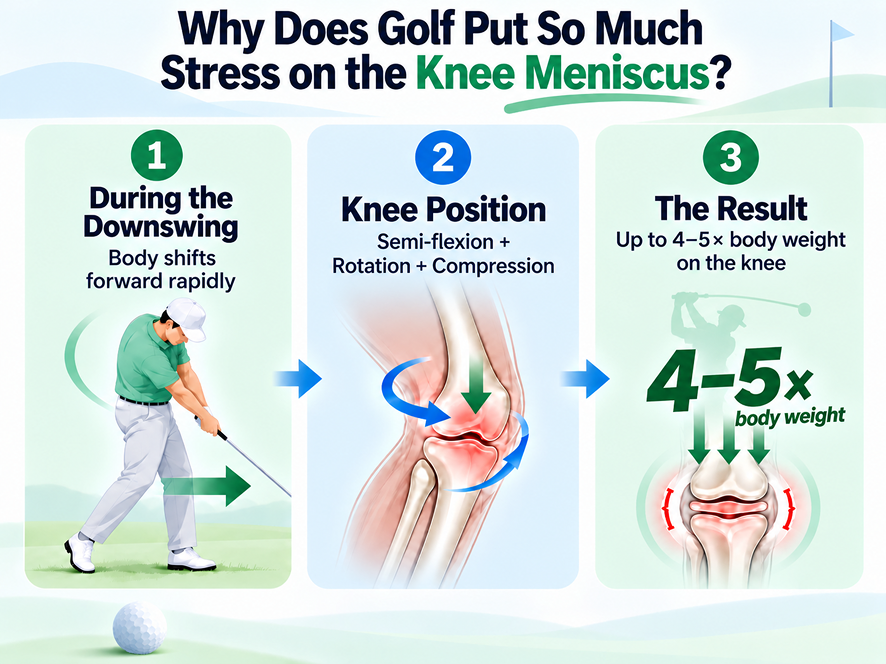
Q1. Why does golf put so much stress on the knee meniscus?
Golf imposes hidden yet real stress on knee structures.
At downswing, the lead foot stays planted while body weight shifts rapidly forward. The knee works in a combined state of semi‑flexion, rotation and compression. Specifically, the lead thigh externally rotates relative to the shin, creating strong compression on the medial meniscus. Peak instantaneous knee load can reach 4‑5 times body weight, combined with torsional shear force. Repeated compound stress over time contributes to meniscus wear and degeneration.
Q2. What are the early warning signs of meniscus damage?
Early symptoms are frequently ignored.
Common signals include:
● Soreness or stabbing pain on the inner knee during squatting or weight‑bearing movements;
● Post‑round knee swelling or stiffness; instability or catching sensation going up‑down stairs;
● Occasional clicking when bending or extending the knee. If knee locking occurs (knee cannot fully bend or straighten) together with severe pain, a significant tear is suspected and prompt medical assessment is required.
Q3. The meniscus lies deep inside the joint — can Ultriix S1 ultrasound reach it?
Yes. Ultriix S1 outputs 1.1 MHz pulsed ultrasound with maximum output power of 15 W. Acoustic energy penetrates 3‑6 cm beneath skin. Its mild sustained deep‑thermal effect improves local knee micro‑circulation, assists joint effusion resolution, and eases tightness in knee fascia and tendons. This reduces extra compressive stress on the meniscus caused by surrounding soft‑tissue compensation.
Q4. Is it safe to place the Ultriix S1 probe directly over the kneecap (patella)? Will it harm bone?
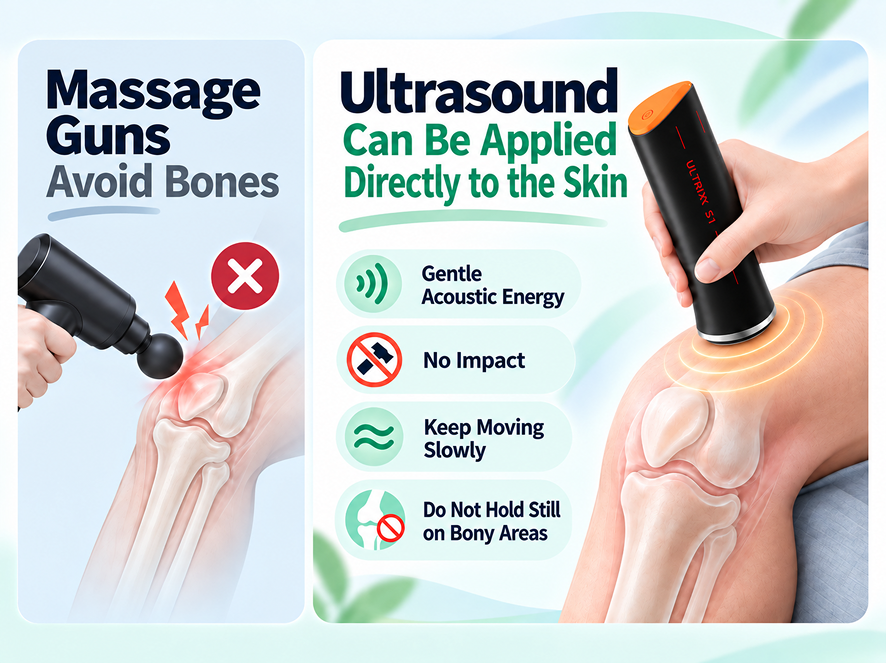
It is safe. Confusion often arises between percussion massage guns and ultrasound technology. Massage guns deliver physical impact and must avoid bony surfaces. Ultrasound uses gentle acoustic energy with no mechanical pounding, so it cannot cause impact‑type bone injury.
Nevertheless, keep the probe moving continuously. Do not hold it stationary over bony prominences such as the centre of the kneecap for long periods. This is not a safety concern — ultrasound will not damage bone — but energy applied directly to bone yields no soft‑tissue therapeutic benefit and constitutes ineffective operation.
Q5. Why do I feel tingling or a sharp sensation over bone during Ultriix S1 treatment?
This is a normal physical response and does not mean injury. When ultrasound waves hit hard bony surfaces, standing‑wave effects stimulate the periosteum and produce transient mild itching or pricking sensations. This indicates deep‑tissue energy delivery. Very often discomfort originates not from bone itself, but from chronically tight tendons and ligaments surrounding bone receiving ultrasonic stimulation. If the sensation is too intense, lower the output level and gradually increase as your tolerance improves.
⚠️ Do not use the device over broken skin or during acute hot inflamed knee episodes.
Q6. How should I use Ultriix S1 before a round to warm up my knees?
Ultriix S1 serves as pre‑exercise local soft‑tissue preparation before full dynamic warm‑up for better outcomes.
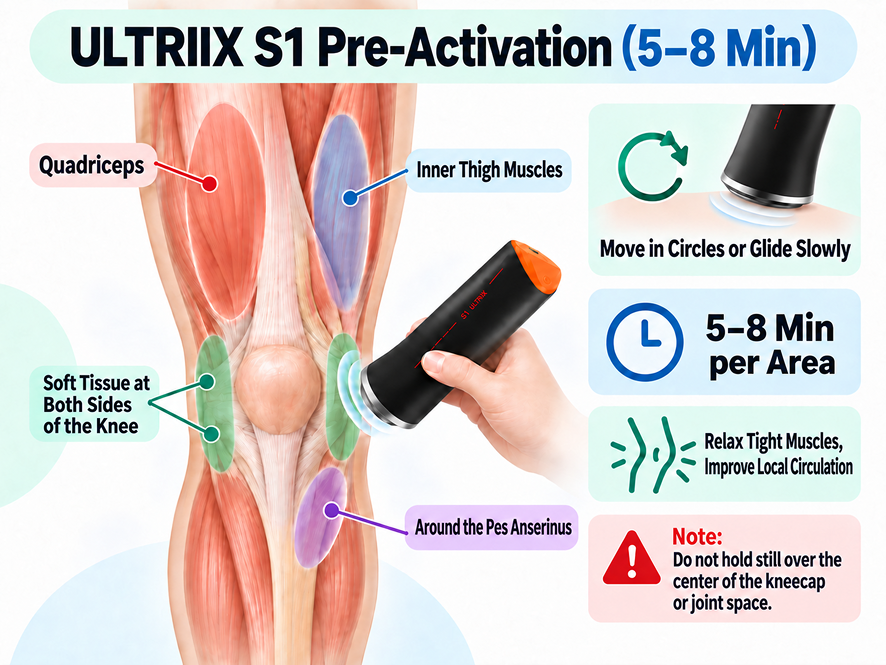
1. Use Ultriix S1 for Ultrasonic pre‑activation (5‑8 minutes)
Apply sufficient coupling gel to probe and skin. Focus on these regions:
● Quadriceps at front of thigh
● Medial thigh muscle groups
● Soft tissues on both sides of knee
● Pes anserine area below knee
Use slow circular or gliding motions for 5‑8 minutes per area. The goal is releasing tight thigh musculature, enhancing local circulation, and lowering extra meniscus compression caused by pre‑swing muscular rigidity.
⚠️ Important: Do not hold probe stationary over kneecap centre or joint gaps. Bony prominences are ineffective treatment targets; focus energy on surrounding soft tissues.
2. Complete dynamic warm‑up
After ultrasonic pre‑treatment, perform full dynamic warm‑up as close to actual golf movement as possible. Dynamic activity further elevates overall muscle temperature, improves joint range‑of‑motion and neuromuscular activation for swing and weight‑shift demands.
Combined workflow: Ultriix S1 relaxes tight peri‑knee soft tissues and boosts circulation; subsequent dynamic warm‑up optimises synovial fluid circulation and whole‑muscle temperature. Together they better condition knees to absorb golf‑related mechanical loads.
Q7. How to use Ultriix S1 for post‑round knee recovery after golf?
Finish golf with 5‑10 min static stretching (quadriceps, hamstrings). Then use Ultriix S1. Glide slowly along muscle attachment sites: distal quadriceps and proximal medial calf. Treat each site 5‑8 minutes. This accelerates metabolic waste removal, moderates inflammatory responses and relieves stiffness.
Q8. When is the best time to use Ultriix S1 after golf for mild meniscus wear?
1. Avoid immediate post‑play hyperaemia phase: After finishing play, joints and muscles remain highly hyperaemic and warm. Wait 1‑2 hours until baseline body temperature returns. Treatment at this time is more comfortable and supports tissue metabolism and micro‑circulation.
2. Address compensatory muscle tightness: Golfers with meniscus wear often rely on quadriceps and hamstrings for knee stabilisation. Treat these tight muscle groups before sleep to release fascial adhesions and reduce next‑day joint stress.
3. Night‑time recovery window: Before bed, pulsed ultrasound mechanically stimulates peri‑articular soft tissues, supporting the body’s natural overnight repair mechanisms, improving synovial metabolism and reducing morning joint stiffness.
● Joint‑gap zone: With ample coupling gel, perform slow circular motions over medial‑lateral knee eye areas (joint gaps). Meniscus has minimal blood supply; ultrasonic cavitation improves synovial fluid movement to nourish cartilage structures.
● Peripheral muscle‑ligament zone: Extend treatment upward onto distal quadriceps and downward onto proximal calf and patellar tendon below knee. Relaxed muscles greatly decrease joint compressive feeling.
● Level & duration guidance: For delicate meniscus‑related structures, use low‑to‑medium power levels. 10‑15 minutes per knee. Never hold probe stationary over bony prominences.
Special scenario: Mild swelling / warmth after play
If knee feels noticeably swollen and warm immediately post‑round:Apply towel‑wrapped ice compress for 15 minutes to control acute effusion.
1. Wait one hour after icing before using Ultriix S1.
2. Use level 1‑3 (do not exceed level
3. Shorten session to 5‑8 minutes to reduce local stimulation.
Q9. What improvements can I expect from consistent long‑term Ultriix S1 use for chronic knee discomfort?
Changes happen gradually. With regular usage you may notice: less soreness at identical power settings; reduced morning knee stiffness; diminished discomfort during stair‑climbing or prolonged walking. These signs indicate improved local circulation and gradual soft‑tissue recovery. Recovery requires patience and consistency instead of occasional high‑intensity sessions.
Q10. Apart from Ultriix S1, what daily knee‑care measures apply to golfers?
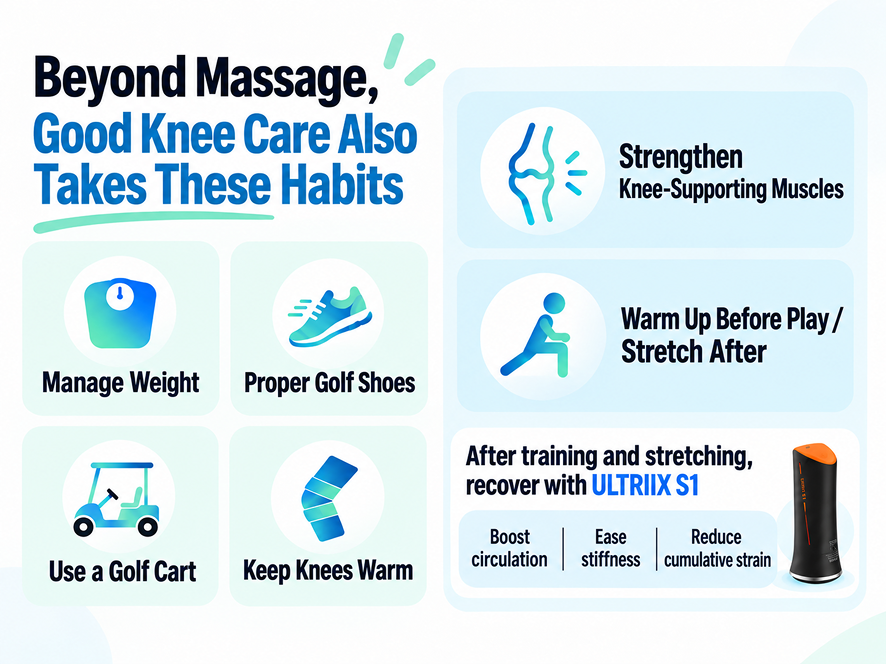
Golf swing generates large rotational and shear loads on the lead knee, compounded by walking undulating fairways. Daily protection covers weight management, footwear, course strategy, strength work, protection gear and movement habits:
① Maintain healthy body weight. Every weight gain multiplies instantaneous knee‑joint stress, directly raising meniscus and ligament wear risk.
② Wear purpose‑built golf shoes with good grip and cushioning support. On wet or sloped lies they minimise unwanted knee lateral torsion and shear stress.
③ Utilise golf carts on hilly courses especially when knees feel fatigued. Reduce cumulative impact from uphill‑downhill walking; downhill walking may subject knees to 5‑7 times body weight.
④ Keep knees warm. Cold impairs circulation and soft‑tissue extensibility and may trigger soreness. Wear thermal knee sleeves in cool conditions; avoid direct cold‑air‑conditioner blowing onto knees.
⑤ Strengthen peri‑knee musculature. Quadriceps and gluteal muscles act as natural knee shock absorbers. Perform low‑load exercises such as straight‑leg raise and clamshell to share joint loads and enhance knee stability.
⑥ Prioritise pre‑round dynamic warm‑up and post‑round stretching. Activate knees and stretch thigh muscles pre‑play; fully relax lower limbs after play. Cease play immediately if persistent sharp pain or catching appears — do not push through discomfort.
After strength training or post‑round stretching, Ultriix S1 is recommended. Golf creates micro‑fatigue within quadriceps, glutes and peri‑knee tendofascia leaving soft tissues chronically tight. Ultriix S1’s 1.1 MHz ultrasound penetrates deep subcutaneous layers, accelerates circulation, eases stiffness and soreness, clears metabolic waste and lowers cumulative long‑term strain risk.
Q11. Can I keep playing golf with meniscus wear?
Depends on injury severity.
● For mild degenerative wear without tears or knee‑locking episodes: golf may continue with sensible frequency limits (avoid consecutive high‑intensity 18‑hole rounds), corrected swing mechanics and consistent pre‑/post‑round soft‑tissue care using Ultriix S1.
● If meniscus tear, frequent locking or persistent joint effusion occur: suspend golf and consult orthopaedic / sports‑medicine specialist. Continued play causes irreversible cartilage‑meniscus deterioration. Ultriix S1 supports surrounding tendon‑fascia soft‑tissue comfort but cannot repair torn meniscus tissue itself.
● Additionally, Ultriix S1 helps with joint effusion. For mild‑to‑moderate knee effusion it enhances local micro‑circulation, accelerates fluid resorption and reduces swelling‑related discomfort.
Q12. Besides using Ultriix S1, what home exercises should golfers with meniscus wear?
Core principle: build surrounding muscle strength so muscles absorb load instead of meniscus. Focus on quadriceps, gluteus medius and medial thigh muscles. Recommended: straight‑leg raise, clamshell, wall sit (small knee flexion angle; stop if pain occurs).
Logic: Swing torsional stress should be partially borne by muscles. Weak musculature transfers excessive force onto meniscal cartilage. Ultriix S1 relieves soft‑tissue tightness and strain; strength training builds joint stabilisation — both work synergistically.
Q13. Why do stronger gluteal and core muscles reduce knee burden?
This follows the kinetic‑chain principle. Swing force transfers upward from ground. Weak gluteal muscles force knees to compensate and absorb large torsional loads generated by upper‑body rotation, raising meniscus shear risk. Robust core stabilises torso, optimises force transmission and avoids unnecessary compensatory knee rotation during swings.
Q14. Should I do full-swing practice on the driving range with meniscus degeneration?
Prolonged high‑volume range practice is not advised. Repeated swing‑induced knee torsion and compression on range may cause more cumulative meniscus damage than actual course play. If range practice is needed, split into short sets with rest intervals; avoid hundreds‑ball marathon sessions. Use Ultriix S1 post‑practice to release fascia‑tendon strain. Stop practice immediately upon onset of subtle knee pain.
Q15. Can I use Ultriix S1 right after acute knee sprain or swelling?
Immediate use is not recommended.
Conservative protocol: prioritise ice + rest within first 48 hours post‑injury. Once acute phase subsides (24‑48 hours or when swelling stops progressing), you may start Ultriix S1 at low power level with coupling gel. It boosts local metabolism, aids resorption of existing joint effusion and supports healing of damaged ligaments and soft tissues.
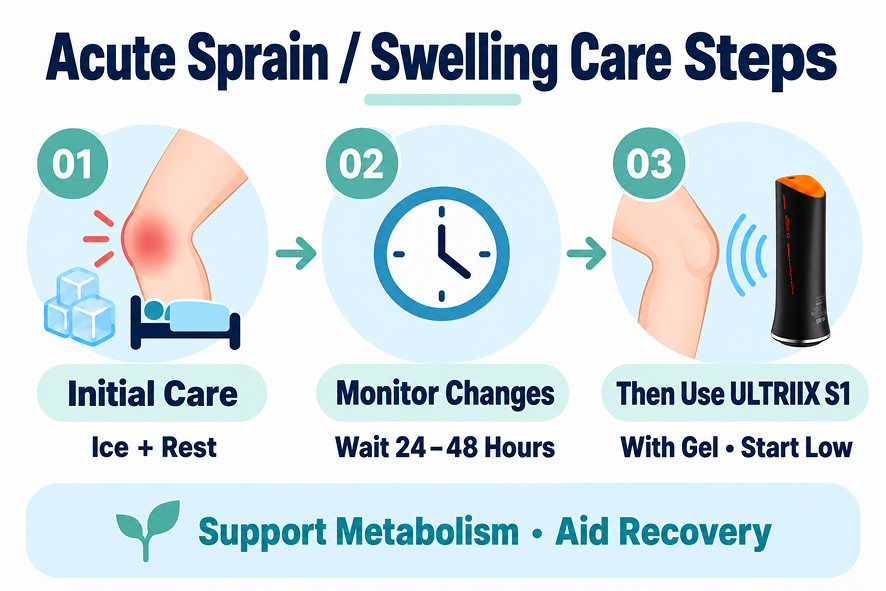
Q16:Can Ultriix S1 reverse existing meniscus wear?
No. Meniscus is cartilage with limited self‑healing capacity. Already‑established degenerative wear cannot be reversed by the device. Ultriix S1 improves condition of surrounding muscles, tendons and fascia: easing chronic tightness, reducing post‑exercise discomfort and optimising knee biomechanics to slow further meniscus deterioration. It is a sports‑recovery tool and does not replace medical treatment. Seek sports‑medicine consultation for persistent pain, locking or swelling.
Q17. When must I see a medical professional?
Stop self‑care and seek medical help promptly for any of these:
● Knee pain persists or worsens after exercise
● Noticeable swelling, catching or repeated clicking with movement
● Sensation of knee instability or giving‑way under body weight
Note: Massager cannot manage severe structural lesions. Worsening pain after home treatment usually indicates injuries beyond simple soft‑tissue strain, such as meniscus tear or ligament rupture. Discontinue self‑treatment and consult qualified orthopaedic physicians.
Conclusion
Meniscus deterioration is mostly irreversible. For golfers, the best treatment for knees lies in proactive prevention. While swing‑related torsional stress cannot be completely eliminated, you can reduce unnecessary compensatory joint load by refining swing patterns, moderating practice volume and strengthening glute‑core‑leg stabilisers.
As a home‑use ultrasonic recovery tool, Ultriix S1 improves the condition of knee‑surrounding muscles, tendons and fascia. It alleviates post‑play stiffness and soreness and supports effusion resorption. Still, it cannot reverse cartilage degeneration and does not replace medication or physician diagnosis. Therapeutic devices and knee sleeves remain auxiliary aids. Real meniscus protection comes from well‑conditioned stabilising musculature and respect for bodily warning signals.
Chasing scores and enjoyment is meaningful, yet a long‑term golf career is built upon healthy joints. Do not ignore early warnings such as subtle pain or morning stiffness. Respect recovery boundaries, reduce activity when required and seek timely medical advice when indicated — this allows you to enjoy golf for many years ahead.