

Have you ever experienced this: you haven’t walked far or done intense exercise, yet your calves turn sore and heavy in the afternoon or evening. Your thighs feel weighted down, and you may even get occasional cramps. Walking a few steps brings temporary relief, but that dull, weak soreness creeps back soon after.
Many dismiss this discomfort as simple fatigue or lack of exercise. Kneading and pounding the muscles offer momentary comfort, yet the issue persists afterwards. In truth, the root cause runs deeper than you think. It is not your superficial muscles that are tired, but the deep fascia wrapping them, which has gradually stiffened from prolonged sitting or lying down.
1. Why do your legs feel sore and weak after long sitting or lying?
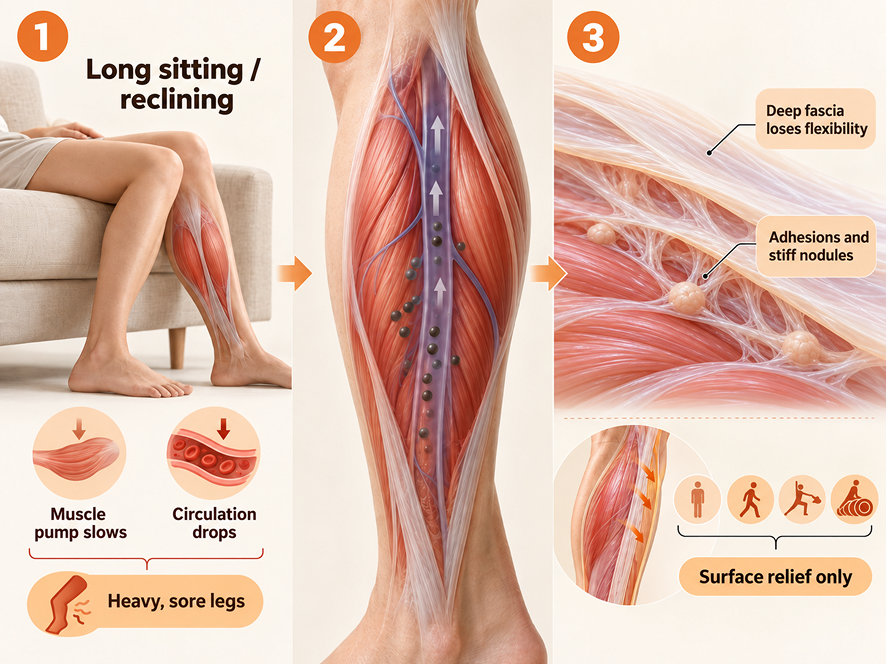
Our calves are known as the “second heart” of the human body. Muscle contractions act as a muscle pump to push venous blood back up from the lower limbs. When you stay seated or reclined for extended periods, leg muscles remain inactive. The muscle pump slows down, blood circulation drops, and metabolic waste accumulates in soft tissues, creating soreness, weakness and heavy legs.
An even less obvious issue comes from the deep fascia. Fascia is the connective tissue network wrapping all muscles. Healthy fascia is well-hydrated, smooth and elastic. Inactivity causes fascia to lose moisture, reduce flexibility, and form adhesions and stiff nodules between fibres.
Simple standing, walking or leg stretching only pulls superficial muscles and outer fascia. The tension cannot penetrate deep under the skin. Even stretching or foam rolling fails to release deep fascia stiffness and adhesions. This is why leg discomfort keeps recurring and is hard to resolve completely.
2. How does the ULTRIIX S1 ultrasound massage device relieve deep tissue issues?
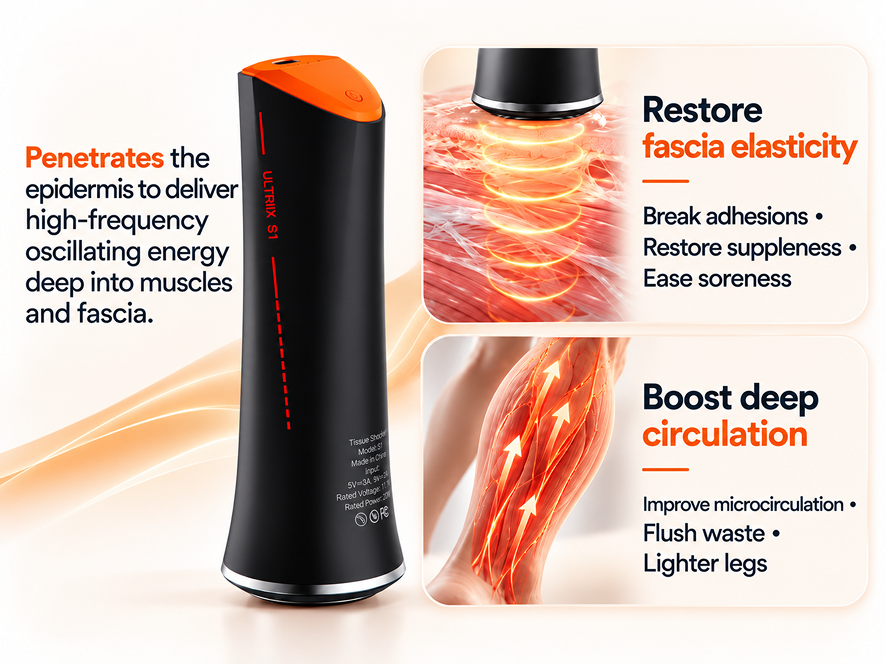
Traditional surface kneading and pressing rarely work on rigid deep fascia. The ULTRIIX S1 uses ultrasound technology to penetrate the epidermis and deliver high-frequency oscillating energy deep into muscles and fascia.
Restore fascia elasticity
The micro-massage effect of ultrasound gently breaks down adhered deep soft tissue and activates fascia cell vitality, restoring suppleness and elasticity. Once fascia regains flexibility, muscle contraction and gliding are no longer restricted, and leg soreness fades away.
Boost deep circulation
Gentle thermal effects generated deep within tissues greatly improve local microcirculation. Fresh blood flows in faster, metabolic waste is flushed out, recharging your lower limbs. Better circulation means lighter, more mobile legs.
3. Deep Fascia Release Guide with ULTRIIX S1 for Legs
Preparation & Power On
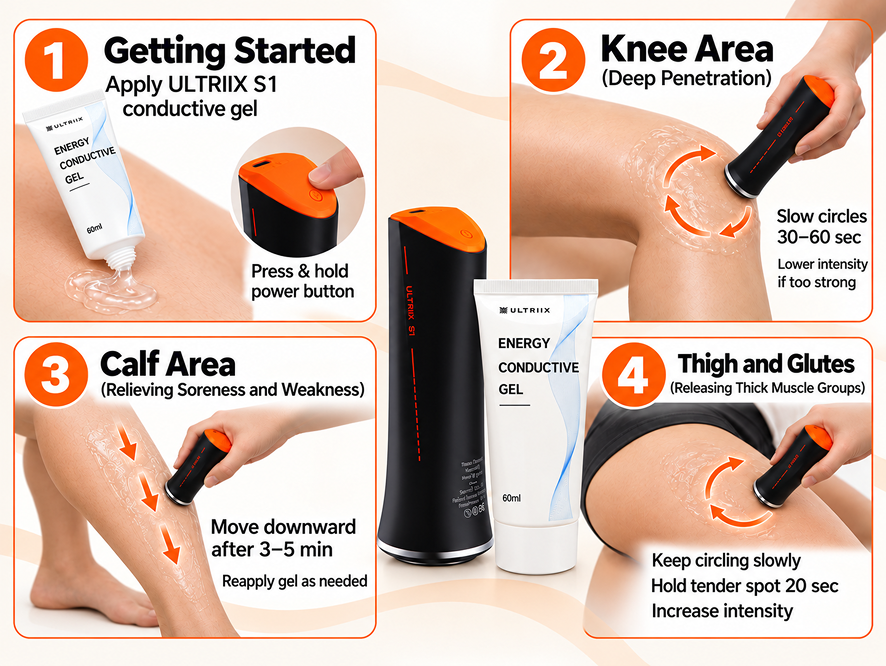
Apply conductive gel evenly to target areas, then long-press the power button to start. Conductive gel is an indispensable medium; it acts as the dedicated medium for ultrasound energy transfer.
Knee Area: Deep Release
Start on your knees with slow circular motions. Avoid quick sliding. Ultrasound energy takes time to penetrate deep fascia. Work in slow circles on one spot for 30 seconds to 1 minute at first, then gradually expand your massage range.
The skin and tissue around knees are thin. If the current intensity causes sharp, unbearable discomfort, turn the power down. If you feel a pleasant deep soothing sensation, keep the setting.
Calf Area: Relieve Soreness
After massaging knees for 3–5 minutes, glide slowly down to your sore or cramp-prone calves, continuing slow circular movements.
Reapply conductive gel frequently while massaging calves. Insufficient gel blocks ultrasound penetration and nullifies the core effect. Many users feel “no effect” simply because the gel has dried out.
Thighs & Hips: Relief for Thick Muscle Groups
Once calves are done, move upward to your thighs and hips if you feel dull ache or heaviness there. These muscle layers are thick, so you may only notice gentle warmth. Take your time and keep moving in slow circles.
When you find tender tight spots, add gel and stay in place for roughly 20 seconds before resuming circular motions. Repeating this 2–3 times on the same trigger point usually eases deep cramping and soreness noticeably.
For thick thigh and hip muscles, increase the intensity appropriately to ensure ultrasound energy penetrates deep into fascia.
Conclusion
Sore, heavy legs do not develop overnight, and quick surface rubbing cannot fix the problem. Deep fascia stiffness caused by prolonged sitting or lying requires deep-level tissue care instead of superficial pressure.
Spend a few minutes daily working from knees to calves, thighs and hips. Apply gel, move in slow circles and give your deep fascia time to release. With consistent use, that heavy, dull soreness will fade little by little. When your legs feel lighter, your whole body feels more relaxed.