

The most frustrating part of badminton is never being out of breath or lacking power in smashes — it’s recurring pain in your elbows and wrists.
Many players know this feeling: you feel fine after warming up, but after half an hour of play, the outside of your elbow starts aching, and your wrist stings when lifting a backhand. The pain eases after two days of rest, yet it comes back the moment you pick up your racket again. Worse still, dull discomfort lingers even when typing, twisting a towel or holding a cup. What was once sports strain becomes a persistent daily issue.
Most elbow and wrist pain in badminton does not stem from poor fitness or simply playing too much. It develops from faulty movement patterns, muscle imbalance, insufficient warm-up and recovery, and ill-suited equipment, leading to chronic tendon and joint irritation.
This article gathers common elbow and wrist concerns from badminton players. It covers pain differentiation, trigger identification, rehabilitation exercises, injury prevention tips and equipment selection, to help you break free from persistent hand strain.
1. Pain on the outer elbow when playing — is it tennis elbow?
Most likely yes. The outer elbow pain widespread among badminton players is medically called lateral epicondylitis, commonly known as tennis elbow. Despite the name, it is not exclusive to tennis players. During backhand strokes, high clear lifts and defensive ready positions, the forearm extensor muscles repeatedly pull the tendon attached to the outer elbow. Constant tension and friction cause micro-tears and aseptic inflammation. Symptoms include soreness and tenderness over the bony bump on the outer elbow, which worsens under load during shots.
2. How to use Ultriix S1 for tennis elbow care?
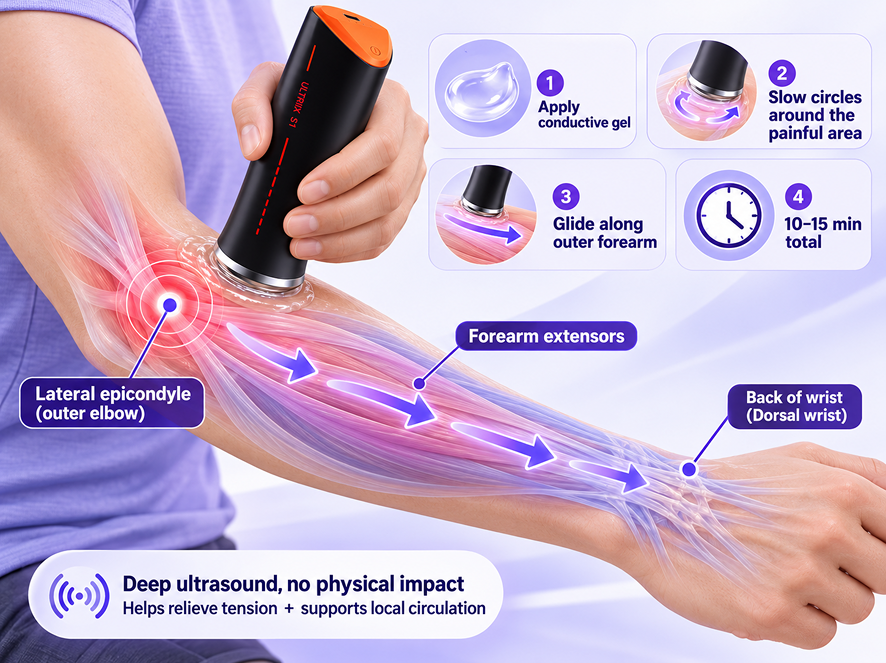
The area of the lateral epicondyle has thin soft tissue and superficial nerves. Aggressive deep tissue massage or percussion devices may irritate the periosteum and worsen discomfort. Ultriix S1 delivers gentle ultrasonic energy that penetrates deep without pounding. It eases sustained tension in elbow muscles, improves local circulation and reduces pulling stress on the tendons.
Usage guidelines: Apply plenty of conductive gel. Glide the probe slowly around the tender spot, then follow the forearm extensor group from the outer elbow toward the back of the wrist. Total session: 10–15 minutes.
Avoid use during the acute phase: If your elbow is swollen, hot and sharply painful, rest and ice it first instead of using the device.
Tennis elbow is rooted in tight forearm muscles continuously tugging the elbow tendon. Relaxing the forearm with Ultriix S1 relieves tension at the source and reduces abnormal pull on the tendon attachment. Combine this with stretching and strengthening work for forearm extensors for better long-term relief and prevention.
3. Why do veterans get elbow strain more often than beginners?
Beginners hit with lighter force and lower frequency, so their tendons endure less load. Experienced players often develop ingrained faulty motor patterns: they rely on the elbow to compensate for power instead of rotating the torso and driving with the upper arm. Every shot channels impact straight into the elbow tendon. Over time, accumulated micro-damage becomes chronic strain — the main reason pain keeps returning.
4. Three harmful elbow movements in badminton
1. Locked elbow power: For high clears and backhands, stiffening the elbow and forcing power only with the forearm, without rotational shock absorption;
2. Rigid ready posture: Keeping the elbow suspended and tense during defensive shots, leaving muscles contracted with no way to dissipate force;
3. Excessive wrist flicking: Generating power for fast drives and blocks only by shaking the forearm and elbow, concentrating impact on the elbow tendon.
5. Post-play wrist pain: muscle soreness or joint injury? How to tell them apart
Quick self-check:
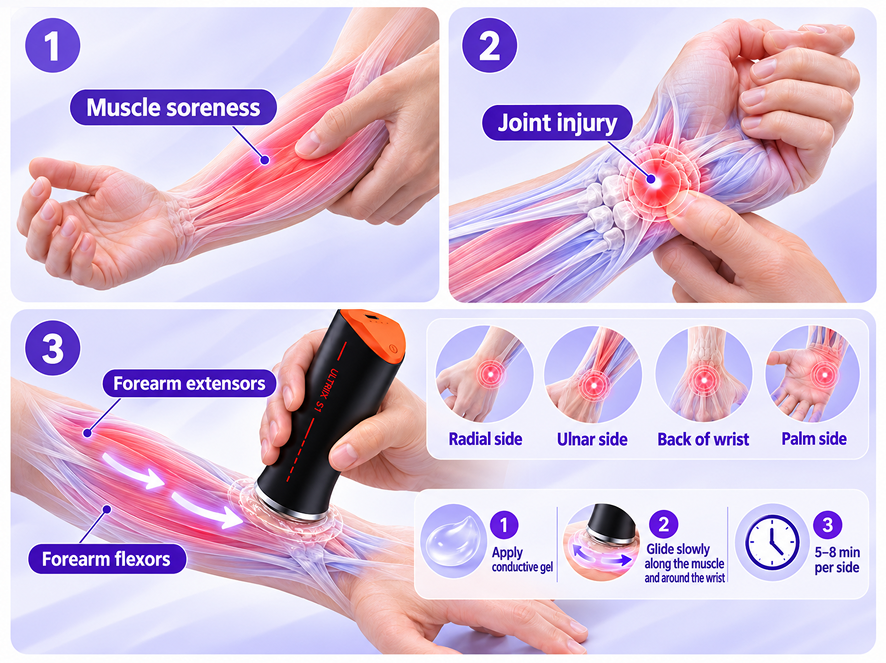
① Muscle soreness: A broad aching feeling across the forearm and wrist. Pressing the muscle triggers discomfort; it usually fades within 1–2 days with no restricted movement.
② Joint injury: Sharp or dull pain at one specific wrist point. Pain spikes with rotation and loaded flicking, such as twisting a towel, weight-bearing or striking. Symptoms return easily after rest, often indicating minor ligament or triangular fibrocartilage complex injury.
6. How to use Ultriix S1 for wrist care?
Target areas: Forearm flexors, forearm extensors, soft tissues around the wrist (radial side, ulnar side, dorsal and palmar wrist).
Method: Apply ample conductive gel. Glide the probe slowly along the forearm muscle belly and continue over surrounding wrist soft tissue. 5–8 minutes per side.
Benefits: Releases tight muscles, boosts circulation and eases post-game aching.
Note: Do not use Ultriix S1 during the acute phase of a wrist joint injury. Prioritise rest and ice first. Resume use for supportive recovery only once swelling has subsided, pain is milder and the skin is intact.
7. Are you using wrist power correctly in badminton?
Many amateur players misunderstand “wrist power” as flicking the wrist hard. In reality, badminton power travels through a kinetic chain: push from the ground, rotate hips, transfer through the core and shoulders, swing the upper arm, and finish with a small wrist snap. The wrist only amplifies power at the end of the chain; it is not the engine. If you feel you are “hitting with your wrist”, the power transfer link upstream has broken.
8. What is TFCC injury, a common badminton wrist issue?
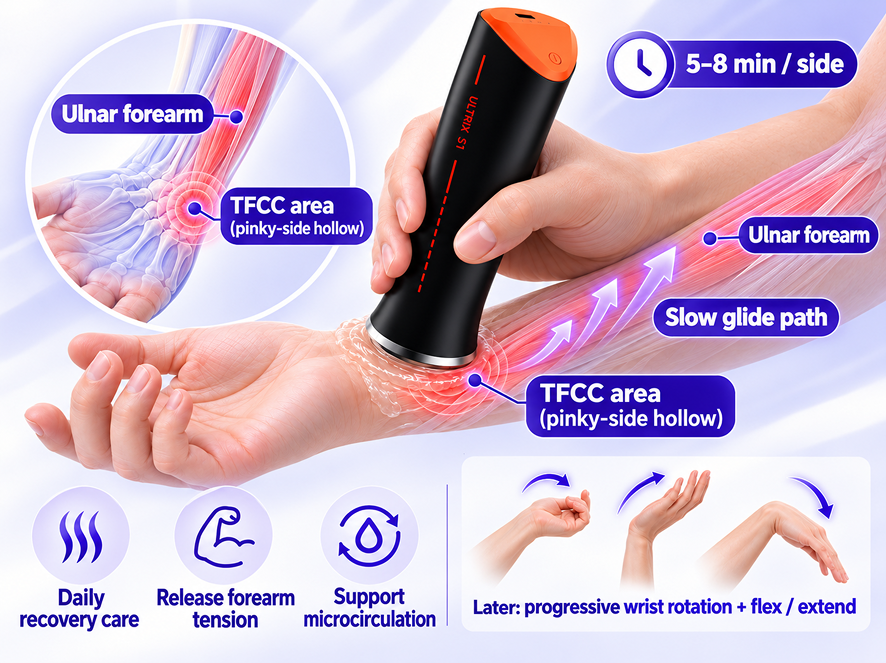
The TFCC (Triangular Fibrocartilage Complex) is the key shock-absorbing and load-bearing structure on the little-finger side of the wrist. Backhand twisting, sharp wrist snaps and defensive weight-bearing on the racket subject it to intense torsion and traction.
Typical signs: Persistent tight aching on the ulnar side of the wrist, limited strength, and a clicking or catching sensation during rotation. It is a commonly overlooked chronic wrist complaint that heals slowly due to poor blood supply.
Shallow rubbing cannot reach the TFCC effectively. Ultriix S1 targets this region directly to support deep soft tissue recovery.
● Acute phase (first 48 hours): Rest and ice to reduce swelling and inflammation; pause S1 use.
● Recovery & maintenance phase:
● TFCC area: Glide the probe slowly over the hollow on the little-finger side of the wrist. The 1.1 MHz ultrasound penetrates poorly vascularised cartilage and ligaments. Mild thermal and acoustic streaming effects activate local circulation and deliver nutrients to support tissue repair.
● Ulnar forearm: Continue gliding inward along the forearm to release tight muscles that pull abnormally on the wrist.
● Recommended session: 5–8 minutes per side. Once tightness and catching improve, add gradual wrist rotation and flexion exercises to rebuild resilience.
9. Common wrist power mistakes for new players
1. Confusing controlled wrist snap with reckless wrist whipping;
2. Locking and stiffening the wrist at impact with no elastic buffer;
3. Relying on the wrist alone for every shot instead of coordinating fingers, forearm and body, causing local overload.
10. Why are backhand net lifts and spins high-risk for wrist injury?
These strokes require extreme wrist rotation paired with sudden snapping. Many players control the shuttle purely with isolated wrist movement instead of coordinating fingers and forearm. The wrist joint undergoes abrupt torsion repeatedly, wearing down cartilage and ligaments over time.
11. Does gripping the racket too tightly cause wrist strain?
Yes, this is a top trigger for beginners. A death grip keeps wrist and forearm muscles constantly contracted, slowing circulation and removing shock absorption. Every twist and impact locks stress directly into the wrist joint. Skilled players hold the racket loosely, tense only at impact and relax immediately afterwards, which drastically cuts wrist load.
12. Pre-game & post-game elbow and wrist routine with Ultriix S1
✅ Pre-game
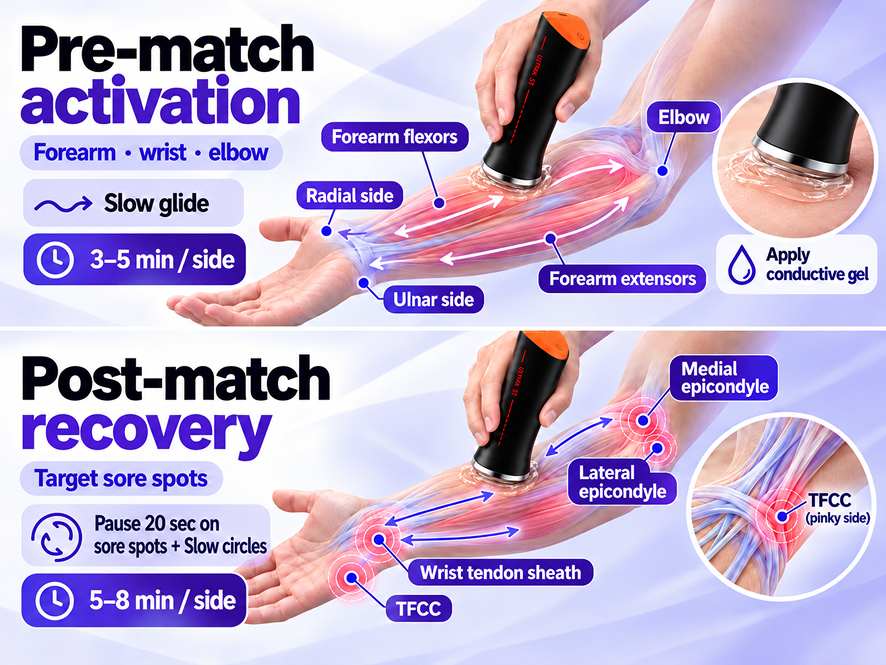
Goal: Raise soft tissue temperature around elbows and wrists, improve muscle pliability, so tendons can absorb impact better during backhands and fast exchanges.
● Target areas: Forearm muscle bellies, elbows, radial (thumb) and ulnar (little finger) sides of the wrist.
● Method: Apply Ultriix conductive gel to forearms, elbows and wrists. Move the probe slowly along flexors and extensors, over elbow soft tissue, then down to both sides of the wrist. Duration: 3–5 minutes per side.
● How it works: 1.1 MHz pulsed ultrasound gently prepares soft tissue, improves gliding between muscle fibres and tendons, and lowers the risk of sudden traction injury under high load.
✅ Post-game
Goal: Relieve muscle spasm from sustained gripping, enhance deep circulation and reduce cumulative strain on elbows and wrists.
● Target areas: Forearm bellies → medial epicondyle / lateral epicondyle → wrist tendon sheaths and TFCC region.
● Method: Apply conductive gel. Glide the probe along forearm muscles, focus around the medial epicondyle (golfer’s elbow) and lateral epicondyle (tennis elbow), then move to the wrist over tendon sheaths and the ulnar TFCC zone. You may pause for around 20 seconds on especially sore spots before continuing circular movement. Duration: 5–8 minutes per side.
● How it works: Pulsed ultrasound reaches deep muscle layers to ease gripping-related stiffness. Tense forearm muscles continuously pull on elbow tendons and wrist structures; releasing them reduces chronic tendon and cartilage tension.
13. Why is Ultriix S1 suitable for delicate areas like elbows and wrists?
Elbows and wrists have thin skin over bony landmarks. Manual deep pressure or fascia tools often press onto bone, irritate the periosteum and nerves, and struggle to reach deep tendon attachments.
Ultriix S1 delivers ultrasonic energy with no mechanical compression. On delicate areas such as elbows, wrists and fingers, the energy penetrates gently to tendon insertions and ligaments, releasing deep fascia and boosting circulation — effects surface massage cannot achieve. It is ideal for fine-area care; simply keep the probe in slow contact with skin, no heavy pressure needed.
14. Are plasters and liniments useful for wrist pain?
They only temporarily soothe superficial soreness and cannot repair micro-tears in tendons or cartilage. Avoid hot compresses or plasters during acute sharp pain, as they may worsen inflammation. They may be used as supplementary comfort for chronic strain, but long-term solutions rely on technique correction, strength training and reducing compensatory movement. For post-session recovery, Ultriix S1 works on forearm and wrist soft tissue with pulsed ultrasound. It reaches deep layers, improves circulation, loosens tight muscle fibres from gripping, and eases persistent pulling stress on the wrist joint.
15. What is eccentric training, and why do therapists recommend it?
Eccentric training means contracting a muscle while it lengthens. For example, slowly lowering a light dumbbell with your wrist (not lifting it quickly) trains forearm extensors eccentrically. For tendon issues, conventional strength training is often less effective, because the problem is not weak muscle but tendons failing to handle load. Eccentric exercise stimulates tendon cells to reorganise collagen fibres and is well-supported by rehabilitation research.
After eccentric training, forearm muscles and tendons enter a recovery state. A 5–8 minute deep care session with Ultriix S1 helps ease post-training tightness and circulation, supporting faster recovery. Eccentric training drives adaptive strengthening of tendons; S1 supports recovery after training. Used together, tendons gradually grow more robust.
How to prevent recurring elbow pain at its source
Four key steps:
① Fix your technique: Stop elbow compensation; learn to initiate shots with torso rotation and upper-arm drive to dissipate force;
② Build strength: Train forearm flexors and extensors twice weekly to raise tendon tolerance;
③ Manage load: Avoid sudden spikes in training volume and consecutive intense backhand/drive rallies. Stretch forearms after every session;
④ Pre & post-session care: Release forearm flexors and extensors regularly with Ultriix S1 to reduce gripping tension.
16. Should you wear an elbow sleeve? Will you become dependent?
A compressive elbow sleeve is helpful during acute pain. It distributes tendon tension and limits harmful pull during shots to prevent further injury. However, do not wear it all day long. Constant compression reduces normal muscle activation, weakens the forearm over time and creates a cycle where your elbow feels worse without the brace. Remove it for rest and rehabilitation training.
17. Will a heavier racket or higher string tension worsen elbow injury?
Yes, this is an overlooked risk factor. Heavier, head-heavy rackets increase forearm and elbow load. High tension and stiff strings reduce shock absorption, transmitting vibration directly into elbow tendons and causing cumulative strain. Recreational players are advised to choose lighter rackets with moderate string tension to protect the elbow.
18. Can I still jog or lift weights with an elbow strain?
Yes, as long as you avoid exercises that load the forearm. Jogging, core work and lower-body training are fine. Pause movements such as bicep curls, wrist work, heavy carrying and push-ups that pull on the elbow tendon, to avoid re-injury and give tendons time to heal.
Conclusion
Many players accept pain as normal and think pushing through builds ability. But progress comes from smart training; injury mostly comes from bad compensation patterns.
Elbows and wrists are the terminal link of the badminton power chain. They have little muscle coverage and fragile tendons, vulnerable to poor technique, overuse and playing through pain. Repeated aching, sharp pain and stiffness are warning signs, not markers of poor fitness. They signal issues with movement habits, gear or recovery routines.
You do not need to play through pain or fear flare-ups. Identify the root trigger, refine your technique, maintain consistent care with Ultriix S1 and stick to prevention habits. You can get your elbows and wrists comfortable again and enjoy playing freely.